Chuo University's ReRAM-and-MLC prototype device boasts an eleven-fold speed boost and 93 per cent lower power demands compared to MLC NAND flash alone.
A team of researchers led by Ken Takeuchi, professor of Chuo University's Department of Electrical, Electronic and Communication Engineering in Japan, have unveiled a prototype solid-state drive (SSD) architecture which combines NAND flash with ReRAM components to boost performance while cutting power draw by as much as 93 per cent.
The team's research, due to be formally announced at the Symposium on Very Large Scale Integrated (VLSI) Circuits in Hawaii today, has been reported by Japanese technology site
Tech-On, and the claims are nothing short of impressive: the prototype device writes 11 times faster than standard multi-level cell (MLC) NAND flash components while reducing power draw to just 7 per cent of the competing technology.
The system works in a similar way to current hybrid hard drives: where a hybrid hard drive combines a slow but capacious spinning disk with a small but speedy SSD cache area, Takeuchi's design combines a large SSD component with a smaller module constructed from resistive memory (ReRAM.)
According to the team's figures, a standard MLC NAND flash module can record data at a rate of around 4.2MB/s. A MLC NAND flash module combined with a ReRAM module and a trio of clever algorithms - including one designed to prevent data fragmentation - results in a speed boost to 46MB/s - and a drop in power from 0.12 joules per megabyte to 0.0079J/MB. If that wasn't impressive enough, it's claimed that a ReRAM-and-MLC hybrid device would feature a lifespan some seven times greater than that of MLC storage alone.
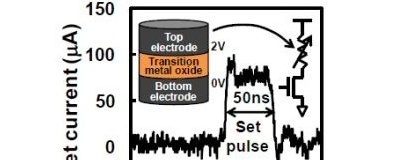
The massive performance boosts are aided by the capabilities of ReRAM, which include read latency of less than 3μs per sector compared to 85μs per page for MLC, write latency of less than 3μs per sector compared with 400μs per page for the fastest single-level cell (SLC) flash, no need to erase data thanks to partial write or overwrite support, 512-byte sector addressing to NAND flash's 16KB page addressing, and low voltage support to 1.2V compared to NAND flash's 1.8V.
Sadly, Takeuchi and his team are silent regarding commercial availability of the MLC-and-ReRAM components, but with numerous companies already investigating commercialisation of ReRAM parts - including memory giant
Elpida - it surely can't be too far away.

27 Comments
Discuss in the forums ReplyElpida a Giant? :P
I've only got a semi.
*chuckle*
I think this would spell the end of SATA not a bad thing if I'm honest. Just make everything PCIe should make things a bit simpler/cheaper.
And yes Baz, I agree mostly we need cheaper SSD before we need faster ones. I'm not against MOAR SPEED!!11! but I'd rather be able to afford a few TB of SSD at the speeds they are now first ;)
Still, at least I spotted that *before* I'd order the damn thing...
As for the type of interface to the PC/tab/phone/yet to be discovered device...... a single platform like PCI-E should do justice to the drive itself..... but it's more likely that there will be cheaper and more generic options available by the time this becomes a retail product.
This isn't a bad design or anything, it's how most storage devices work already, but (I assume) using a much larger cache, probably a few GB vs the 64 MB HDD's use. But such a design could easily eat up a lot of the ReRAM cache while moving a large file around, and then any read requests would be much more likely to have a cache-miss. Which is probably why we don't have any numbers for the drive's read times; the performance boost is more obvious if they optimize the drive for write times than if they had to show the drive performing exactly like a SSD for the first 10 minutes of operation while the cache is populated.
All that being said, I think it's a great design concept and a genuine first step in making a commercially viable ReRAM device. I just think the numbers we see are comparable to the range specs on wireless routers, which they test in open fields to avoid any of the interference you might get from, say, a building with walls.
And IIRC, there are designs being made already for SATA III's successor that will communicate along PCI-E lanes.
[/longpost]
Thunderbolt?
Screw Thunderbolt - it'll be a long, long time before this is at capacities that would make an array of ReRAM disks make sense. Aside from that, it's not an industry standard - Intel owns it.
Why move to TB when there are already a huge number of PCIe SSDs? Personally, I'd rather see it on a standard interface that's known and proven, and not controlled by a single corporation.
TB is also not bootable, if I'm not mistaken, while PCIe has the potential to be, depending on driver support.
Were this to happen, who's to say the manufacturer's wouldn't start sticking x1 or x4 slots on another part of the board? ATX tends to have some room to spare. Or look at mSATA slots - even the mini-ITX board I have has mini-PCIe - that seems a perfect fit here.
But I agree its a step in the right direction, less power more speed. Last year I bought a 256GB SSD its the single best advance in computer speed for years. Keep em coming boffins you know we love it.
At least the OCZ RevoDrive 3 can be used as a boot drive, I am currently running on one.
There seems to be no drivers for anything but Windows 7 at the moment on their site, and they have in fact replied to a forum thread asking for Linux drivers with "We do not have Linux drivers for Revo3 and we are not planning any.".
PCIe is just a bus interconnect standard not a slot standard, and although there are standardised sockets there is no reason that any shaped/positioned socket could be used so long as it meets requirements. There are lots of PCIe sockets depending on how and who uses it.
As others have said, a Thunderbolt socket could be used, but I'd thank all involved in the development to not use Thunderbolt. Intel is rich enough without more bucket loads of my money being transferred to them as royalties.
http://techon.nikkeibp.co.jp/english/NEWS_EN/20120514/217732/
It's interesting to see which of the competing post FLASH technologies will end being the best for consumers. There's definetely several competitors at the moment. This is perhaps the biggest thing in the coming years, since ultra fast non-volatile memory will really mix up the current landscape dominated by DRAM and NAND FLASH. It just remains to be seen how fast they can ramp up production and move from cache applications to full fledged drives and finally as DRAM replacement.