Japanese researchers have released details of a new wireless networking system which uses a high-frequency band to transmit data at a rate of up to 100Gb/s - a significant boost on the capabilities of current Wi-Fi technologies.
Dubbed 'T-ray,' the new system is named for the terahertz frequency band, although its frequency range actually starts at around 300GHz and rises to 3THz. Many of the frequencies used are borrowed from prototype medical imaging systems - where 'T-ray' systems are being investigated as a safer alternative to traditional 'X-rays' - and boast impressive material penetration capabilities above and beyond the 2.4GHz and 5GHz bands used by Wi-Fi.
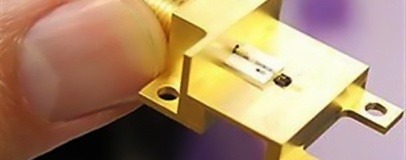
It's the information-carrying capabilities of the high-frequency systems that have researchers interested, however. During testing, the researchers were able to tune a T-ray system to 542GHz using a 1mm-square component called a 'resonant tunnelling diode' or RTD. This oscillating device, the smallest ever developed for high-frequency systems, holds the key for getting T-ray technology adopted in smartphones, tablets and other compact gadgets.
Using the 542GHz RTD, the team from the Tokyo Institute of Technology successfully transmitted data at a rate of 3Gb/s - although it is claimed that the system has a maximum theoretical throughput closer to 100Gb/s. Compared to 802.11n Wi-Fi, which tops out at 300Mb/s in current implementations, that's an impressive boost.
T-ray transmissions are short range, but high-bandwidth. As a result, the technology is likely to see significant interest from manufacturers whose products rely on shuffling large amounts of data around as quickly as possible. Smart TVs equipped with a T-ray transceiver, for example, could transmit and receive high-definition content with ease; a digital camera with T-ray capabilities could transmit its images to a laptop or tablet near-instantaneously.
The team's research, published in the
Electronic Letters journal, shows that the technology is quite some way away from being ready for commercial implementation. With the RTD proving the key to low-power and compact T-ray components, however, the technology looks a lot closer now than ever before.









Want to comment? Please log in.