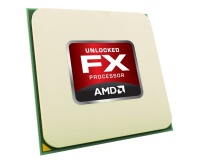
AMD and Microsoft have jointly released a pair of updates for Windows 7 in order to introduce scheduler improvements that make better use of the dual-core module architecture of the Bulldozer architecture AMD FX processors.
Designed to offer competition to Intel's speedy Sandy Bridge and upcoming Ivy Bridge architecture, Bulldozer includes a novel modular architecture whereby each pair of cores share a floating point unit; offering, AMD claims, improved coherency and, thus, performance.
Sadly, the truth isn't quite what was promised: in our
comprehensive review of the AMD FX-8150 chip, the first retail Bulldozer unit we could get our hands on, performance was lacklustre at best; coupled with the high price - some £37 more than Intel's Core i5-2500K chip - we were forced to describe what should have been AMD's return to grace as a '
stinker.'
It's a conclusion which AMD is well familiar with: adoption of Bulldozer has been slow, and ours was far from the only critical review around. The company still believes that Bulldozer is the future, however, and believes it knows how to boost those benchmark scores with a new patch.
Backporting scheduler code from Windows 8, a pair of Windows 7 hotfixes aim to improve performance by telling the operating system to stop treating the processor as eight individual cores - to which tasks are assigned at random - and instead treating it as a collection of dual-core modules.
Described by AMD's Adam Kozak as '
similar to the SMT path that the other guys [Intel] use,' the hotfix is joined by another patch which prevents Windows from prematurely shutting down unused cores while there are still threads to be assigned.
'
Our testing shows that not every application realizes a performance boost,' Kozak admits. '
In fact, heavily threaded apps designed to use all 8 cores get little or no uplift from this hotfix – they are already maxing out the processor. In other cases, the uplift averages out to a 1-2 percent uplift. But heck, it is free performance, and this is the scheduler model that will be used in Windows 8 - along with some further enhancements.'
One of the two patches is actually a re-release: back in December, Microsoft accidentally pushed the patch live in an unfinished state, with the result that those who had downloaded it were left with a system even slower than before. However, AMD assures us that these patches are the real deal.
While the patches are unlikely to make enough of a difference to change our minds about Bulldozer as a recommended purchase, if you've already invested in an FX chip they're certainly worth a try. Both the
scheduler update and the
core parking update are available for download now, but it's a manual process; they won't appear in Windows Update.
Are you pleased to see AMD working to improve Bulldozer performance, or is the company spitting into the wind? Share your thoughts over in the
forums.











Want to comment? Please log in.