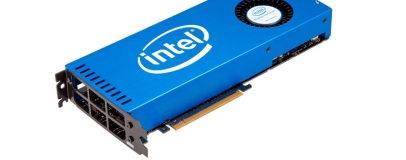
The processor will be packaged on a traditional 16x PCI-E card.
Intel
officially took the wraps off its next generation ‘Knights Corner’ processor last night; a dedicated 50-core maths co-processor chip based on the technology from Intel’s
abandoned Larrabee graphics project.
Intel confirmed that the 50 x86 cores used in Knights Corner will be fabricated using the same 22nm Tri-Gate process as next year’s Ivy Bridge processors, meaning the processors will use the very latest transistor technology.
Intel also explained that Knights Corner is only the first product in what will eventually be a range of Many Integrated Core (MIC) processors. Indeed, another iteration of the MIC family - dubbed Knights Ferry - is already being trialled at several supercomputing laboratories across the globe.
The processors will also be packaged on a traditional 16x PCI-E card, so they'll potentially provide an easy upgrade for any workstation that requires a little extra processing grunt.
Intel understandably envisages the MIC processors competing directly with current co-processor technologies; most notably Nvidia’s range Tesla products, which are currently based on the company’s Fermi GPU architecture.
Intel believes it has the edge in this battle, however, as it says it will be easy for people to use their existing tools when programming for its x86-based MIC processors.
‘
If you can program a Xeon, you can program this microprocessor,’ says the general manager of Intel’s Many Integrated Core Computing division, Anthony Neal-Graves. ‘
You can use the same tools and the same compilers. That makes parallelism simpler for the end user. It provides a saving in terms of time and money, and allows programmers to be much more efficient in terms of what they do.’
Would a super-powerful maths co-processor improve your working life? Could Knights Corner threaten GPGPU computing? Let us know your thoughts in the
forums.

45 Comments
Discuss in the forums Reply...sorry couldn't resists :P
Also, different architectures will always perform differently at different tasks. It might be amazing at one thing (handily beating GPGPU) and be terrible at another.
Time will tell.
Even though that looks like the same pic we've been shown for ages, I wonder if the latest version will be a dual 8-pin affair, with some pretty high thermals.
Maybe, but not necessarily. Without the need for Video Outputs like on GPU's they may just as well open up the back as not - it'd be a bit silly not to really...
They'll attach a CPU to it soon, just watch. Dual CPU PCs using one on a PCI-E port ;)
I can see the scenario... SR-2 with Xeon add-ins
..?60Core madness?
I will reserve comments on the performance until there is more detail of what they have taken from the Larrabee core, but one thing should be pointed out. It's not just competing against Tesla, it has to compete with a few other processors as well such as Niagra which is a 128thread best of parallel processing.
However, stuff that requires a couple of floating point precisions is probably going to run faster on this thing with its 50, assumedly faster and greater instruction flexibility, cores than on a GPU with more, but less capable cores.
My other guess, this is going to be a lot like CPU vs GPU computing. Somethings work better on full fledged CPUs and somethings work better on full fledged GPUs. This I think is going to be one of those grey areas inbetween where it is better than both at some things, and not as good at others. You need a steak knife for steak, a scaling knife for scaling and a paring knife for fruit. You can use each for the other's tasks, but they just aren't as good.
Tyan Thunder n4250QE + Tyan Thunder M4985-SI Expansion Board + 8x 12-cores opteron = 96 cores ... and you still have 4x PCI-e16x free to be used .... nom nom nom
JC
it's interesting isn't it? =]
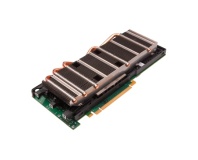
That's the nVidia Tesla line.
Fill up a board with 2 GPGPU cards, 2 of these, and you have a machine that is capable of doing a lot pretty fast rather than a few things a bit faster. Sure there are specific companies that want to model proteins and the like that will likely say no thanks.
Its a good product, it has its place.
I quoted my own post :D
add a this and 2 GTX590 (with WB and single slot bracket and you have a 146 cores CPU and 2048 cores for GPGPU. Pretty much do everything rig.
Even in it's 'natural home' running x86 code, it will be up against both Nvidia and ATI.
I see it like this: Intel release 50 core card, Tesla and AMD cards recieve 50% price cut. They're only non-intentionally-gimped common GPUs with commercial-use prices and software and support packages.
CUDA is moving at break-neck speed towards ever better flexibility and performance. By 2012 Keppler will be out and about (focused on flops/watt), CUDA will be improved, and I do not see x86 being 'all-that' in a field (HPC) where C++ is the requirement and nothing more. Plus they just shown their hand a year in advance. Thats a lot of pricing/marketing/CUDA pushing wiggle-room for Nvidia.
Disclaimer: I do not like Nvidia much at all.
http://www.amd.com/us/products/workstation/graphics/Pages/workstation-graphics.aspx
Job done.
Intel promised OpenCL within 6 months of launching Clarksdale. We still don't have it with Sandy Bridge. :(:( Yet we have Intel compilers ready since launch for its Quick Sync Video..
Including superheat your abode and create a stupendous electric bill :)
I know, sounds like a medieval yoghurt.
Intel put their stockpile of useless 'wannabe' GPU processors on a pci-e card and sell it as math co procs and still make profit of it. Typically Intel....
mmmmmmmmm.....yoghurt.;)
Stockpile? It'll be 22nm - they haven't even got that production ready yet. The original Larabee was only 32 processors iirc.
These are not GPUs any more, they are IA co-processors in the same way the original FPU was a co-processor to the CPU in the early 90s.
Its a better strategy than their first attempt, it removes the arrogance that they are Intel and they can take over the Graphics market whenever they want. They may however have given up making a mass parallel x86 graphics card and are settling for the openCL world.
They could really make a big hit with x86 cores if they get the software process correct. Ideally what we want is for the CPUs to be transparent to the programmer. Windows will use them if it needs to, but we want it to use the main cores in preference. Then I think we also need the ability to tell a thread if it should run on the slower cores, so we can reserve the main cores for critical work. If that is all that it took to use them then we'd be getting extra performance from programs that are already parallel almost immediately. If its just an openCL implementation or propriety then its not going to be a big release.
Erm, news is known as such because it's "new." This is 5 months later... ;)