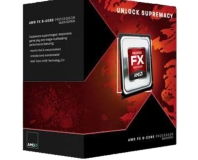
AMD is due to reintroduce the FX brand for its fastest processors, a move that nostalgic hardware enthusiasts should appreciate.
Back in the days when single-core CPUs ruled and dual-core processors were deemed overindulgent, the Athlon FX range of AMD processors had hardware enthusiasts drooling. Pitched as an alternative to pointless Pentium 4 Extreme Editions, FX processors were what we wanted.
That all changed with the advent of Conroe circa 2006 though, and so the FX brand was retired after failing to justify its high price tag. With the advent of Black Edition CPUs, which used the same unlocked multiplier trick that FX CPUs offered but for very little price premium, we had thought we’d seen the last of the FX processor.
Today at
E3 AMD confirmed the rumour that it will brand its next range of high-performance processors FX. ’
FX-branded products will be geared toward enthusiast PCs and HD entertainment aficionados…The first platform to earn the FX title, the “Scorpius” platform, will feature the now-available AMD 9-series chipset motherboards and AMD Radeon HD 6000 Series graphics cards, plus the upcoming “Zambezi” unlocked, native eight-core processor.’
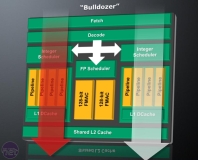
The Zambezi core will be based on the
Bulldozer architecture that we previewed last year. Back then the word was that Bulldozer would only be a server and workstation part, but we now know that it’ll fit in Socket AM3+ motherboards.
We don’t expect Zambezi processors to have an integrated graphics chip, unlike the rest of AMD’s 2011 processor lineup, as AMD expects FX processor owners to use a discrete graphics card for maximum performance, especially when gaming.
While current-generation Socket AM3 processors should work in Socket AM3+ motherboards, Socket AM3+ Zambezi processors probably won’t work in Socket AM3 motherboards. There may be exceptions to this (if a motherboard makers gets fancy with its BIOS) but we doubt it. Zambezi processors are expected to go on sale in
September if rumours are to be believed.
Excited to see the return of the FX processors, or just annoyed you might have to wait another three months to see what it’s like? Let us know in
the forum.

18 Comments
Discuss in the forums ReplyDoes this mean that AMD feel they can actually take a bite out of Intel's enthusiast/gamer market with competitively-powerful FX CPUs?
I hope it does, and I hope they're right.
This is taking an absolute age!
WHAT? I get the first part, enthusiast PCs, fine. But HD entertainment aficionados? Do they mean HD video? An 8 core enthusiast grade processor should be massive overkill for this - if the cheapest, most basic CPU in the new line-up can't decode multiple 1080p streams simultaneously without breaking a sweat, they need to go back to the drawing board. Or by "HD entertainment aficionados" do they mean gamers / video / photo editing aficionados? In which case why not say gamers / video / photo editing aficionados?
i think even VIA could make a single core cpu+gpu solution that could play HD video. i'm sure what amd meant is an entire HD experience, so with video, games, rendering, etc. if they really are talking about just video, then i agree with you.
Its not like AMD is alone on this... Intel did the same thing with the next gen i3, i5 and i7's
http://i.imgur.com/qFAgK.jpg
man I would just buy them for the boxes they come in :P
Some later ones were (you're thinking of Quad FX I think) but the first range was of single-socket CPUs.
Me wants to cry
Yeah that is called Llano. Process shrink + Integrated 6550 GPU = Llano APU. Llano supposedly features no new architecture other than what it took to integrate the equivelent to a 6550 on chip, its just a process shrink. Its only taken them 2+ years to do.
Intel is at least rumoring to be doing some minor architecture tweaks on Ivy Bridge when it is released (and some heavy modifications to the integrated GPU) in addition to not just a process shrink, but 3D transistors, all of this just a year after Sandy Bridge came out.
I am reserving judgement completely till I see what Llano and Bulldozer actually deliver, but from what it seems like Llano is going to target budget and casual gamers, and bulldozer is going to target budget workstation power users and cheap servers. Intel is going to have the users who need serious power, without heavy graphics and who don't want to pay for a discrete GPU and also users who already know they are going to pony up for a good discrete GPU and want/need the CPU processing power.
So basically again AMD is going to target the "low end" of most catagories (or at least that seems to be what their CPU and APUs are going to be able to handle). I want big competition between the two, because it can be pretty healthy, especially for us consumers, but what has me worried is that as process nodes shrink, chips become cheaper to manufacturer. Currently, at least pre-32nm, it was easy for AMD to produce processors that undercut Intel in the $ for performance catagory, even if the upper mid and high end processors just weren't nearly as fast, and clock for clock weren't nearly as fast. Now that process dies are shrinking, a $200 gap in chip price might well become $100 or $50 or less to go to a better performing Intel chip. Makes it harder for AMD to really capture the low and mid range of the market in anyway significant way if Intel chips that perform better only cost a very slight price premium.