Newcomer Lyric Semiconductor has announced its rather novel approach to dominating the processor industry: a chip that can say "perhaps."
In a video interview with tech news site
V3.co.uk, company founder Ben Vigoda revealed details of his company's planned "
probability processor," which dispenses with the black-and-white world of binary logic for a series of ever-shifting greys.
During the interview, Vigoda described the processors as "
[taking] in numbers between zero and one [...] instead of zero and one they have 'maybe.' [The] transistors are like dimmer switches."
Flying in the face of decades of traditional processor design - which relies on the simplicity of binary logic, simply adding more and more transistors to the mix to 'brute-force' solutions to increasingly complex mathematical problems - the company's probability processor allows, Vigoda claims, specific instructions to be built to solve specific tasks far more efficiently than with binary logic.
The company's research will come to fruition in a product known as the "
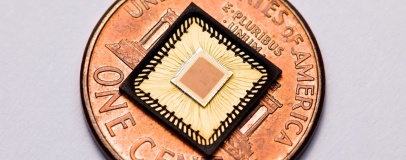
Lyric Error Correction chip," a processor for solid-state storage devices which aims to cut data transmission errors to one per thousand trillion - down from the estimated one in a thousand achievable with current binary logic processors.
As well as improving data transmission quality, Vigoda claims that the reduced complexity of the probability processor means companies can "
cut the size and cost of the silicon, reduce the power consumption [by] twelve times, and still get your data faster."
Beyond the LEC, Lyric - an MIT spin-off - is looking to produce a more general purpose probability processor - and, while Lyric Semiconductor isn't looking to replace CPUs with PPUs just yet, the company
is hoping that its probability processors will become an essential component of modern motherboards in much the same way as math co-processors were before becoming integrated into the CPU.
Can you imagine a world where processors are able to answer "
maybe" to a question, or is Lyric on a hiding to nothing with its probability processing technology? Share your thoughts over in
the forums.









Want to comment? Please log in.