Lists of Intel's up-coming Sandy Bridge processor parts have been leaked.
German site
Computerbase has posted what it claims is the first list of Intel's up-coming
Sandy Bridge-based processors - and there are some interesting chips for both desktop and laptop use.
The lists - spotted and translated by
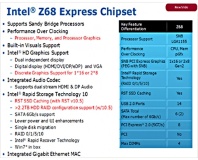
The Tech Report - indicate that Intel's new desktop processors will range from the top-end Core i7-2600K quad-core unit running at 3.4GHz (3.8GHz when Intel's Turbo Boost functionality is engaged and two cores are disabled) with 8MB L3 cache and a TDP of 95W, to a Core i3-2100T dual-core chip running at 2.5GHz (no Turbo Boost on this one, sadly) with 3MB L3 cache and a 35W TDP at the low end.
The Sandy Bridge parts list has also been leaked for the up-coming mobile processor range, with the top-end Core i7-2920XM offering four 2.5GHz (3.5GHz with Turbo Boost) processing cores with 8MB of L3 cache and a TDP of 55W, and the bottom-end dual-core Core i5-2520M offering speeds of 2.5GHz (3.2GHz with Turbo Boost) with 3MB L3 cache and a TDP of 35W.
If the TDP appears high on the mobile side of things, that's because it is: Intel's Consumer Ultra-Low Voltage (CULV) chips - the ones that make it possible to produce slim laptops with ten-hour runtimes - won't be getting Sandy Bridge technology just yet.
Although the parts lists haven't been confirmed by Intel yet, they match expectations - so the only thing remaining for Intel to announce is the price and precisely when the new chips will be available to system builders.
Are there any chips in the new Sandy Bridge range that particularly jump out at you, or will it all depend on what price Intel sets on each as to which is your next planned upgrade? Has the fact that Intel will be
limiting overclocking on the new chips put you off already? Share your thoughts over in the forums.

31 Comments
Discuss in the forums ReplyDon't get me wrong, I can see they've added a 2 to the model number, but to non enthusiasts the upgrade isn't obvious.
Tells us very little about how well they perform though.
I hope you're not thinking that Sandy Bridge would be out in a week... more like several months. If you need a new CPU now, then go with the I7 930.
To everyone who is thinking of commenting on this article...
You are all so very- very welcome.
Now, on to some REAL discussion. What i'm really missing from this list is a low-end overclockable chip. It looks like Intel is going to only let us overclock the chips that are high-end. That's a real kick in the nuts for the community. I wasn'r really worried when i learned that they are locking the BCLK, limiting OCing to K-models in their lineup. Now that they seemingly intend to limit their lineup of K-models to two high-end parts, i'm a bit about sandy bridge.
+1 they need to sort out there naming conventions and NOT have core i7 for multiple sockets this time. actually, i hope they stick to ONE socket only!!!!
think i'll keep my i7 860 for now.
Dont be a sarcastic ass
Was holding out for this but ah screw it
On the high end models only being overclockable, there's a slim (and I mean very slim) chance that perhaps overclockable models won't actually be too expensive. Currently they're priced so much higher that there's really no point and maybe Intel will see that no one is buying them. Sure extreme overclockers will still eat right out of the palm of their hands regardless of price, but the rest of us will be a little wary of buying a higher priced CPU when we've already got extra cooling to buy. Maybe the low demand will drop prices to a reasonable leve.
if they make the non-OCeable models a lot cheaper than their OCeable counterparts then I really see this as something positive for the market!
remember, many people just buy the hardware just as is, some pay a lot for an OCeable CPU without actually OCing!
The more stuff you put into a package, the more likely the package will burst and people who buy an i7 or an i5 are going to add a discrete GPU anyways, as the intel GMA isn't exactly what you'd call a potent GPU.
This is mainly caused by threads full of people asking stupid questions (contrary to popular belief, they do exist) while displaying a complete lack of willingness to put any effort into finding the answers for themselves.
Plus, i also did the 'good cop' thing where i provided ALL the answers to their questions, backed up by evidence in links, neatly arranged in groups. After all that, i can't help but feeling entitled to a modest dose of arsehollery.
I dont agree with the hopes of prices being low etc, that's not really the point. What i'm really missing here is that chip that allows people on a really tight budget (let's face it, we've all been there at 13) to axtually play games. Chips like the G6950 and the X2 550. You know, cheap as chips, overclockable to no end. A friend of mine had an E4300 that ran 24/7 at a 100% OC, while some X2 chips today can be unlocked all the way to X4, AND OCed. That kind of overclocking is going to be a thing of the past now, and the only thing that's left is to make fast chips run even faster. While that's a lot of fun to do, it's NOT the original idea of OCing.
Indications are that hex core chips will remain high end on either 1366, or the new 2011 socket with either triple or quad channel memory interfaces. So IF you want "mainstream" hex core it's gonna be AMD for at least another year or so I suspect.
Interesting that both companies have a different view on memory interfaces, I wonder if it translates to lost performance for AMD customers, or wasted bandwidth (and cash) for Intel customers...
If you're going to point out mistakes take a look at your own first. . . .
i'm = I'm
axtually = actually
dont = don't
that used in the second sentence should really be referenced with the as you're defining an object.
There's more, but I figured the most obvious would establish the point.
Plus, i managed to stay ontopic until this post.
I do see some special K's in the Sandy line up. their probably gonna cost a kidney and a lung with minimal over clocking potential a nice black box and a cool sticker.
Or, if I'll be allowed to dream, AMD will rival Intel at all levels and price points with the products being very competitive and the advantage being that AMD chips can overclock, thus stealing away from Intel's greedy overclock locking. But we'll see :D
Personally I think that's crock from Intel to excuse the tri and quad channel memory. AMD got hex working on dual channel for one (a much slower hex core tho) and I was under the impression that ram speed and bandwidth was only saturated in very memory intensive applications and apart from benchmarks and a few professional applications was it needed. Maybe I'm totally wrong tho.