Intel's own slides confirm just 2-3 per cent overclocking headroom. Oh dear!
Information provided by Intel in its own presentations about its upcoming mainstream LGA1155 Sandy Bridge CPUs appears to confirm the company has designed the CPUs to deliberately limit overclocking.
A
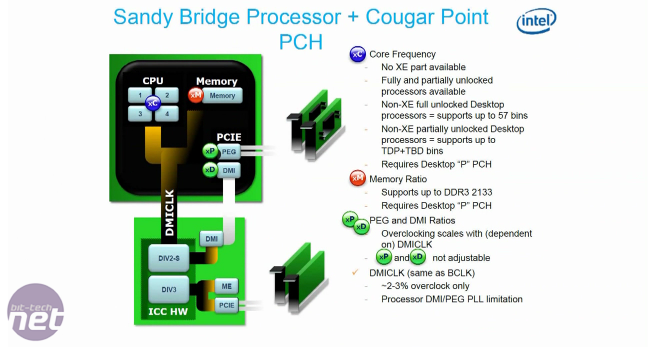
video leaked to HKEPC and posted on YouTube (see from 2mins onwards) confirms the fact that only a 2-3 per cent OC via Base Clock adjustments will be possible. This is because Intel has tied the speed of
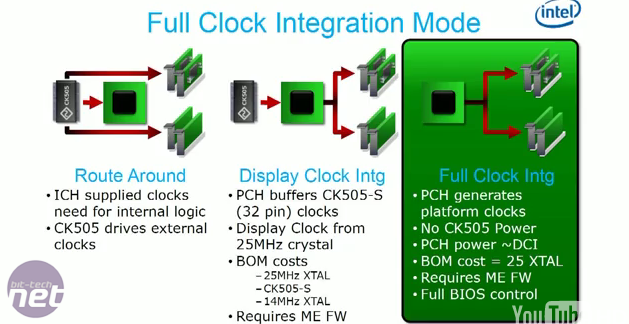
every bus (USB, SATA, PCI, PCI-E, CPU cores, Uncore, memory etc) to a single internal clock generator issuing the basic 100MHz Base Clock.
This clock gen is integrated into the P67 motherboard chipset and transmits the clock signal to the CPU via the DMI bus. This means there's no need for an external clock generator that used to allow completely separate control of all the individual hardware.
When you're overclocking, you want to be able to push certain frequencies, such as the Base Clock and memory clock, but leave others, such as SATA, completely stable as they're very sensitive to adjustment. Current motherboards allow multiple bus speeds because external clock generators are programmable via the BIOS.
According to one Taiwanese motherboard company, on a Sandy Bridge system, the fact that all the busses are linked means that turning up the Base Clock by just
5MHz caused the USB to fail and SATA bus to corrupt.
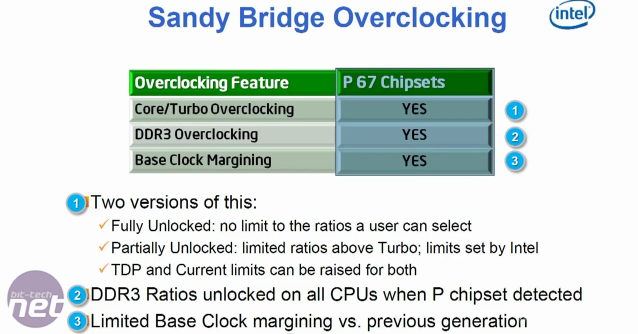
We chatted about possible work-arounds but at the moment the few 'asynchronous' setups tried were currently not working. It's been claimed to use out-of-the-box the design was deliberately limited with the intention to simplify board design and lower costs. This obviously has the 'unfortunate' side effect that enthusiasts will be unable to manually overclock Sandy Bridge CPUs to their limits, but the CPU's own internal overclocking, TurboBoost, will still work and Intel will offer some
controlled multiplier overhead for enthusiasts as a token gesture.
At the time of writing we are still talking to Taiwan's motherboard companies, but the few we have had contact with are certainly worried as Intel's move not only impacts enthusiasts, it also takes control and emphasis away from motherboard manufacturers. After all, why would you buy one board over another if they all overclock the same? On the plus side, if a company does crack the Base Clock limit, then it means a potentially huge advantage over the competition. It's no understatement to say the next few months are crucial for the motherboard engineering teams.
On the plus side though, memory strap limits are at present removed on sample Sandy Bridge hardware - Intel's slides claim 2,133MHz - which is nice to have, but since most of the performance comes from additional CPU MHz rather than memory speed, it's not the answer we were really looking for.
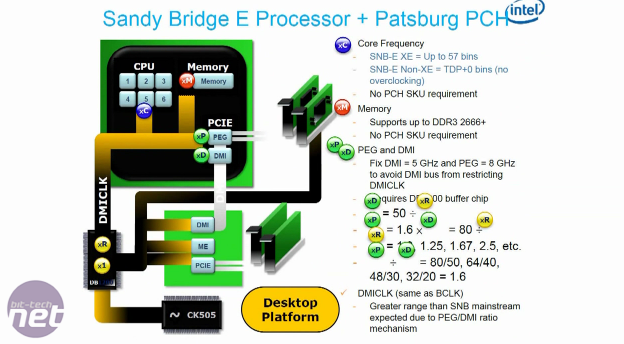
HKEPC also mirror what we've heard and go further to include details Intel's upcoming LGA2011 Sandy Bridge-E and 'Patsburg' chipset that will replace the current X58 and LGA1366 platforms.
According to HKEPC the upper limit DDR3 support currently exceeds 2,666MHz (wowzers) and most importantly follows previous current generations basic designs so overclocking potential is unaffected, yet, unspecified.
Intel still plans to sell K-series CPUs which come with an unlocked CPU multiplier - and with this move, the K-series CPUs start to make a lot more sense, as they will be the only Intel CPUs capable of overclocking. Is this move a slap in the face for enthusiasts that will send them towards an AMD Fusion platform or are CPUs just getting fast enough that overclocking really doesn't matter that much to you any more?
Let us know what you think, in
the forums.

97 Comments
Discuss in the forums Reply"buy the 3Ghz sandy bridge for £100 blah blah blah NO OVERCLOCKING" but .....
"check out our 3Ghz sandy bridge with UNLOCKED MULTI for £350"
Absolutely. Intel wants to up-sell you as much as it possibly can to make money. Don't expect any more G6950, i3-530, i5-750 or i7-920s to really offer that much value though. And no more competition and discussion among enthusiasts unless you can afford the K-series, as that is the only totally unlocked multiplier. No base clock makes motherboard tweaking an almost entirely defunct pass-time.
edit: typed that on iphone, hence short response.
overclocking is core of PC gaming experience (at least for many users here) so if they remove this option, i will sure be jumping onto AMD ship. however, it will also depend on price difference, if the K chip is only £50 more than cheapest of the same architecture (i7 875k vs i7 860) and it performs miles faster than AMD's, then it may be worth it.
Thing is the market that overclocks and play games, tend be younger cash strapped students which boardline on going to the darkside that is console gaming.
i mean seriously just why, there is no point.
yes they may make a bit more money but few people will buy there top range CPUs as they are so over priced tbh
Now, I haven't actually bothered overclocking my i7 920. There's no need.
But this still astounds me and I find it annoying on a principal level.
Hopefully AMD's Bulldozer will be both good in stock form and enthusiast-friendly. Maybe Intel will rethink if they're losing the great marketing of enthusiast and extreme OC builds.
Especially when you will still continue raking in the cash with the unknowing consumers gobbling up your chips.
i guess ill have to switch to amd argh
but i doubt this if this in anyway is true
almost every company will fail
My next 7 processors were all intel and all overclocked.
My next processor will probably be an AMD!!!!
Realistically though how many people will this affect? i would have thought the majority of chips sold are to oems, which usually spec crap mobos that limit the OC potential anyway. It only seems to 'cripple' a minority market imo of which im a member GRRRRRRR.
With pc's becoming so mainstream there is an inherent craving for simplicity and stability that cannot be overheard nobody wants to don the geek-glasses because of a bsod, computers are also mature enough that it should be expected by now, this could have severe implications on the homebuild pc over time. As it could render them a moot point.
Besides to most people there are not many tasks left that are truly limited by the cpu alone.
..and of course taking more money for more performance, does make sense, when you are the one selling it.
well not for a couple of years,until my 920 is out of date. :)
With each passing day, the likelihood that I replace my Q9550 with another Intel CPU decreases.
what if the unlocked processors allow us overclock to reach 5ghz on air,and amd ain't got anything like it....
Please let Fusion be good Please let Fusion be good
http://www.overclock3d.net/news/cpu_mainboard/intel_set_to_stop_overclocking_on_mainstream_nehalems/1
This is just Intel managing our expectations, promising a little and hopefully offering a lot, hopefully!
Let's go back to AMD. ;-)
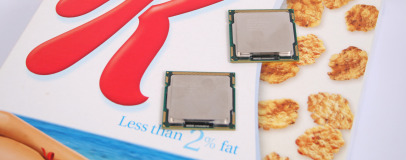
Special K brand (from Kellog) reference to the i5K/i7K processor that are unlocked. Article suggests that only way to OC in the future may be with the *K processors, unless motherboard manufacturers can come up with a workaround.
As a side point, I bought an i7 860 partially on the basis that its Turbo Boost was good enough that I wouldn't need to manually overclock it until it e.g. ceases to deliver adequate frame rates in games.
Lets hope AMD's on top form at the end of the year instead then..
One for oem builders and that don't care for over clocking and one for enthusiasts.
Intel arn't stupid
It all come back to them ,Nand chips, Chipsets
The average man on the street doesn't overclock and that's where most of the money is. So why should Intel be interested?
It's definitely interesting news, because I might've considered one of these. However, as other people have said - performance is what matters. If a stock clocked Intel outperforms an overclocked AMD, how many will go for AMD just because they like overclocking? There are far more variables involved. Pricing/platform costs, different tasks, cores, heat etc......
Still, we can't allow this travesty to actually come to pass. Be forced to pay $1000 to get the high peformance we crave, instead of <$300? If Intel actually intends this, that must truely belive that
[1] they rule the whole bloody world and [2] we are all screaming effing idiots.
If they do this, we'll have to boycott them. *******s.
Well F--k you very much Asstel if I didn't want to overclock I would of bought a MAC.
AMD please take me back.
Thanks Intel for my venerable Q6600, but it's time to change sides...
Intel are Morons..
thats not to surprising, I mean really they have been doing that for a while now anyways with all their previous lines.
Because we (a few enthusiasts on a forum) doesn't mean dick to their bottom line. Joe Schmo will buy Sandy Bridge, like every Intel product before it - even P4!!
Does anyone here have a CPU better than an i7-920 who bought it with their own money (i.e. not a promotion, sponsorship, review sample, etc.)?
I'd wager that few, if any, of us have the flagship CPUs, when the $300 one overclocks to the same performance. I'm surprised that there is a market for the i7-950 and i7-980 when the 920 and 930 have so much more bang for the buck. Granted, I am sure there are a couple "money is no object" people with those top CPUs, but I bet that most people with top-of-the-line gaming rigs are running 920s and 930s, since the marginal returns from going past that are terrible.
For years, smart enthusiasts have purchased the lowest end of the flagship series. Because of how the CPU manufacturing process works, (same line for all clock speeds of the certain CPU, and each batch is sampled and then marked as a certain speed), there is always a likelihood that the lower end CPUs can be overclocked just about the same as the higher end CPUs.
If Intel offered the same 920/930 CPU it does now, clocked at just under 3GHz, without overclocking, it would still be a very popular chip. If they offered a 950 CPU at almost 4GHz, they would be able to sell far more than they are now, since people now are just overclocking 920/930 to 950 speeds or faster.
it's always been an odd relationship between overclockers and AMD/Intel.
Some of you may remember the days when you could bridge two contacts on the Palomino core Athlon XPs, and unlock the multiplier. at that time, nobody had unlocked multipliers.
Then, with the Thoroughbred, they "fixed" it so you couldn't unlock the multiplier.
There was a time around then when it seemed like they were both 'cracking down' on overclocking and implemented methods of restricting it.
However, overclockers buy enough CPUs that AMD/Intel have to cater to them, or lose their business. That's where the Extreme Edition and Black Edition stuff came into play.
Providing a low-cost chip that overclocks like a beast (right now most people are getting 800Mhz-1GHz additional on air, which is just insane) is a good way to shoot your higher end CPUs in the foot. However, it is also a good way to shoot down the competition's CPUs. It won't affect retail sales at all (helping or hurting), but enthusiasts will swarm over an overclockable ~$200 CPU that can run with the big boys, and whoever is selling it stands to make a lot of money. The damage it does to hurt your higher-end CPU sales is less than the damage it does to hurt your competitors mid/high end CPU sales.
At this point, perhaps Intel is complacent enough with the dominance of Nehalem that it isn't worried about competing with AMD. The low end core i7s - 875, 920, 930 - AMD can't compete with them. I have a Thuban X6, AMD's flagship (well, not quite, mine is a 1050T and the flagship is 1090T BE, but close enough), and it is struggling to compete with i5 750 for games. Their only competitor to the i7 875/920/930 is the higher end core i7 950 and 980 and whatever else there is up there.
Intel won't lose sales of its low end i7 range, because AMD doesn't have anything to compare to it, even at stock speeds the i7 beats the P2X6. But they will gain sales of its high end i7 range.
Now, what this would do would be provide AMD with an opportunity to hit Intel very hard. The Thuban was a step in the right direction. 6 cores for cheaper than Intel's 4 core chips, and overclocks just as good. However, K10 just can't compete with Nehalem on games and other applications that don't use all six cores. If Intel locks up the overclocking like this, and AMD can figure out something that is as good as Nehalem, they could take the enthusiast market back by storm offering a $300 CPU with an unlocked multiplier that can overclock to having higher performance than the $300 Intel offerings.
It's also a potential jackpot for motherboard manufacturers that can find a way to circumvent this. Look at the popularity of the Black Edition and Special K cores, and the fact that people will easily pay a 50% premium just for an unlocked multiplier. If they can figure out a mobo configuration to bypass FSB limits, they could easily sell it for 50% more than similarly equipped ones without it.
And that's coming from someone who almost never overclocks
Ummm, what? No mainstream manufacturer I've ever heard of sells overclocked CPUs. They're buying the more expensive ones already.
I'm getting a little amused by all of this anger.
In any other industry, being able to tweak some settings and make a $300 product perform the same as a $600 product would be completely insane and unheard of.
Can you go out and buy a vanilla, base model 2.0L hatchback with 125hp, and then change some settings for free and get 250hp out of it? Can you re-flash the firmware on your 60GB MP3 player to make it a 120GB MP3 player?
Intel's goal is to make money. it's a business. it's publicly traded. the entire point of anything intel does is to make money for its stockholders. it's not Gordon Moore sitting in a cave, laughing at the plight of the common man while he counts his bags of money and treasure.
AMD is hurting right now. It's easy to see. Intel wouldn't do something like this if they were trying to take market share from AMD. They're far enough ahead that they can take a break from trying to beat AMD, and instead focus on trying to milk the most profit out of their current line-up as they can. This is a very bad thing, and AMD needs to come out of the bullpen with some serious hardware. Competition creates innovation, and if AMD starts making some chips that can give the i7 a run for its money, Intel will play the overclocking card again to try to boost sales.
But Bit-tech are right it will be very hard for the motherboard manufacturers to differentiate themselves in a market which is already finding it difficult exemplified by the loss of some major motherboard players, Abit DFI to name a couple. This isn't a surprise from Intel and if they didn't want their mainstream processors to overclock I'm pretty sure a workaround wouldn't be possible, those engineers at Intel aren't working on the most advanced micro-architectures for no reason. Let's just hope this is hype and it doesn't come into fruition or there will be a lot of enthusiasts sticking to their current set-ups because they can't afford the overclocking chips they need to make the jump to another Intel socket worthwhile.
Sorry, brainfart. Meant to say system builders like OcUK and Scan, who buy huge volumes of CPU's.
But on the subject dont Dell overclock their top end XPS machines?
Wow - that works out a a new CPU every 6 months!
Agree though about o/c - I've only just retired my £50 E2160 and it's 45% overclock after 2.5 years, just from an increase in FSB. Just installed a Q9650 and will be o/c that too.
Also, apologies for any noobness in my next question - I take it that LGA1155 isn't a typo and Sandy Bridge will require a new socket? That's a shocking lifespan for LGA1156 if it - & I assume a new mobo will be required for the new CPUs...
I wanted a fast cpu, but bought a cheap one. and overclocked it. Now I will have to buy an expensive one. and they will rake in the cash.
except that I just became an amd fanboy.
This is just rumour control, so lets just wait for the facts.
I'm Afraid not
That's lowering costs..... not prices. How nice. :-)
The article says that Intel has consolidated every single system clock into a single base clock, which is completely different from an artificial (software) overclock block. Tweaking the base clock on Sandy Bridge will break USB, break SATA, and break PCI-e - it is said in the article that a 5MHz bump broke USB and SATA, and since the clock speed of the PCI-e bus is presumably based on the same base clock then those three factors will be the limits of overclocking on Sandy Bridge.
Sad thing is that we may just be forced too and it wouldn't surprise me if motherboard manufacturers do as well, how exactly can they sell high end motherboards for a platform that can't overclock? what can they use to differentiate between their motherboards than just I/O ports, the PCI placement and the headers/SATA ports on board? Gone will be the days of buying a motherboard to overclock. AMD should get a massive surge of extra fanboy's and extra income from people buying their CPU's which by the experience of this generation have lower performance but since Intel can't overclock you can just overclock to gain yourself performance better than the intel CPU's!
I realise the money to be made is on the cheapest of motherboards but if there was no money in enthusiast boards and OCing boards why would they do it other than for competition wins to add to their rep?
Would definitely consider going AMD if their next iteration of CPU's do away with the K10 architecture and are going for a decent price.
Like a few people have also mentioned, this is going to have a definite knock on effect on a number of other manufacturers, namely Motherboard and RAM producers as well as Heatsinks and waterblocks, the demand for all of them is sure to drop a fair extent.
For those of you who have already made the switch, how many of you are desperately hoping they make it AM3 compatible, as they did with the phenoms and 2+. Intels constant socket changing was the reason I switched to AMD.
As for the over-clocking thing, my guess is intel makes a lot more money. It seems like a lot of us out there dont overclock cheaper 'bang for buck' CPU's because we cant afford the more expensive ones, its because we like to give ourselves the victory of achieving the same performance for a lesser cost. Take the option out, and most of them will end up still wanting decent performance in games/rendering/encoding/benchmarking/ whatever you like to do with your CPU, and will buy the more expensive option.
That is price structure dependant, if bang for buck remains fairly constant. The high high-end stuff will probably still be ridiculously priced (see the i7-970). In the end, its that pricing structure, and the sockets (not only changing it every generation, but having different sockets within generations) which fuel most of my annoyance, not overclocking.
Those that buy the xtreme cpus will continue to do so but Mintel will not force those that do not or can't afford them to purchase them, makes we wonder if this is a spin off from their recent "K" series of cpu's for overclocking...were they testing the market?
Are we going to have three catagories, buget not ocable, medium which will be ocable but multiplier still locked and xtreme with the unlocked multiplier.
One thing for sure if they are going to deliberately restrict their product so that they can charge a higher price for the unrestricted version then customers not like that, they will see that as profiteering and vote with their wallets.
It's possible, that the 32nm and the architecture are really good to OC...
Anyway, just want to wait and see, for now I'm considering AMD (if they deliver something close to their powerpoint slides) :D
"My first processor in my first build was an intel core 2 duo E6700.
My next 7 processors were all intel and all overclocked."
!!!
My first CPU was a PIII, and I'm not sure I've had more than 7 since then (10-15 years ago)
Mine was a 486 overdrive mis-sold as a P75 (by Tiny Computers) - it cost me £1,500 in 1995. Since then I've had 6 including my current rig. In fairness though, I started building machines for friends/customers to stop me wanting to upgrade my own so often :)
You all switch to amd that will be fun
An i920 at stock speeds beats amds top quad core overclocked on pure performance.
The i980 is brought by people who do alot more than game on there pc and a few of us have the chip and will not need to replace it for a good few years.
Intel has a huge percentage of the Market in the high end (i750 and above) there is not 1 competing amd product. Fusion is unlikely to deliver what is really required a cheap quad core that out performs the i930 by a considerable margin. It's never going to happen there 6core CPU gets owned by the i920 even sadly.
AMD are just not at the level they were once the days when the athalons was the gamers chip are long gone it's been nearly 4 years since I brought amd and it will be many more before I consider it
An unlocked multiplier means easy overclocks, for anybody
There enthusiast Market is below 1% of all CPUs sold so you all boycott they won't even notice the difference. If you think 10000 people switching to amd would affect there profits your very wrong.
Intels main buyers are still system builders like dell, most the people i know still shop at pc world or currys and don't even know what overclocking is. Once it's too slow they wi buy something better at pc world or dell. Alienware has a big Market for gamers who don't read this sort of site. 2 of my m8s read this site and still brought alienware
Scan overclockers Ect is love to know there total CPU sales as I'd guess it's not even 1000 a month which is a tiny number when compared with dells pc sales.
If so . . . well, I guess enthusiasts will just flock to it and skip the LGA1155, no? Wouldn't be the first time that a lower-end socket got passed over as a dud . . .
-Tuthmose
You sir, are correct.
Only the K-series will be overclockable.
I had already decided to make my next Machine AMD based, just for cost, but if they are "upping the price for enthusiasts" then they're gone.
The Mobo's and CPU's will be expensive compared to AMD's offerings though.
edit : the picture at the bottom right, the intel-2011.png, has the XE CPU's being overclockable by up to 57 bins, and the Non-XE version being TDP only + 0 bins.
Therefore no overclock out of TDP boundaries if not an XE chip. No matter how much cooling.
This would push enthusiasts to the XE chips only, or to AMD since most of us do not have limitless money supplies..
You, Intel, will reap this whirlwind.
the reason you use intel in the first place is that there cpu's are usually more efficent look at there 6 core cpu compared to amd's (i know they are differnet arcitectures and the price difference is huge)
the clock thing will be broken either by the manufacters or by hackers either way i dont think it will last long becasue people probably wont buy it
My previous comment on the matter was a big over reaction, I had jus got home from work and was tired and ratty but it doesn't matter wether it's computers or anything else, people just don't like something being taken away from them.
Yes, SB-E socket will use an external clock gen so it'll be similar to the current LGA1366 platform. ;)
Enthusiasts who want to OC themselves will have a greatly limited choice of parts - none of them cheap - but hey, what's a few overclockers compared to a huge market of pc gamers who want to buy a pre-built system? Intel is in this for money, and I suspect they were losing a lot of potential income to third parties who overclocked cheaper CPUs, slapped on a warranty and pocketed the difference.
Personally, as an AMD user, I'm quite pleased with this news. It'll drive Intel's enthusiast market half mad with rage, and hopefully a good number of them will turn to AMD just in time for their new architecture. It's not that I'm an AMD "fanboy" or anything, just that I think a monopoly would be terrible - a 50/50 market share would give consumers the best deals and keep innovation at a high. Currently Intel has left AMD in the dust, and this is what results - they can do whatever they want and don't have to worry too much that they'll lose customers because of it. I'm hoping this will boost AMD's chances of getting back in the game good and proper.
Er... no? With both at stock the Intel is 5-15% better in most benchmarks I've seen. In some tasks the AMD wins by a similar margin. Granted, this is because the 920 is only 2.8Ghz vs 3.4Ghz at stock, but the AMD part is also a good deal cheaper.
Overclock them and the Intel wins, but if it were this generation that had restricted Intel chips, the AMD would be the clear winner - almost as good at stock but overclockable too. If AMD even manages to be as close behind Intel as it is now, it'll be in a great position when Intel enthusiasts start looking for <£200 overclockable CPUs.
http://farm5.static.flickr.com/4135/4829572743_fe6be548fb.jpg
But yer I think CPUs are getting so fast overclocking isn't really worth it now, for £500 you can build a PC to play most modern titles at modest quality so I say don't fret, most people won't miss it and the few that do will learn to live without it
I was hoping that Intel would have an overclock-able 4 core CPU with no video. A CPU like that should reach close to 5GHz on air with a good motherboard and cooling.
Unfortunately for me I do not know what Intel's plans are for the K series or if something similar [4 core] will be available and overclock-able for a larger socket.
32nm should put 5GHz 4 core CPUs on air within reach, otherwise why should overclockers invest in a new computer build?
Is 5GHz needed for most apps, including games? No. But, for many of us it is the fun involved.
Currently my E8600 clocked at 4.2GHz does fine for everything I want, including games. Why should I upgrade if there is not incentive?