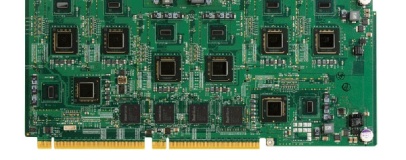
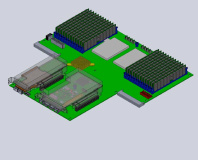
Each processing board in the SM10000 contains eight Intel Atom processors for a total of 512 CPUs.
Intel's low-power Atom processor will be familiar to anyone who's used a netbook or nettop, but at least one company is betting it can take the chip to a whole new place - the high-performance server market.
According to coverage over on
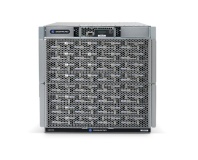
CNET, start-up SeaMicro has just announced a deal with the US Department of Energy to launch the SM10000 10U server, which features 512 individual Atom processors stuffed tightly into its rackmount casing.
Justifying its decision to use such a large quantity of low-powered processors - instead of the more common approach of a lower quantity of extremely powerful chips - the company claimed that its inaugural product meets the unique needs of an Internet data centre where "
the challenge is to handle millions of relatively small, independent tasks like those needed for searching, social networking, viewing web pages, and checking e-mail," or exactly the sort of thing where the
number of processing cores is of far greater advantage than the
power of the processing cores.
Speaking of power, SeaMicro claims that the SM10000 draws up to 75 percent less juice than a traditional server of equivalent capacity - meaning that companies can both drop their power bill drastically and reduce their data centre's heat output, providing their particular usage is suited to a whole mess of Atom processors.
The SM10000 is expected to launch in the US at the end of next month for an eye-watering
starting price of $139,000 (around £94,110) - although if you find yourself needing 512 processors in a single box you're probably a bit beyond worrying about the price.
Can you see a market for a vast quantity of low-power processors, or would companies be better off filling the same 10U space with a series of
Magny-Cours-based servers? Share your thoughts over in
the forums.

17 Comments
Discuss in the forums Replycan it run crysis?
It'll be interesting to see how it does.
But i do like this, a lot.
And i believe the company looked at running ARM processors but chose atoms as they are x86. no need to recompile any code and youve already got a lot of software that can be run on it.
As for the OS... as far as its conserned its just one BIG CPU (or as many as you want, its virtulised) so you can run windows, *nix, OS2/Warp (maybe?)
^^ Got it in one. Though the downside of all these small chips is that if one particular job is massive, it'll have to go through a relatively poor CPU. Stick in a couple of Xeon E6xxx chips for those :)
Look on the anandtech website for more info.
Andy
Yes, it's not entirely a "big" willy wave at all is it! It's kind of one where everyone turns and points their fingers at it and laugh.....................ok, that happened to me alot.
my kids have custom built mini itx machines than run atom 330's, and they do everything they need them to.
What they get is a selection of mature, well maintained tool chains, large software base, a well understood architecture (32 bit x86), and a huge talent pool tha is already comfortable with x86.
The picture looks like it's all based on Menlow and there is an SCH for each CPU. I'm not sure how they are linking each 'computer' together (nontransparent bridge, Ethernet, some other IO tech), or if they are linked at all. But having each be independent means they could just put an inactive SCH/CPU pair into S3 or even switch it off.
Assuming that the hardware platform is fixed (no PCIe slots, fixed RAM config, etc), the BIOS can be made to boot very fast, and the OS can probably be tweaked top do the same. That could make a full system boot fast enough with an SSD to make a full shutdown feasible (as opposed to S3).