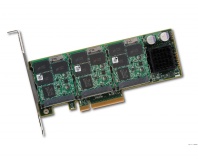
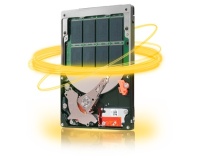
The new PCI Express SSDs from Seagate - likely to be significantly smaller and faster than the drive pictured - are aimed at the enterprise market.
Seagate has announced that it is planning a range of PCI Express-connected SSDs, in partnership with controller specialist LSI.
Continuing to distance itself from
comments made back in 2008 by then-CEO Bill Watkins that solid-state storage wouldn't make a splash compared to traditional mechanical drives,Seagate has announced a continuation of its partnership with LSI which will culminate in the release of several PCIe SSD models aimed at the enterprise market.
As announced over on
HotHardware, the devices are designed to compete directly with those from companies such as
Fusion-IO, which recently combined eight of its PCIe-based ioDrive cards to create a system capable of transferring 1TB/s and boasts Apple co-founder Steve Wozniak as its chief scientist.
Whatever Seagate's plans are for SSDs at the consumer level, this isn't it: aimed firmly at the data centre crowd, Seagate and LSI's SSDs will be high-performance and high-price - more for those running
World of Warcraft servers than the
World of Warcraft client. Solid-state storage has long held the promise of massive amounts of operations per second and stunning random access times, which makes it - theoretically, at least - the Holy Grail for hosting large databases. Its high price has traditionally kept it from all but the biggest players in the industry, but with more companies looking to produce enterprise grade devices the competition will only drive prices down.
Speaking of prices, Seagate sadly hasn't: so far it has yet to announce anything firm about its partnership, from expected product shipping dates to capacity and price. Expect to be going cap in hand to the bank manager if you want one of these in your next gaming rig, though.
Are you still pinning your hopes on SSD as the next big thing for performance computing, or will mechanical drives always have the price/performance edge? Share your thoughts over in
the forums.

18 Comments
Discuss in the forums Reply1.make more money byselling many at a low price
2sellin few at a higher price
and at themoment he companise are doing number 2 becasue as long as there is high demand for them at that price they will keep it there its the same as the iphone. for example a 32gb iphone is £674.
now i dont know about you but the ipone is not worth 600 pounds to make it would probably cost them less than £200 but because of the popularity of it they wont lower the price becasue it brings in a lot of money
as long as they keep selling out their stock at this price then they will not lower it. it is only when they find themselves unable to sell all their stock at current prices that the price will fall. that is how supply and demand works: prices only fall when supply outproduces demand at that price point, and even then there is usually a market lag the keeps prices artificially high for a few weeks.
SATA 6 Gb/sec is only 600MB a second max
(there are ocz ones allready out that have 1tb just search on google)
Either way, that's an acceptable speed for me.... though I suppose I don't have any servers, which would see more of a benefit from that bandwidth.
Ahh, some things never change. :)
*When I say cheap, I mean compared to these 1TB enterprise drives.
At last a use for all those x1 PCIe slots.
people are misinterpreting the supply and demand and laffler curve. demand is high and supply is decent, but there's a price to manufacture. when a technology is still relatively new there's plenty of room to inovate in creating said product. As long as demand remains high, I'm sure manufacturers will figure out how to reduce costs as fabs come online and the technology matures. There's a lower limit on the price to manufacture.
A lot of the cost is R&D. That is much lower for mechanical hdd's as they are much more mature and all the changes are incrimental.
I'm guessing over the next few years. we'll see bigger and bigger market penetration first in laptops then desktops, because IMO storage demand is not increasing at the same pace as HDD size. I mean most grand parent or family computer types will never fill a 1tb HDD. My mom has a 120gig hdd and even with pictures and her small music collection she'll never fill it.
actually it is i just didnt bother to take into account the 1024 bit rate or bothering to convert it
Bit-tech made my day with the picture + it's description under it. :D
I really did not expect that. :)