If you're always on the lookout for the smallest computing system possible - and the newly-unveiled
Mobile-ITX form factor is still a little bulky for your tastes - check out Direct Insight's TRITON-TX51.
As revealed over on
Linux for Devices - via
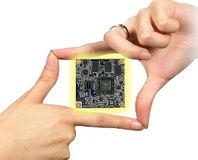
SlashGear - the TRITON-TX51 is a an entire computer crammed into a PCB the size of a stick of laptop RAM - just 6.85cm x 2.54cm.
In this SODIMM sized footprint you get an ARM Cortex A8 processor running at 800MHz, 128MB of DDR400 RAM with another 128MB of NAND flash memory, support for a pair of SDIO cards for additional hardware, a touchscreen controller which can output and drive displays of up to 1,280 x 768 at a 24-bit colour depth along with PAL and NTSC video output, a 10/100 Ethernet controller, USB 2.0 On-The-Go and host support, and I2C, SPI, I2S, 1-Wire, and PWM interfaces.
Video support isn't exactly lacking either, with the teeny-tiny system featuring a PowerVR graphics engine which supports both OpenGL ES 2.0 3D rendering and 720p MPEG-4/h.264 hardware accelerated playback - and even manages to cram in support for a CMOS camera device.
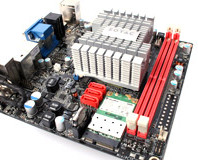
Of course, in order to use the functionality of the system a much larger daughterboard is required to hold the outputs in a similar manner to VIA's Mobile-ITX form factor, but Direct Insight promises to offer a baseboard design service that will allow OEMs to shrink the footprint to the smallest possible while still retaining the outputs required for their implementation.
Designed primarily for video processing systems, the TRITON-TX51 is expected to launch in January for €150 with full compatibility for Windows CE 6.0 and Linux kernel 2.6 and above.
Does the thought of such a tiny little system with so much power get your modding juices flowing, or is the lack of x86 compatibility a problem? Share your thoughts over
in the forums.










Want to comment? Please log in.