Nvidia says that over 400 million Tegra devices will be shipped in 2012, bringing in a lot of revenue for the company in the future.
With the tech industry taking a big beating in the financial stakes, it’s no surprise that Nvidia posted a loss of $201.3 million ($0.37 per share) for the first quarter of fiscal 2010 yesterday. However, Nvidia’s CEO Jen-Hsun Huang is determined to look on the positive side, and predicts that GPGPU computing and Nvidia’s Tegra platform will become big money spinners for the company in the future.
In a webcast to coincide with the announcement of Nvidia’s figures, Huang said that
“during the quarter, we made good progress managing operating expenses and reducing inventory.” With regards to the latter, Nvidia says that it’s reduced its inventory days from 144 to 64 compared with the previous quarter. The company also points out that its revenue has grown 38 percent sequentially from the fourth quarter of fiscal 2009.
However, Nvidia’s revenue has still dropped severely in comparison with the first quarter of fiscal 2009. For the first quarter of fiscal 2010, Nvidia reported revenue of $664.2 million, compared with a massive $1.2 billion in the same quarter in fiscal 2009 – that’s a drop of 42 percent.
AMD's figures showed a similar story, with dramatic losses in the fourth quarter of fiscal 2009, but much better results in the first quarter of fiscal 2010.
Looking on the positive side, Nvidia points to its recent
market share figures from Mercury Research, in which Nvidia was shown to have 69 per cent of the discrete desktop GPU market. Nvidia also said that the figures for the last quarter were better than the company expected, particularly in comparison with the fourth quarter of fiscal 2009. Nvidia’s chief financial officer, David White, said that the sequential growth of 38 percent was
“significantly higher than our estimate, which was flat to slightly up.”
In the future, Huang said that the company would continue to invest in four main initiatives:
“one, maintaining our GPU leadership; two, driving the GPU computing revolution; three, increasing the adoption of GPUs in all segments of computing; and four, leading the mobile computing revolution.”
Huang pointed out that
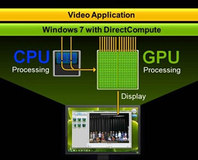
“GPU computing will be incorporated into the two most important operating systems in the very near future - Windows 7 with DX compute, and OS 10 Snow Leopard with Open CL.” These operating systems, says Huang,
“will incorporate GPU computing into the core operating system and the GPU will become indispensable to achieve a great computing experience.”
Huang also has a lot of faith in Nvidia’s mobile
Tegra system-on-chip technology. “
More than 400 million of these devices will be shipped in 2012,” said Huang, adding that “our nearly four-year investment in Tegra has positioned us squarely at the center of the next computing revolution. We estimate that Tegra has opened up an additional $10 billion growth market for us.”
Do you think that GPGPU computing become “indispensible” in the future, and will Tegra be the runaway success that Nvidia predicts? Let us know your thoughts
in the forums.

I'm curious what sour experiences you have had to make you say such a thing. I have an Nvidia 8600 and I have nothing but praise for it. I am looking forward to a Radeon 4850 soon but that's purely because ATI made advances and tied it to a comparative price. But that's competition, but I hardly see any spin or propaganda.
The sour experience is really down to the fact that nVidia has rebranded what is effectively the same chip four or five times now. 8800GT -> 8800GTS -> 9800GT -> 9800GTX -> 9800GTX+ -> GTS250.
The misbranding of laptop GPU parts is another bitter pill. The GTX280M is actually just a 9800GTX. I wouldn't mind about the Mobility parts being clocked lower... if they actually used a GT200 core when they called it 'GTX280'. They imply that it is the mobile equivalent of the desktop GTX280 part... and it isn't.
Couldn't have said it better myself.
Also, not sure why their fiscal year numbers are ahead of the actual year but I checked their website and their press release says the same thing, Q1 2010. Last I checked we just finished Q1 2009, but hey whatever...
Yeah... looking forward to AMD's Bulldozer and Intel's Westmere.
Totaly agree and it's not just the rebranding it's the confusing pointless naming architechture many companys have to their products, the whole industry does it nvidia amd intel. How much confusion is there for a 'noob' when it comes to picking a gfx card/cpu model there really should be some kind of industry sliding scale to judge against but then again no one is going to activly admit that their GF 239850000 GTSx 24 is slower than a R41 something!!! ho hum just my 2c
Itchy D
I disagree. From what i've heard of GT300 it looks like Nvidia is just going to make the same mistakes over again.
ATI got it right with a small, cheap, scalable die in R740, so right that the only way nVidia was able to stay competitive was to make huge price cuts, and subsequently huge losses, on it's monolithic GPU.
Nvidia is posting large losses, ATI was in profit. Throwing aside fanboyism (allthough it is very hard to LIKE nVidia atm) ATI's strategy really shows up team green.
Sure rip on Intel and nvidia pretty sure AMD did same thing back in the athlon days with the model numbering confusing customer to thinking it was the clock speed when it was actually not. I knew a lotta people burnt by this.
200 Series 100 Series
GeForce GTS 150 *
GeForce GT 130 *
GeForce GT 120 *
GeForce G100 *
GeForce GTX 295
GeForce GTX 285
GeForce GTX 280
GeForce GTX 275
GeForce GTX 260
GeForce GTS 250
9 Series
GeForce 9800 GX2
GeForce 9800 GTX+
GeForce 9800 GTX
GeForce 9800 GT
GeForce 9600 GT
GeForce 9600 GSO
GeForce 9500 GT
GeForce 9400 GT
GeForce 9400 mGPU
GeForce 9300 mGPU
8 Series
GeForce 8800 GTS
GeForce 8800 GT
GeForce 8600 GTS
GeForce 8600 GT
AMD wasn't trying to make people think that their chips ran at any clockspeed with the old Athlon numbering system, it was meant to HELP the consumer by indicating which chips from their competitor a particular model compared to since the average consumer is a complete idiot and WOULD only take a look at the clockspeed to make a decision.
;)
So seems like it's not the end of the world because even $46.7 in the grand scheme of things isn't going to break the bank for Nvidia.
You're wrong. Correct rebranding:
8800GT -> 9800GT
8800GTS -> 9800GTX+(this card featured 2 Sli connectors, higher clocks and Hybrid Power) -> GTS250 (different coolers)
It does seem over the top to rebrand products so often but if the technology underneath is unrivaled why bother designing an expensive new one?
it was proven that nVidia never once offered CUDA to ATI, so because of that they never bothered with attempting support for it, why would they that would be a waste of money as CUDA in itself is a flawed concept but ehh wont matter much if your concern for CUDA was its conversion of PhysX as thats going to die soon enough with DX11 and OpenCL thats why nVidia was trying to convince the OpenCL comity to use their PhysX but the flip side to that would it would open it up to ATI and have to be license free which is why no one has heard anything further from nVidia and their physX, so far nVidia has made two big mistakes, one is PhysX that was a complete waste of money on their part and two those stupid 3d glasses that the tech itself is about 10 years old and everyone had the smarts to say pass and go a different direction with it. But anyhow Im done ranting, I agree the company gives little concern to its consumers. They just want money...