Pat Gelsinger holds the 300mm Larrabee wafer. The line is inserted for reference by ourselves.
French tech site
Hardware.fr seems to have taken the only photo of Intel Senior VP, Pat Gelsinger, at IDF in Beijing, showing off Larabee.
PC Perspective claims to count 64 dies in the picture, which means even at full yield (it never happens) that would be a very costly part. This is on the assumption that Intel's Gelsinger is holding up a recent die made on 45nm, and not an older one made on 65nm, as there were some claims last year of early samples being used internally on the older process.
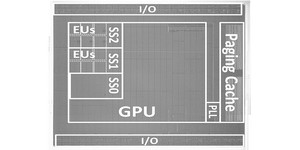
Attempting to calculate the die size (on the heavy assumption that it's square) we think Larrabee is a massive 700mm die. To work this out, we first jimmied the levels of the image in Adobe Photoshop, and could just about make out there are eight cores almost exactly in a diagonal. Assuming Gelsinger is holding a 300mm wafer, that equates to 37.5mm per diagonal, or 26.5mm a side. 26.5 squared therefore makes 702.25 mm² total area.
In his article on the French site, writer Damien Triolet claims a die size of
"approximately 600mm²" however. Either way, 600-700mm² has people claiming somewhere in the region of
1.6-1.7Bn transistors.
In comparison, Nvidia's GT200 was 576mm at 1.4Bn squared making Larrabee in the region of 4-22 percent larger on that wafer.
Another comparative - Intel Tukwila - is a 2 billion transistor Itanium chip at 712mm squared, however while Tukwila is mostly L3 cache, whereas Larrabee is small IA cores. It also depends on the core frequencies too, and whether it's electrical paths buffed out for extra frequency like the ATI Radeon HD 4890 versus 4870 for example?
The general consensus claims Intel will launch its super sized part on 45nm - the largest to date on High-K Metal Gate, however since the process is mature this will give more security for a larger die. The 45nm High-K MG will lower power and leakage quite considerably, but it depends on the actual transistor and "core" count, as well as power/clock gating, versus aforementioned frequency fattening and IO routing: basically there are too many factors still outstanding for firm conclusions.
What do you think? Big and hot or the next super seller? What do you make the die-size to be? Let us know your thoughts and calculations
in the forums!

36 Comments
Discuss in the forums ReplyAnyone know a release date? I'm assuming Q4 this year sometime?
will Larrabee support Dx11?
Sorry, 700mm²
Fixed it now - I was on my laptop before which doesnt have a numberpad so I couldnt do alt+0178
Btw, what is a wafter? (Image caption)
Wafer*, it's the silicon plate chips are etched on to. Each square on the wafer is an individual Larrabee prototype GPU.
is there a list of useful alt+numbers? it'd certainly be very useful.
They are round because they are cut from silicon rods that are drawn out of molten silicon. I imagine they could cut it square after the rod is extracted but that would not give you an optimum yield.
http://www.sehmy.com/Product/abtWafers.htm
I can just imagine the stock heatsink.. this should be interesting.. at least ati has amd to fall on- they maybe able to dev something similar.. nvidia has alot ot worry about- there marketing machine better kick it up into super bs mode :D maybe the ntune guy can pretend he wrote a driver that doubles performance on every game ;p call it 'my ass got big banged by intel- help!'
http://www.usefulshortcuts.com/downloads/ALT-Codes.pdf
What a crock of ****... The reason ATI have done well against Nvidia is something called performance per watt. Larrabee is clearly going to be a hot overpriced, crap yield, expensive to fabricate chip. Nvidia and ATI gpus rape x86 and Intel don't have a chance in hell in the GPU market against these two. Your intel fanboyism is totally blatant and larrabee will be another Pentium 4. And we all remember what a resounding success the Pentium 4 was dont we...
http://en.wikipedia.org/wiki/Czochralski_process
Very interesting! :)
I agree, but Larrabee will simply be a GPGPU monster and Intel will rack in tons of money in the server space where it's already strong and business' will pay through the nose. I doubt it cares too much about the PC gaming market until it gets in the PS4 (my prediction) where it can levy some game publishers with Sony's help.
lol it's not fanboyism.. just wait and see- well I am kinda a intel fanboy.. but if you define fanboy as liking the best ocing chips then- that's what I am!
Nvidia and ATI are fine tunning the current technologies, and adding new stuff.
While Intel, has to design it, produce it, put it on sale and then they have to start trying to get in part with the competition.
If they trying new technologies and tunning, at the scale ATI and Nvidia do, they will never put the product on the market.
And if it's like P4, with my blessings, the fun boys should downgrade their monitors from now.
transistor count is through the roof though.. going to be something to contend with for sure- the driver thing only matters in that nvidia and ati have a huge headstart in optimizing specific titles.. even if larry releases without any optimizations..
it should be able to handle 1080p gaming- if anything nvidia has been sandbagging for years now.. I could really care less what they do nowdays because it's all sand.. maybe larry will be the kick in the ass to get gpu's beyond what we have today and engines like crysis the norm
Quite.
To the Hippo, if you look at the increase in transistors from Nvidia's G80 to G200 core, you will see a 100% increase. Therefore the GT300 will probably end well in excess of 2 Bn transistors, not to mention significantly higher number of (shader) cores, no way will Larrabee outperform it in terms of pure computing power. As Bindi stated the Larrabee's game winner is its native X86 cores, perfect to run all those GPCPU and C / C+ etc business apps, that the Cloud computing movement will hoover-up.
If the PS4 does go with Intel, I hope it does not result in a hot, noisy beast, like the XBOX 360.
However, fanboy or not, we should all be excited. More competition means lower prices (at least until one of them go under).
GT300 is not going to be anything great when you look at price/performance.. they would rather keep technology stagnant to milk money.. I'm not saying larrabee will be the nvidia killer.. but I do think it will have a big impact on what goes into dev from that point on and it will hurt nvidia's bottom line.. I'm not so concerned with ati because they have amd to work with
I'm just sick of nvidia's marketing.. they love to say how much better they are than everyone else.. when you look at what they offer compared to ati- it's just rehashed with some clock plays.. I think this will hurt thier bottom line- far as gaming goes, how can you say it can't compete with what's out! that's fanboyism at it's finest when you talk trash on things that haven't even been tested! I'm basing my opinions on what I see out and what I've been following for the past couple of years since the G80.. I've owned these cards! :D I just want something better- GT300 in excess of 2billion is yet to be seen also
There will be no issue for gamers, as this will either work or not.
To be compliant, they will have to have the whole feature set compatible, not just parts of it.
So DX will work or it will not, there will not be any specific problems with certain games.
optimisations, maybe, but not outright bug corrections, unless the problem appears on all the graphics adapters.
the first Larabee's or Larabi, will be for the business end of the stick, since they probably won't be good enough to run consumer level games at an acceptable speed.
GPGPU stuff will probably run like nuts on larabee tho, right from the beginning....
When the die shrink appears in 2010, the speeds/Number of cores, will be sufficient for it to enter the consumer market, or not.
Making the x86 a future standard for GPGPU or just GPU would be hard for Nvidia, and OK for AMD/ATi...
I see it as more of an Itanium of GPU world. Great concept, fantastic on paper but fairly useless in reality. I don't see nVidia and AMD afraid of that, especially given Intel's history of crappy GPUs.
Theoretically Larrabee could grow and mature to be useful, but I don't think that they have the time to do it. We're getting close to the end of what the silicone-based technology can offer, multiplying cores doesn't give expected advantages (memory access times and latency suffers greatly, not to mention heat output etc.)
x86 is too old, slow and limited to be used for GPU or GPGPU. While introducing high performance double-precision computing would mean a revolution, this is not going to happen.
A question i always wondered but never asked.
Learning +1.