Custom PC Media Benchmarks
Download: CustomPC Media Benchmarks
Custom PC,
bit-tech's sister magazine, has developed its own Media Benchmarks to simulate the tasks that most of us perform on a regular basis. There are three tests, each of which measure different aspects of a PC's performance. You can download the suite from the link above, and see how your PC or laptop compares to those we test.
The scores are normalised against a reference PC that includes a stock-speed Core 2 Duo E6700, 2GB of DDR2 memory and a fast P45 motherboard, as you can see below. This PC scores 1,000 points, so if your PC scores 1,300, it's 30 per cent faster than the reference system, and if it scores less than 1,000 points, it's slower.
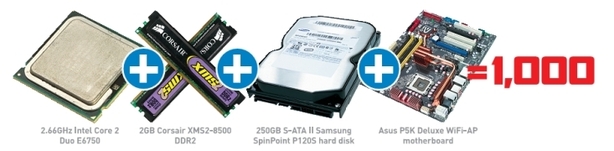 If your PC scores 1,000, then it's as fast as the one above.
The scoring is linear: if your PC scores 800 points, it's 20 per cent slower than this PC; if it scores 1,300, it's 30 per cent faster.GIMP Image Editing
Website: GNU Image Manipulation Program (GIMP)
Our GIMP image editing test simulates how well a PC can manipulate a collection of large digital photos. To achieve a high score requires a PC with a powerful CPU, plenty of quick memory and efficient hard disk drive access.
-
Kobalt G860 (1.6GHz Core i7 720QM)
-
Asus W90Vp (2.8GHz Core 2 Duo Mobile T9600)
-
Alienware M17x (2.8GHz Core 2 Duo Mobile T9800)
-
Asus G60Vx (2.53GHz Core 2 Duo Mobile P8700)
-
MSI GT729 (2GHz Core 2 Quad Mobile)
Points (higher is better)
See the
Results Analysis page for our take on what these numbers mean.
Handbrake H.264 Encoding
Website: HandBrake
Our test uses Handbrake - an open-source, GPL-licensed, multi-platform, multi-threaded video encoder, available for MacOS X, Linux and Windows - to encode a high resolution MPEG-2 video using the H.264 codec. This primarily tests multi-threaded CPU performance.
-
Kobalt G860 (1.6GHz Core i7 720QM)
-
MSI GT729 (2GHz Core 2 Quad Mobile)
-
Alienware M17x (2.8GHz Core 2 Duo Mobile T9800)
-
Asus W90Vp (2.8GHz Core 2 Duo Mobile T9600)
-
Asus G60Vx (2.53GHz Core 2 Duo Mobile P8700)
0
250
500
750
1000
1250
1500
Points (higher is better)
See the
Results Analysis page for our take on what these numbers mean.
Multi-tasking Performance
Website: MPC-HC
Website: 7Zip
To run multiple applications well you need a powerful (ideally multi-core) CPU and plenty of RAM. Our multi-tasking test performs a massive file backup (with encryption) using 7-Zip, while simultaneously playing back a HD movie file using Media Player Classic, making it a demanding test for any PC.
-
Kobalt G860 (1.6GHz Core i7 720QM)
-
Alienware M17x (2.8GHz Core 2 Duo Mobile T9800)
-
MSI GT729 (2GHz Core 2 Quad Mobile)
-
Asus G60Vx (2.53GHz Core 2 Duo P8700)
-
Asus W90Vp (2.8GHz Core 2 Duo T9600)
Points (higher is better)
See the
Results Analysis page for our take on what these numbers mean.
Overall Score
The overall score is an unweighted mean average of the scores of the three individual tests.
-
Kobalt G860 (1.6GHz Core i7 720QM)
-
Alienware M17x (2.8GHz Core 2 Duo Mobile T9800)
-
Asus W90Vp (2.8GHz Core 2 Duo T9600)
-
MSI GT729 (2GHz Core 2 Quad Mobile)
-
Asus G60Vx (2.53GHz Core 2 Duo P8700)
Points (higher is better)
See the
Results Analysis page for our take on what these numbers mean.










Want to comment? Please log in.