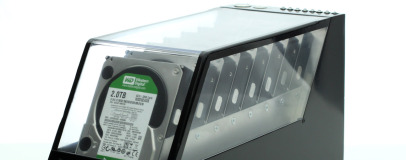
The Black Dwarf holds over 16TB of storage - with 12.7TB available - in a custom-made enclosure.
A veteran of the modding scene has unveiled his latest creation - a stunning-looking NAS dubbed the Black Dwarf, which holds an incredible 12.7TB of data.
Created by video editing and modding whiz Will Urbina and showcased over on his
site - via
Engadget - the Black Dwarf is a stunning-looking build constructed from aluminium, steel, and a Lexan transparent lid - and entirely made by hand, with nary a mass-produced part in sight.
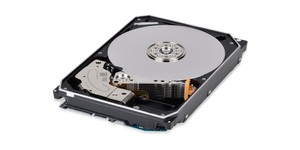
The NAS - which is powered by a 1.66GHz Atom N270 processor, which helps keep the power draw and heat as low as possible while still providing the grunt to keep the data travelling at top speed - holds eight 2TB hard drives in a RAID 5 setup, providing 12.7TB of usable space while allowing any single drive to fail without losing data. A 320GB drive is included for a boot drive, and a 30GB SSD allows certain data to be cached for rapid access.
While the processor is a little on the slow side, the overall performance is pretty nice: an 88MB per second write speed is dwarfed by the units incredible 266MB per second read speed.
Urbina has posted a
pair of
videos detailing his work, along with an impressive
time-lapse video which compresses over 100 hours of work into just six minutes.
Are you impressed at the amount of storage Urbina has put into the world's most stylish looking shoebox, or are you aghast that he hasn't spread his risk by using drives from differing manufacturers - or at least batches - for his array? Share your thoughts over
in the forums.

33 Comments
Discuss in the forums ReplyAre you on crack? All of these data drives are WD Caviar Green 2.0TB drives! Even the 320GB drive is a WD Scorpio Blue. Only the SSD is from OCZ.
I think what Gareth means is that by using drives from different manufacturers, you again minimise total array failure. Say that batch of WD 2TB greens had a bug - wouldn;t you be happy that half of your array was on entirely unlinked 2TB Seagates, or visa-versa?
I cannot even begin to comprehend how you read that sentence. That was entirely my point - if there's a bad firmware or manufacturing error that affects the entire batch, the NAS is ruined. Splitting the drives across manufacturers would help prevent such an issue - it's SOP for RAID.
Out of interest, whats it going to be running? Being a media PC (Windows?) or a file server (Linux?)
I read "or are you aghast that he hasn't spread his risk by using drives from differing manufacturers - or at least batches - for his array?" as "or are you aghast that he has increased the chances of drive failure by using drives from differing manufacturers - or at least batches - for his array?"
I was quite upset with a school related matter (My hatred of lessons may or may not have any relation with that), and quite a few people on YouTube happened to be commenting "Why is he using different drives?" so my frazzled mind was confused.. Apologies for that!
The reason you use drives from different manufacturers and different batches is so that you really reduce your risk of simultaneous failures. While this isn't traditionally an issue, it was REALLY highlighted by the Seagate BSY issue. We had a client who spent quite a bit of money when he built a system to make sure that drive failures wouldn't **** him over, and wham, lookit that.
For URE's of 10^15 (quite possible with Enterprise-grade disks) the chances are lessened, significantly. Well, as long as the manufacturers are correct.... RAID-6 doesn't make it much better.
My personal preference would be to keep two smaller arrays and concatenate them (not stripe, i.e. RAID 50) so that one disk failure has more chance of rebuilding, two disk failures in either array is passable and if two fail in one array (very unlucky) then at least you haven't lost all of your data. Just the end of the file system, but that's still more recoverable than striped data.
How did he manage 266MB/sec read on GigE though? Surely it's limited to 125MB/sec?
I was thinking the same thing, at least have a quarter of an inch for some airflow. That would worry me.
I would assume thats raw drive read rather than over network throughput
But that's rubbish for 12 drives! Three Samsung F1s in RAID0 would be faster!
I assume the raid 'grunt' is being done via the Atom CPU though, I don't think that is hardware raid.
Combined with Raid 0 having no redundancy which that box does have (and thus the overheads for that)
Read / write performance - I don't know if thats RAW performace, or done on top of a file system, if so what file system / what OS - and overheads that that puts in too?
Either way is a very nice build ;)
The bits where the other cameras seem to slide around amuse me. And I think I counted an SLR and two video cameras in addition to the time lapse one? One well documented build!
He has a RAID slot in card?
There should be something handling RAID on the card itself - there's a HS on the card.
I can't comment on that card, I've never tried it :)
You can have my workshop in exchange for your soul... :D
All the raid card really does is bundles up the drives and addresses commands to them, but it doesn't really do much of the processing. You need a much more expensive card for that.
At least he could survive the loss of two disks with a small loss in overall capacity and write performance.
I have to say I don't like the idea of using 8 different branded drives.
I'd rather have them all the same as well.
To me, adding drives from several Manufacturers is like adding more drives to a RAID0 array, just increasing the chances of having an issue.
I understand there's always the risk of a firmware issue taking out all the drives but it's not really likely is it?
Even the Seagate one was recoverable (albeit with sending your drives in for repair) and all the drives wouldn't die at exactly the same time.
But, more importantly, frikkin awesome skills (modding and video editing) and yeah, I'd love to have a workshop like that too. :)
They're WD Caviar Green drives. Probably one of the most silent and low vibration drives on the market.
That explains that then. Thanks! :)