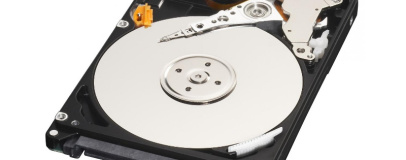
The market for traditional mechanical drives, while massive, is shrinking, with one market watcher predicting a near-12 per cent drop in revenue for 2013.
The global market for traditional spinning-platter hard disk drives is set to take a massive slump this year, with industry analysts pointing to a double-digit drop in revenue.
According to a report from industry watcher
IHS iSuppli, the hard drive market's revenue for the year will drop 11.8 per cent to a still pretty sizeable $32.7 billion, compared to $37.1 billion in the last financial year. Things won't get much better the year after, with iSuppli predicting a slight slip to $32 billion for 2014.
The reasons for such a gloomy outlook? The growing domination of solid-state storage devices and the increasing interest in so-called 'post-PC' devices like tablets and smartphones. '
The HDD industry will face myriad challenges in 2013,'' claimed Fang Zhang, analyst for storage systems at IHS, of the report. '
Shipments for desktop PCs will slip this year, while notebook sales are under pressure as consumers continue to favour smartphones and tablets. The declining price of SSDs also will allow them to take away some share from conventional HDDs.'
It's worth pointing out that iSuppli isn't predicting the death of the mechanical hard drive, however: the company's report points out that spinning platters are still king of the hill when it comes to cost per gigabyte, and it's increasingly common to see original equipment manufacturers (OEMs) and original design manufacturers (ODMs) exploit that fact by pairing a spinning disk with an SSD or using hybrid drives, even in ultra-slim devices like the current crop of Intel Ultrabooks.
While sales may be slipping at the cheaper end of the consumer market, where buyers are increasingly turning to tablets for their computing needs rather than upgrading their ageing laptops or desktops, iSuppli's report claims that enterprise use - in particular for cloud storage systems and 'big data' server farms - is only set to grow, being a market where solid-state disks would be cost prohibitive for the capacity required.
As a final prediction that should surprise no-one, iSuppli points to a potential end to the optical drive. As the world increasingly looks to the internet for distribution of software, video and audio, the optical drive - and, as HMV has discovered to its cost, the weekly journey to the shops to check out the new releases - is looking under increasing threat. As new ultra-compact form factors - like the aforementioned Ultrabook and Intel's Next Unit of Computing (NUC) desktop design - push the drive out as an external component, it's likely that fewer consumers will feel the pinch of its absence.
For consumers, the news of a slowing hard drive market is a mixed bag: iSuppli predicts prices could slip by as much as seven per cent over the coming year, meaning cheaper storage for all - but tighter revenues will lead to reduced research and development spending at the major manufacturers along with 'inventory adjustments' that may see production slowed to keep prices artificially high.

43 Comments
Discuss in the forums Replyfluffy white clouds above our head. no HDDs required.
The workfiles from the last 10 years take up some 20GB (PSD, HTML, AI, JPG, etc), my MP3-files use some 60GB, and I'm not collecting much movies, maybe some 4-500GB of series and movies.
A 1 TB NAS (backup) + 32 GB (workfiles) and 64 GB (music) USB-stick is all I need really to store and backup my files :p
True. But, where as before 5 users would have 5 hard drives, with cloud storage 5 users could share a single cloud hard drive. Its a more efficient use of a single disk.
As for R&D on hard drives, I say screw it. Lets just move to SSDs make em big and cheap. Hard drives will eventually go the way of the dodo.
This.
My retailer of choice sold 1TB Spinpoint for 44,90 EUR just before the floods.
Now the cheapest comparable drive goes for 81,00 EUR. Plenty of headroom to drop prices.
I do know I'd get better EUR/GB ratio from bigger drives, though. Still gonna sit tight and wait for prices to drop.
Where that isn't the case is in mobile, where cloud storage is used instead of local storage - as with Google Music - but for desktops and laptops, the increasing popularity of cloud storage means more hard drive sales (the hard drive each user has anyway, plus a smaller number of larger hard drives for the datacentre) rather than fewer.
2TB for £46? jesus how did i miss that!
oops I forgot about the local storage aspect of the cloud
They have come down quite a lot from their post-flood peak . But they're still at least 40 percent higher than before the flood.
but , hdd`s do need to drop in price - there`s no supply issues yet the prices are sky high , ergo punters wont buy them.
Exactly, I have been holding off on more drives to expand an array for a few years now. To save the money I just increased the amount of high compression 7z files to make more space. (for the type of files I store it can reduce space by >75%).
As I see the price of SSDs drop I am getting to a point where I might rather spend more to just get that b/c I know it is an actual value for my money. The HDD market will continue to feel like a ripoff to me until I see new low prices not simply a return to how they were 5 years ago.
As for optical drives, I expect they will die out at about the same rate as the HTPC and smart TV's catch on, slowed of course by the media industry's steadfast opposition to progress, think floppy drives but with anyone at all saying they should stay around.
How long does it take to press the ~50GB of information on a blueraydisk through your average cheap DSL-line?
Same goes for streaming media, sure you can watch movies online, but if you go for high-quality full HD your looking at ~5-10GB even when compressed.
The same goes for harddisks.
Remember the "Retina" display? resolutions are going to silly levels, levels that will require incredible amounts of data. Imagine a pixeldensity like that (or like the Nexus 10's) on a large screen.
We don't even film on these resolutions yet, but boy are movies going to become storage eaters.
Yes, but SSDs are governed by it, hence why magnetic media would need to match it to keep up.
Currently, a 2TB mechanical hard drive will cost you between £50 and £70. A 2TB SSD... Well, there aren't any on Google Shopping, so we'll go for two 1TB models at a cost of around £2,000 each. So, every two years the cost of the SSD halves while the hard drive - in our simplified projection - stays the same because the industry is greedy, lazy or both. In two years' time, the SSDs cost £2,000 in total while the hard drive still costs £50. In four, £1,000. In six, £500. In eight, £250. In ten, £125. In twelve, £62.50. In fourteen years, £31.25.
So, it takes nearly a decade and a half for the cost of the 2TBs of SSD storage to beat that of the mechanical drive - and that's assuming the spinning-platter manufacturers don't increase areal density again or find some other way of increasing capacity and decreasing costs in that time period, which is pretty unlikely.
So, do hard drive manufacturers need to worry about Moore's Law? No, not really. At least, not this decade.
(Also, nothing is 'governed' by Moore's Law. It's a historical observation, nothing more. Okay, it's a historical observation that has proven surprisingly enduring and accurate, but it's an observation nevertheless.)
I think when we get back from California it's going to be time to start working on a new NAS box.
I've got 4TB in my NAS and a 500GB secondary in my desktop, so I'm good for a while. Eventually I'd like to fill the NAS with 3TB or 4TB drives, but not anytime soon, apparently. It was announce way, way back that capacity is back up to pre-flood levels, so now they're just profit mongering. Screw 'em.
As to optical drives - the internal in my desktop now is my last. I'll pick up a cheap USB external at some point, but I'm long past the point of needing an internal drive. I burn backups rarely, and the last time I've used it in the past year was for DVDs that I hadn't gotten around to ripping or torrenting.
They are almost there though, I saw last week an ad for $59.99 1TB hitachis.
I concede that I misapplied Moor's law, but after a little poking about i came across Kryder's Law, described by one of the top-dogs at Seagate a few years back. Statistically speaking, magnetic storage technology has advances with the same exponential trend as transistor density, but faster.
Based on a statistical analysis I did for a paper in highschool, I'd venture to say the the industry is governed by Moore's Law, I don't have a digital copy of the paper anymore, so I don't recall the specifics, but I found that the correlation between flagship processors' transistor count and numbers projected by moor's law relative the the flagship processor when he made the first assertion, was over 99%. Any statistician will tell you that you don't see correlations that strong by chance. The entire industry had a formula with which they could estimate the performance level of their competitors next product, so the whole industry set their pace by it.
Just some food for thought.
Well if the industry was influenced by his prediction and they matched what he predicted then surely by any accounts its a self fulfilling prophecy. You can replace prophecy with prediction to make it seem less mystical or wizardy.
What makes moore's law special is not simply that his equation was accurate, it's special because of what that equation entails. No other sort of technology in the history of man kind has experienced such rapid growth for such a long time, and he made the prediction not too long into the life of the transistor. If cars had improved at a similar rate over the last 50 years, you could get a million miles to the gallon in a car you bought with loose change you found in the couch. If it weren't true, the prediction would have made him look like a babbling idiot.
Don't believe me? Here's a handy PDF of the article in which 'Moore's Law' was first codified. Far from being a prediction, or even an equation, here's the 'law' in full:
Moore does venture into the realm of prediction in that paragraph, but still in a very woolly manner - and phrased as "basically, nothing will change for the next decade, unless it does."
If you can find a 'formula' in that which shows '99 per cent' correlation to actual transistor counts, congratulations: a bright future awaits you in a council planning department.
Wow, people are being way more hostile to me lately than I think is reasonable. Maybe my memory is failing me and I actually did post a bunch of inflammatory remarks earlier.
I apologize for associating the man who the principle is named for with the slightly more specific connotations said principle.
I actually read the entire article where Moore's Law was first described years back when I was writing a paper on it, I just didn't take such a cynical view of the loose relationship between his statements and the popularized version of Moore's Law. Perhaps because it was not named that by a team of scheming Intel publicists; the term was coined by Carver Mead, Professor Emeritus at Caltech. Or, possibly because it has been called Moore's Law for a long time, everyone knows it by that name, and Dr. Moor is a great man and a pioneer of the industry.
I DID find a formula for 99 percent correlation, for a mandatory research paper in a high school statistics course. I codified the general form of the law (doubling every 2 years) and set its y-intercept to the transistor count of Intel's flagship processor in 1965. I then gathered data points from other flagship processors over the years to create a fit curve. I then used the Chi-squared distribution test (after shifting both equations to a logarithmic scale) to find the correlation coefficient between Moore's 1965 statement and the actual growth of technology since then. The result was an unnaturally high coefficient of 0.99....
I think I was 15 at the time. Currently I'm earning a degree in computer science and working as a web developer, IT rep, and programming consultant for research faculty; where I'm currently helping researchers in the bio-medical engineering department leverage GPGPU computing in one of their more time-consuming simulations.
I was planning on doing something with that in the future, but if you think my afternoon's work all those years ago means I should reconsider my plans, I have some serious thinking to do.
I was irritated already; you made some unfortunate choices while phrasing your post.
Forgiven and forgotten.
In turn this altered my brain to spend more wisely...
It's taken between the first floods and now to finish the burning and mass deletion of all my backups of the past six years, now I just try not to download so much junk to have that problem again.