Scythe has unveiled its latest CPU cooler, the Ashura, and it comes equipped with a new fan design it calls a 140 Hayabusa, with claims of cool running and near-silent operation.
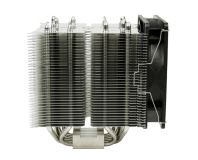
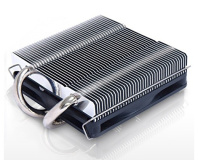
The heatsink itself is a relatively unsurprising design: based on a tower stack of thin aluminium fins connected to six 6mm heatpipes leading to a sizeable coldplate with a mirror-like finish. That plate is clamped to the processor through a newly-designed bridge-type retention bracket, which uses screws and a three-piece design to handle the weight of the hefty 750g cooler. At 145mm x 65mm and 161mm tall - with the fan adding an extra 25mm to the thickness - it's a pretty tall but narrow heatsink, and Scythe claims to have maximised compatibility by keeping the height below 200mm and raising the bottom of the fins to clear any heatsinks fitted to RAM modules.
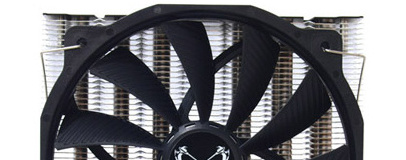
The fan, meanwhile, is a new design for Scythe dubbed the 140 Hayabusa - a Japanese word for the peregrine falcon, and used on everything from high-power motorcycle engines to a range of unmanned spacecraft developed by the Japan Aerospace Exploration Agency. In Scythe's case, the name is given to a pulse-width modulation (PWM) controlled 140mm fan which features large blades connected to a small central shaft to increase static pressure over similar-size rival fans. According to Scythe, the new design - which includes a slit in the blade to reduce air resistance and noise levels - offers 1.47 to 10.0 Pascals of static pressure and 37.37 to 97.18 cubic feet per minute of airflow at speeds of between 500 and 1,300 RPM with noise levels measured at 13dBA to 30.7dBA.
Compatible with the whole range of Intel and AMD sockets, the cooler is supplied with a single 140 Hayabusa fan but supports two 120mm to 140mm fans mounted in a push-pull configuration thanks toa redesigned and stronger wire fan retaining clip design.
UK pricing has yet to be confirmed for the Scythe Asura, with the company claiming a $55 US recommended retail price (around £35 excluding taxes.) More details and images are available on the company's
official website.










Want to comment? Please log in.