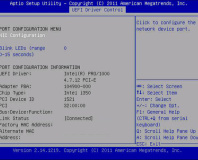
Selected Samsung laptops are being killed thanks to a faulty implementation of UEFI interacting badly with a Samsung-specific Linux kernel module.
Trying to load Linux on certain models of Samsung laptop could lead to permanent damage to the system, as an incompatibility between the company's implementation of UEFI and a specific kernel module has been uncovered.
According to an in-depth analysis of the flaw over on
The H Open, the problem was first noticed late last year when a Samsung laptop owner attempted to load Ubuntu 12.04 on his Samsung 530U3C laptop. Booting from a live USB installation - which, in theory, should make no modifications to the installed operating system - resulted in the system freezing, and a power cycle didn't resolve matters. Rather more seriously, even removing the USB stick didn't fix the problem - the system was well and truly dead.
The user returned his laptop to Samsung under warranty, and was given the unit back with a replaced motherboard. Assuming that it was a coincidental hardware failure, the user attempted to boot Ubuntu again - and once again trashed the hardware.
An official
Launchpad bug report for the flaw reveals multiple users all having the same problem: booting Ubuntu, and other Linux distributions, on selected recently-launched Samsung laptops results in a dead device. The flaw, kernel developers claim, comes from an interaction between the Unified Extensible Firmware Interface (UEFI) BIOS on the laptops and a Samsung-specific kernel module in Linux. When booting on a UEFI-enabled Samsung laptop, the module is loaded and proceeds to corrupt the system firmware - rendering the laptop little more than an oversized paperweight.
A temporary work-around has been introduced for inclusion in future versions of the Ubuntu Linux software, which detects the presence of UEFI on a Samsung laptop and disables the module. Samsung is also reportedly at work fixing the problem in their UEFI interface, planning to release a firmware update that will prevent the module from riding roughshod over the laptops' firmware. Linux kernel developers have also supplied patches for the module, one of which again deactivates the module in the presence of Samsung's UEFI implementation, but these have yet to be accepted and merged into the mainstream Linux kernel.
For now, users with recently-released Samsung laptops who want to play around with Linux would be well advised to do so in a virtual machine via the free
VMware Player,
VirtualBox or similar virtualisation package.

28 Comments
Discuss in the forums ReplyDoesn't matter how bigger are the profits for some of these companies, they are always cutting corners...
It's basically Anakin Skywalker that's become Darth Vader.
It's clearly on Linux fault and it only happens with a handful of Samsung laptops. It's not that all Samsung laptops were affected.
Seems a more appropriate title.
If it's sold as a windows machine, while it's the end users choice to install penguin of any flavour, it's not possible for them to test every permutation. It's not like they sold it as supporting Linux when it didn't - They sold the machines as windows machines, the user wanted something Samsung haven't (reasonably) tested, and it broke.
I think the take away from this is, sure it didn't work, but Samsung didn't fob the user off, and are instead working on a fix.
https://plus.google.com/111049168280159033135/posts/h7FjkQKZHKT
I thought it would come down to this.
You can kill all kinds of modern electronics by running bad code on them. It's certainly possible to brick most hard disks by sending them the right commands. Anything with firmware - which is effectively everything - can be destroyed in this way.
Much as the bug appears to be Samsung's, I just love the way the Linux people argue about how much they can be bothered to care. At some point in the Launchpad thread for this, someone called Kate Stewart apparently decides that it's "invalid" and of "undecided" importance.
Welcome to Linux! We will destroy your laptop, and then we'll claim it isn't really a problem after all, and we can't even work out whether we care or not.
So you say it's fine Samsung laptops have a bug which can easily kill your laptop with any OS ? Just because it is Linux where it has been found doesn't mean you won't have a virus later which will try to do exactly this thing.
There's a difference between a technically unsupported OS and malicious code.
As others on the forum have said, bad coding should not be allowed to kill the hardware upon which the OS is running; regardless of whether the OS is supported by the supplier of the computer or not.
A big minority? I don't think Samsung is to blame, as with most laptop manufacturers it recommends Windows. If loading Win8 bricked it then fair enough, but part of the risk with Linux is that you are relying on an open source community which doesn't provide the same support/warranty as Windows for example.
If it was to brick them (ie kill the hardware) I would not be able to get samsung or any other manufacturer to fix it. They would tell me I loaded a custom OS they did not.
Well done for samsung at least looking to address the issue.
Sent on my CM10 JB powered i9100 by TapaTalk 2
It shouldn't be possible to damage hardware by simply writing to the wrong memory locations. Don't play the incompetent developers argument; it's a core principle of hardware design. Sometimes stuff throws out invalid data; sometimes that might end up going to a part of the operating system. At worst, this should end up with a system crash.
It's irritating that this seems to be both the fault of Samsung and the interfering Linux module.
What to say any of the many Linux based tools wouldn't do the same, I'm thinking drive imaging software like Acronis, Macrium, Etc.
Like others have said there should be some safe guards in place not to allow this to happen, you cant write a incompatible BIOS file to a ROM unless you go to a lot of trouble for example.
I'm interested in knowing exactly how the laptops were bricked - did the flaw simply corrupt the chip storing the system board's UEFI code, or did it cause physical hardware damage? The former is easily fixable with a firmware update, the latter would point to a very serious hardware flaw that could potentially be exploited by malware.
Article said that Samsung replaced the motherboard. I'm assuming if it just needed a BIOS reflash they would have done that instead, but no telling anymore. It may well be that a new motherboard costs less than a technician's time to actually diagnose the problem.
When they say they replaced the motherboard, it doesn't mean they threw the old one out.
For the end user, replacing the motherboard is the easiest option; for Samsung, they can take out the chips that work and use them to make a new motherboard, or since they know the problem (some of the flash memory onboard) they could just remove those chips and replace with new ones. It wouldn't be done in the same step, because that'd take ages, the motherboard would have to be returned to the factory and posted back, it would just be a logistical nightmare.
I thought the same at first.
Ok, couldn't resist.