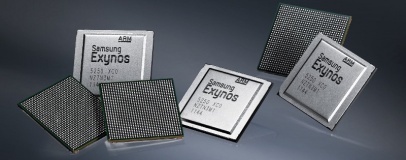
Samsung's Exynos 5 Octa packs two quad-core processors into next-generation smartphones and tablets for a serious efficiency boost.
In an announcement sure to take some of the shine off Nvidia's Tegra 4 unveiling, Samsung has announced the latest iteration of its own Exynos ARM-based system-on-chip processor - and this one boasts eight processing cores.
Dubbed the Samsung Exynos 5 Octa, the new chip isn't strictly speaking an eight-core processor: instead, it's an implementation of ARM's big.LITTLE concept which pairs low-performance but low-power cores with high-performance high-power cores, theoretically allowing system designers the best of both worlds. Whereas prior implementations have been limited to a single companion core - as with Nvidia's Tegra 3 and Tegra 4 processors - Samsung's version packs four of each.
The main part of the processor is constructed from four ARM Cortex-A15 cores, the same IP as featured in Nvidia's Tegra 4 chip. These processors are joined by a second cluster of four Cortex-A7 cores, which can take over undemanding background tasks such as managing network traffic, playing audio or handling the modem in a smartphone. The result, Samsung claims, is a hybrid device that can maximise battery life while also providing on-demand power to meet or exceed that of its rivals.
'
We believe the right component DNA drives the discovery of what's possible,' Stephen Woo, president of Samsung's LSI (Large-Scale Integration) Device Solutions division, told attendees at the Consumer Electronics Show unveiling. '
Components are building blocks—the foundations on which devices are built. We at Samsung's component solutions are creating new, game-changing components across all aspects of devices. The new Exynos 5 Octa introduces a whole new concept in processing architecture [...] designed for high-end smartphones and tablets.'
Formal performance figures for the Exynos 5 Octa have not been released by the company, but Samsung did claim that the use of ARM's big.LITTLE architecture means the dual-processor quad-core system-on-chip design offers around 70 per cent better energy efficiency than the current Exynos 4 4412 quad-core design.
Some of that improvement will come as a result of a process shift: the Exynos 5 Octa will be Samsung's first ARM SoC to be produced on a 28nm lithographic process, a node down from the 32nm process used for the Exynos 4 family and Exynos 5 Dual chip. Full specifications of the device have yet to be released, but ARM has confirmed that Samsung's big.LITTLE implementation sees the four Cortex-A15 cores running at 1.8GHz and the Cortex-A7 cores running at 1.2GHz. The graphics processor chosen for the system has not yet been announced, but is likely to be the same ARM Mali-T604 quad-core GPU as featured in the Exynos 5 Dual, with the two chips also likely to share the same 32-bit dual-channel 800MHz memory controller with its DDR3 and LPDDR3 memory support and peak 12.8GB/s bandwidth.
What Samsung has not yet revealed is when the first devices running the Exynos 5 Octa will be available on the market, nor at what cost.

17 Comments
Discuss in the forums ReplySave the die area and make the high power chip better.
Hurry up and go to sleep.
You probably don't... a tablet on the other hand...
Very few of them have any usage for that proccessing power.
The screens require GPU grunt not cpu cores.
Also seems like Samsung intends to drop the tegra platform which is a bit of a shock. but not a huge surprise in the long term as they can develop there own chip to keep pace with the competition and not need to be at the mercy of nvidia and company.
Can not see samsung developing this chip then not using it so i guess Nvidia just lost a huge contract for chips. Tegra 4 looks like been left to fight for the lesser rivals who don't sell enough and are all struggling to stay in business.
Also a big loss for qualcomm who have developed there next gen chip. ( samsung used both qualcomm and nvidia chips in last gen phones )
Samsung and Apple together are showing the power of dominating the profits for so long they have both effectively removed the need for outsourcing there cpu designs. Which will give them another advantage above the competition.
For those arguing that a smartphone doesn't need eight cores: did you see the bit of the article where Samsung claimed the Exynos 5 Octo offers 70 per cent better energy efficiency than the quad-core Exynos 4?
So imho it would be far better to concentrate on single-core performance and increase GPU-performance along with it.
More =! better in some cases.
If you read the article it says that there would be a 70% increase in efficiency. Sure, more cores doesn't always mean better performance, but a single core isn't enough, as it would have to take care of all background tasks and the more prominent ones like gaming.
The same reason my amp goes to 11, so I can lord it over everyone else who's amp only goes to 10
Except that devices with multi window support happen to be from Samsung.
Besides, calling it an 8 core cpu is very misleading, just like we abandoned the concept of single core processors we will abandon the current approach to multiple cores, what Samsung is doing is creating 4 cores of one type and 4 of another, its the next big revolution in cpu design, have different cores so you can run each thread on the type of cpu ideally suited for it, in theory at least, because software will need to catch up.
+1 from me - currently mobile OS's are not making the most of multicore processing.
I'd counter that by saying that multicore is the future, it is, in fact the OS and software that needs to become multithread and core affinity friendly (use different cores for different apps intelligently and use all cores for one app when the demand requires it.... google/linux it's over to you, but if Microsoft do it first and do it right, they could win market share quite easily.
EVERYBODY buys phones and if one trumps the other with 'MOAR CORES!' a lot will buy just for that.
However, I will direct you to the Google Chromebook which uses the old Samsung Exynos processor. Arm is actually making a little (read minute) headway in the notebook market. I am considering buying one and putting Arch on it because it outperforms an Atom extremely cheaply.
It only uses 4 of the cores at once. There are 4 really fast but less efficient cores, and 4 slower but *much* more efficient cores. Most of the time, the 4 fast cores are completely switched off, and everything runs on the slow cores. Then, when the OS notices that the slow cores are struggling to keep up, it moves the program to the faster cores in less than 20us. It's explained in the Samsung CES video, and there's a demo from 24:10 onwards
http://www.youtube.com/watch?v=GDJ67df0p6A#t=23m10