Facebook voters have told Razer to stick high-end Intel CPUs and mid-range discrete graphics into the Project Fiona tablet, and to hell with portability.
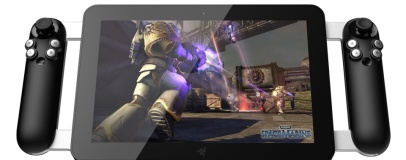
Razer's Project Fiona gaming tablet - originally unveiled
back in January as a design prototype and then
given the green light for production thanks to Facebook demand - now has a target set of specifications.
While Razer had settled on the rough design of the tablet, which packs a 10.1in display into a strange bondage outfit that clips it to a pair of analogue controller sticks with buttons and triggers, it had made no firm decision on the hardware that would be contained therein. Following the overwhelming interest from its Facebook fans as to the creation of the Razer, the company turned to its audience to firm up the internals - and the message is clear: the Razer needs to be the most powerful tablet around if it is to succeed.
Given a choice of various options, from low-end battery-friendly parts to top-of-the-range hardware, voters settled on putting an Intel Core i5 or - better yet - Core i7 processor into the device along with mid-range discrete graphics hardware. As a result, the Fiona tablet should rival mid-priced gaming laptops for performance.
There are trade-offs to be made here, of course: by voting for the high-performance hardware option, fans have told Razer that the weight and size of the device are less important. As a result, the Fiona will be significantly less portable than originally anticipated with the vote settling on allowing it to be around twice the thickness and weight of Apple's iPad in order to make room for the hardware and a battery that might last for more than ten minutes at a time.
The controller pads must be detachable for when you're using the tablet as a tablet, the voters stated - although there's no word that Razer will make them compatible with other 10.1in tablet devices - and pricing should be set somewhere at around $1,300 to $1,500 (around £806 to £930 excluding taxes) - higher than the original target price of $1,000 set at the start of the project.
With the hardware target set, a price point in mind and the first prototype devices already passing through the US Federal Communications Commission (FCC) certification process, all that remains is for Razer to set a launch date - and for the armchair hardware designers to translate their Facebook Likes into firm orders.

15 Comments
Discuss in the forums ReplyIt'll probably be a lovely toy but PC hardware heat and power requirements is going to mean it'll be too big, drain too much juice from the cells and cost a LOT.
But I assume Razor know this so hopefully they'll have sourced a production run that will allow them to make money on small volume sales. It'll be a shame to see the product tank because Razor are relying on them selling them by the truckload.
i would say most that voted have rigs already and would rather buy a new GPU than that.
Based on the expected prices it could run on something like this
i7 3630qm
8gb of ram
120gb mSATA
and something like a GTX660M - 675M or AMD equivalent.
Windows 8 (non RT)
Hopefully it's something more pedestrian than that. I've got a similar setup (i7 2720qm, 16gb ram, 120gb ssd, GT555M) and I'd be lucky to get 45 minutes of gaming on a 9-cell battery. For a tablet device that's pretty much unacceptable, especially when you consider that you'll probably get a 4-cell at most.
If Razer have any sense they'll wait for Haswell and it's greatly improved integrated graphics, which should match up reasonably well against low-midrange discrete laptop cards. As long as they don't go crazy with the screen resolution it should be fine for most games.
I am perfectly fine with this. It is an excellent development, and has immediately put it above the hordes of ARM-based tablets with anaemic GPUs and no compatibility with your existing games.
As is I just think people don't understand the demands of hardware like in terms of power consumption. Power means heat too and plenty of people already bitch about that with laptops. I would love this to be successful but I'm sceptical...
I'd buy one.
Sent from my GT-I9300 using Tapatalk 2
just like real life then.
Backpack containing a Temjin TJ11 with water cooled i7 and 690's
Powered by a discrete yet long lasting diesel generator
BOOM
Done.
Proper mobility gaming, accept nothing less, untill that is hardware companys just start being honest with themselves and admit the technology isnt there yet to provide the powerful mobile gaming we would all like and stop trying to sell us **** WE DONT NEED.
Imagine the whole laptop market. Now imagine how few 'gaming laptops' are sold. Imagine maybe 1% of that piece of the market. Razer will be lucky if they get that much.
The consumer market doesn't seem to understand that powerful hardware = high battery drain. Core i7? Seriously?