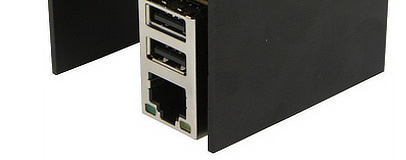
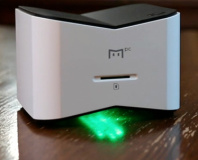
The ODROID-U2 is the world's smallest quad-core ARM board, but its heatsink gives it a surprisingly cubic design.
Korean compact computing specialist Hardkernel has formally announced its next-generation ARM products: the ultra-compact ODROID-U2 and the extremely expandable ODROID-X2.
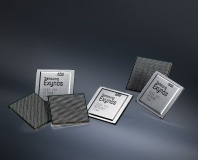
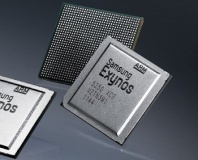
Designed for the same market as the popular Raspberry Pi, both ODROID products have one thing in common: performance. Rather than the outdated and slow ARMv6 processors found in most low-cost development boards, Hardkernel has opted to use Samsung's Exynos 4412 quad-core chip as found in the Galaxy S3 smartphone and the Exynos 4412 Prime variant. The result is pair of boards boasting a Cortex-A9-class processor with four cores running at 1.7GHz, 2GB of memory and a svelte design that makes the Raspberry Pi look positively porky.
The ODROID-U2 is designed to appeal to those with a need for compact computing: the board measures just 48mm x 52mm, or around half that of the already-small Raspberry Pi. Despite this, is manages to include the full-fat quad-core processor, 2GB of RAM, a 10/100 Ethernet connector and a pair of USB ports, along with a micro-HDMI connector and a micro-SD card slot.
For those who need more connectivity, the larger - 90mm x 94mm - ODROID-X2 uses the same processor and memory as its smaller equivalent, but includes six full-speed USB 2.0 ports and a full-size SD card slot.Both models include holes for mounting screws - something the Raspberry Pi only received in a recent board revision.
There are, of course, sacrifices: both the ODROID-U2 and the ODROID-X2 require a large heatsink which, while passive, increases the height of the system beyond that of any other development board on the market today. It's also impossible to power either through the micro-USB port, with both needing a separate 5V power adapter capable of providing a full 2A of current - suggesting a peak power draw of 10W.
For those who find footprint, rather than volume, important, the ODROID-U2 could prove a popular alternative to the Raspberry Pi - and its more powerful processor, based on the ARMv7 instruction set, provides out-of-the-box compatibility with Android and most Linux distributions. That power does come at a price, however: while the Raspberry Pi's official retail price is set at $35 - around £30 including VAT from most UK retailers - the ODROID-U2 costs $69 while the larger ODROID-X2 costs $135 (around £43 and £84 each, excluding taxes.)
The ODROID-U2 launches on the 21st of December, with the ODROID-X2 launching on the 10th of December. More details are available on the
Hardkernel website.

20 Comments
Discuss in the forums ReplyThey easily run PS2 emulators and the like - I'd imagine the quads are even more impressive.
I started dreaming of removing my car stereo and installing a touch screen with linux or android. (dunno what i would do about the audio connectivity but i am sure something would allow me to sort it:D).
I can imagine this thing to affect all sorts of areas, like xmbc boxes, in car audio, etc.
An xmbc box hidden behind the tv.
A second pc inside my tower for android development:D the uses for this would be just amazing:D.
Can wait for this to be out:D, and spend a good few hundred quid in extras with it.
I'll dig out the link when I get home.
If you want homebrew but need a touch-screen, either buy a USB HID touchscreen - which will work out-of-the-box under Linux - or think about Olimex's OLinuXino, which has a 7in touch-screen available as an optional extra. You'll pay for it, though: the OLinuXino is £63-ish and the touchscreen another £40-50 or so.
That said, they're still damned impressive pieces of kit.
P.S I didn't know they made the cheap ones with capacitive screens now. I'll be ordering this on pay day now, so again, thank you !
Sure, a board designer can go ahead and add in a third-party SATA controller, but they still have to connect it to the SoC - and many SoCs don't have any kind of high-bandwidth bus that would make SATA worth it over just using USB in the first place. Some do: the Marvell Sheevaplug eSATA, which uses a Ferroceon SoC design, has a single eSATA port on it. Adding that in costs some serious dosh, though: the Sheevaplug eSATA costs about £97 excluding VAT.
http://cubieboard.org/2012/11/15/unboxing-of-cubieboard-prototype/
It looks to be $59 and has a single SATA socket, and will self power a 2.5" drive.
It's an intriguing development, but like a lot of these other boards doesn't have
a strong community behind it.
On that front, the Raspberry Pi is way and beyond the competition in terms of support and community.
That's my take on it just now; waiting for the dust to settle a bit to see what to dabble with.
This is exactly my concern with it. While there's a lot of support out there for armhf/armel in terms of distros, there's little support in the way of graphics acceleration for X11 - particularly for the Mali-400 GPU, so beloved of cheaper SBC/SoC implementations. Though at least with the Odroid-U2/X2 that quad-core 1.7GHz chip does rather compensate somewhat...
The cubieboard also has a hell of a lot going for it, especially at a price point that almost matches the Raspberry Pi.
Im expecting my cubieboard next week, hopefully it will do great and replace my raspberry pi HTPC + torrent downloader. (have other plans for my pi regarding some home automation stuffs)
Please keep us updated! I am super intrigued by all these wonderfully efficient ARM boards.