Sapphire is branching its Vapor-X technology out from graphics cards and into CPUs, offering a heatsink capable of dissipating a claimed 200W of heat.
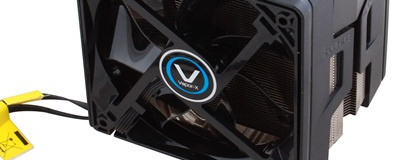
Sapphire has announced that it is to bring its Vapor-X cooling technology, used on the company's graphics card products, to CPUs with the launch of the imaginatively named Sapphire Vapor-X CPU Cooler.
Shrouded in black plastic and featuring a version of the company's Dual-X dual-fan design in a push-pull configuration, the Vapor-X CPU Cooler can dissipate a claimed 200W of heat - enough for even the meatiest processor, the company claims. A universal mount provides compatibility with all current AMD and Intel sockets.
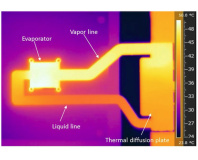
Sapphire's Vapor Chamber technology is, the company
explains, based on technology originally developed for high-end servers and aerospace applications. Similar in principle to heatpipes, the system works by holding a reservoir of liquid coolant inside a metal block. This block is placed in contact with the item to be cooled - previously a GPU, now a CPU - and the heat causes the coolant to vaporise. The vapour then rises, hits the cooler upper surface, and condenses back to a liquid - falling back to the base of the reservoir for the process to begin again.
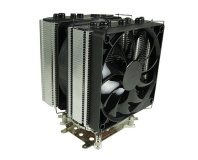
Measuring 135mm x 110.4mm x 163.5mm, the cooler features a vapor chamber in direct contact with the CPU and four 7mm heatpipes leading to aluminium fins. There's certainly plenty of metal in there, too, with Sapphire's cooler coming in at a hefty 925g in weight. The two 120mm fans provide a claimed 77 cubic feet per minute (CFM) airflow at their maximum 2,200RPM speed, and can drop to 495RPM under pulse-width modulation (PWM) control. At full throttle, the fans hit a claimed noise level of 40dBA. Built-in blue LEDs provide some bling for those with a windowed case.
The heatsink's size means it should fit in most standard ATX cases, while its width has been kept to a minimum in order not to foul RAM sockets on most motherboards - with particular attention to Intel's enthusiast-level LGA 2011 socket, which has RAM slots on either side.
'
Sapphire is extending its portfolio into areas aligned to its core business of PC graphics,' claimed Adrian Thompson, vice president of marketing at Sapphire, of the launch. '
We are harnessing our expertise in advanced technologies to deliver better performing products for the enthusiast which will then push down into an expanding product line for the mainstream.'
The Sapphire Vapor-X CPU Cooler is available now, priced at around £60.

19 Comments
Discuss in the forums Replyhttp://www.overclockers.co.uk/showproduct.php?prodid=HS-000-SP
To think google have been spending a fortune on elaborate server cooling for all this time when all they needed were some pins!
You should email them RIGHT NOW with your theory.
It's funny everytime I see comments like yours. You think you know but you don't.
This is simple physics... claiming 200W heat dissipation is meaningless if no temperature difference is given. It's just a way of advertising for the company. I would hesitate buy such a product if I see these misleading ad numbers.
What truely matters for a cooler is the C/W ratings, as should be used by all cooling enginners. Anything can dissipate 200W, @Bakes is right. The stock cooler can dissipate 200W of power when it's 30C higher than ambient while a high performance cooler dissipates the same amount with maybe only 10C higher than ambient. When you compare 0.15C/W with 0.05C/W, you know which is better.
Sapphire engineerers know this. But their marketing department do not care.. They will just throw out a numbe .... 200W, sounds plenty, Ha!
What Bakes said is physically accurate. Newton's Law of Cooling says that heat transfer is directly proportional to both surface area and temperature difference. If you make either one of these values large enough, it compensates for the other.
Only if its linear
I figured you would have dropped this. Newton's Law of Cooling applies to the lumped capacitance model of thermal bodies where temperature remains at a constant temperature inside both bodies. This improves the rate of heatflow since the gradient is so narrow. For small or metalic objects, it's a good approximation, for air, not so much since the thermal conductivity sucks. But even when you factor this in, you wind up with a temperature curve that looks like 1-e^-x with some constants to scale the amplitude so that x=0 produces the temperature of the heatsink and another to determine the half life.... but even this is linear since the derivative at x=0 is proportional to the temperature.
I've already determined that it's linear so I could stop this right now, but it's actually better than that. If you get really, really hot, well above what semiconductors can survive at, maybe 500-1000C depending on geometry, the warm air will have significantly less density than cool air, convection has now become a major force.... In practice, it reduces the size of this half life and thus makes the derivative at the boundary x=0 larger, thus more heat flow.
You then have blackbody radiation, which is proportional to 1/(e^(1/x) - 1), this curve starts out less than linear and it's one of the least efficient modes of heat transfer, but it accelerates slowly.
Shh you. Even if we completely ignore Newton and just stick the pinhead computer in space, by the time we reach 10000C it's emitting about 500W in black body radiation alone. If you can make your components survive temperatures of 10000C, then by all means attach a pinhead for cooling purposes, because it'll get the job done.
In all seriousness though: what if sapphire actually, against all odds, took the number 200W as it's "normal" mode of operation and performance as compared to the competition? (like keeping a 3960X at 50C while it is OC-d to 4,5GHz or whatever) One can hope. :)
In other words: yes, a pin head could dissipate 200W of heat - but not without raising the CPU temperature to a level at which it stops operating. The Vapor-X CPU - and any other cooling system that says "can dissipate XW" - by contrast can.
If anything, this heatsink has arguably missed the bus by going the 120mm route; the very best air coolers are all 140mm and it's unlikely that a 120mm heatsink will be able to compete, whether it uses vapourisation or not.
EDIT: the "dense aluminium fin stack" is also a bit of a step backwards... all it means is that the cooler will need powerful fans for optimal performance (or, conversely, that it will fail dismally when furnished with quiet fans).
EDIT 2: The American spelling of Vapour is really bugging me. :D
Yes, it's all you've got, but it's a totally useless piece of information, because it tells us nothing about the quality of the cooler. For example, a standard 3770k will throw out about 77W when not overclocked; basic electronics tells us that if at 5GHz with a fairly dramatic 1.45V vCore it will be sticking out about 148W - which is enough for an Artic Cooling Freezer 7 Pro v2, which is rated at 150W (sorry, didn't mean 200w in the previous post).
Would you want to run those settings with a Freezer 7 Pro? Probably not.
All the numbers are saying is that what they've come up with is at least a viable CPU cooler. < Not interesting info.
There's not really any point attempting to quantify it/buying into the marketing info; the information means nothing, because any modern processor would be running at obscene speeds before it would actually release that much heat (I may be overlooking some of the Sandy Bridge-E parts here). < my point