A leaked slide deck has provided hints as to Intel's plans for low-power system-on-chip processors over the coming years, as the company seeks to beat Cambridge-based low-power chip giant ARM at its own game.
According to slides obtained by smartphone specialist site
Mobile Geeks, Intel is planning to upgrade its current-generation dual-core Atom system-on-chip design with a quad-core part some time in 2014. Built on a 22nm process, the quad-core Atom is based on the Bay Trail-T core and is currently codenamed Valleyview-T - the suffix standing, it would appear, for Tablet.
According to the slides, on which Intel is refusing to comment, the Valleyview-T system-on-chip packs four Bay Trail-T cores and is designed to take over from the dual-core 32nm Clover Trail platform for tablet devices. Despite dropping Hyper Threading support, meaning the chip is capable of running the same four simultaneous threads as the dual-core Cloverview, the processor is claimed to draw around half the power for the same level of performance while scaling to an overall performance improvement of 50 per cent or more.
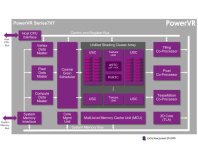
The chip includes support for low-power DDR3 (LPDDR3,) something missing from the LPDDR2-based Cloverview design, with a 64-bit data bus width offering up to 17GB/s throughput to Cloverview's 8.5Gb/s peak figures. The Imagination PowerVR SGX545 from Cloverview has also been ditched, with Intel 'dogfooding' its own seventh-generation Intel HD graphics processor for a claimed three-fold performance boost. As a result, high-resolution displays - like the one found in Google's ARM-powered Nexus 10 tablet - are supported, with both MIPI-DSI and eDP connections providing 2560x1600 support alongside an in-chip HDMI 1.4 connection.
Additional features in Bay Trail-T include lower power draw leading to a claimed 11 hour video playback battery life in Intel's reference platform, a new microarchitecture with full out-of-order execution (OoOE) support, DirectX 11 support under Windows, and new security features for the platform.
Intel, naturally, has refused to comment on unannounced products, but while Bay Trail-T sounds like an extremely impressive chip it could prove too little too late: ARM's multitudinous licensees are already shipping quad-core parts, and with the slides pointing to a 2014 release timescale for Bay Trail-T the company could find itself playing catch-up once more.









Want to comment? Please log in.