Intel's newest Core i7 Extreme Edition, the i7-3970X, boasts a 3.5GHz stock clock reaching 4GHz under Turbo Boost conditions.
Intel has kept to its promise of a mid-November launch date for its latest 'Extreme' enthusiast chip, revealing details of the Core i7-3970X processor which it hopes will be tempting those with money to burn.
Sitting in the Intel Core i7 Extreme Edition family of LGA2011 chips, the Core i7-3970X - officially launched earlier this week, bang on schedule - boasts six cores running at 3.5GHz with a Turbo Boost speed of 4GHz. The 64-bit chip features Hyper Threading for executing up to 12 simultaneous threads, packs 15MB of L3 cache alongside 256KB of L2 cache and 32KB each of instruction and data caches for each processor module.
As an Extreme Edition, the chip boasts an unlocked clock multiplier, allowing those who don't mind risking a processor that costs more than most people's entire computers to easily overclock the chip from its stock 35x setting. Those doing so, however, would be advised to watch its temperature: the hex-core chip features an eye-watering 150W thermal design profile (TDP,) making it one of the hottest-running Intel chips on the market today.
Internally, the architecture of the Core i7-3970X may come as a disappointment: rather than the latest Ivy Bridge design, the chip is based on the previous-generation Sandy Bridge platform. As a result, it's lacking some of the performance improvements enjoyed by Ivy Bridge parts, and its 32nm processor size may be contributing to its impressive heat output.
Nevertheless, Intel is positioning the chip as an upgrade for those running the Core i7-3960X chip, offering 200MHz faster stock clock and 100MHz faster Turbo Boost speed, but at a cost of 20W extra on the TDP.
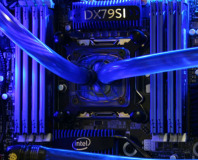
The chip also comes with a new motherboard platform, the Intel Extreme Series Desktop Board DX79SR. Codenamed 'Stormville,' the board includes room for eight memory modules for up to 64GB of system RAM, three PCI Express 3.0 x16 slots with support for Nvidia's SLI and AMD's CrossFireX technology, and various features designed to appeal to overclockers.
With the chips now available in the channel, retail pricing is confirmed at the £800-£830 mark depending on your chosen supplier, with the Stormville board coming in at around £230-£250.

22 Comments
Discuss in the forums ReplyHow???
I'm surprised that Intel aren't ditching the hex-core stuff as they already have something better?
Can you imagine the heat? You could probably mount a wok to it and start cooking your Thai green.
So I'd assume a straight hex core IV-E processor running at, say, 3.7Ghz and maybe 4.2Ghz max TC probably would run around 120w TDP. Going from 6 to 8 cores would up your TDP to 160w.
Ramp back the clock rate slightly, and you are probably at the same 150w TDP with 8 cores for an Ivy Bridge E model running around 3.4-3.5Ghz.
You could similarly get a 6 core chip with around 3.3Ghz clock speeds probably in the 110w TDP range.
Really, I am looking forward to Broadwell. I know Intel is pushing TDPs and general use power consumption lower and lower, which is a good thing, but I really hope with Broadwell, well finally see "mainstream" hexacore processors for desktops at least and octocore for higher end stuff.
Give me quad core ULV processors and hexacore enthusiast desktops (and maybe even a hexacore laptop 45-47w extreme part or something) with octocore high end parts and I'll be a happy, happy boy.
http://forums.bit-tech.net/showthread.php?t=222446&highlight=geekbench
Not sure why that would be. They got the very best at the time and are still very capable now. The socket was left due to intels tick tock strategy, introducing new sockets every couple of years to make way for new features.
3970X TDP = 150W
3770K TDP = 77W
2x 3770k TDP = 154W
154W minus the parts that don't need to be doubled up (graphics for example) = lower TDP than 3970X.
And the heat isn't really an issue, Ivy Bridge runs hot for two reasons, one: the tiny contact area between the die and the ihs, two: the crappy tim used by Intel.
The contact area would obviously scale pretty much linear with an increased number of cores and the crappy tim, well I'm sure Intel can find something better than what they use in the 3770K, so an eight core Ivy Bridge is far from impossible, there are other reasons why they won't release one.
I don't see Intel coming out with mainstream hex- or octa-core mainstream processors for quite a while - why should they bother? Multi-core processors have been around for what, 6-7 years now, and software still hasn't caught up. It's still not terribly common to see mainstream software where more than 2 cores makes a hell of a lot of difference. Toss in another 2 cores for OS processes, etc, and you've still got more processor than you need.
Workstations running professional software are different, obviously, but that's not what Intel's Extreme series are for, really, are they? They're pure e-peen.
I don't think so!!
Interestingly though (for me any way)... would a 3960X work in a Stormville board? @Bindi... Asus gonna do a top end Stormville board?
i'll have what his having...