Despite Intel using the company as a predictor for
ARM's allegedly inevitable demise, VIA has shown that it still has some fight left in it with the launch of what it claims is the world's smallest quad-core x86-architecture PC.
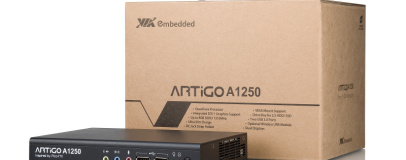
The VIA ARTiGO A1250 is based around the company's own low-power QuadCore E-Series processor family, unsurprisingly featuring a 64-bit quad-core 1GHz x86 processor and 1MB of L2 cache. Designed for home server, embedded, industrial, medical and even military usage, the system supports up to 8GB of DDR3 1,333MHz RAM and includes a VX11H media-system processor (MSP) to power VGA and HDMI video outputs. As well as high-resolution displays, the system supports 3D steroscopic monitors and projectors and can decode 1080p H.264, MPEG-2, VC-1 and WMV9 format video with nary a hitch.
As well as the two video outputs, the system includes a gigabit Ethernet port, two USB 3.0 and two USB 2.0 ports, line-in, line-out and microphone-in analogue audio jacks and a 12V DC power connector. A SATA port is included for storage, while Wi-Fi can be added with an optional upgrade pack. Operating systems including Windows Embedded Standard 7, Windows Embedded Standard 2009 and Linux are officially supported.
According to VIA, the entire system comes in at an average thermal design profile (TDP) of just 27W, which is impressive enough - but it's the size that is shocking: measuring just 17.7cm x 12.5cm x 3.0cm including case, the system is around 10 per cent smaller than the previous-generation ARTiGO A1150 it replaces.
Sadly, there's one piece of information VIA isn't yet sharing: the price. Although the company is keen to promote the device for home server use, its mentions of the industrial and embedded markets along with its certification of Windows Embedded Standard compatibility suggest that it may be pricing this model out of the reach of most home users.










Want to comment? Please log in.