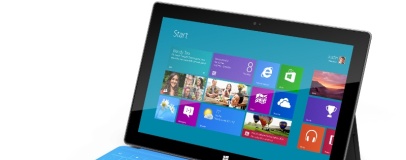
Microsoft's Surface tablets, which pack an ARM processor and the as-yet unproven Windows RT, will cost £498 when coupled with the Touch Cover keyboard accessory.
Microsoft has announced UK pricing for its first Surface device, the Windows RT-based ARM-powered entry-level model: £399.
At first glance, and taking into account the 10.6in display and capacious 32GB storage capacity, that seems like a pretty reasonable launch price. Sadly, Microsoft is trying to pull a fast one on consumers: while its launch announcements were full of talk of the clever Touch Cover - which combines a screen-protecting cover with a physical keyboard - that won't be included in the package.
Instead, buyers of the near-enough £400 tablet are being asked to spend £99 on the Touch Cover, which uses a pressure-sensitive membrane keyboard much like Sir Clive Sinclair chose for his £99 ZX80 and £79 ZX81 microcomputers at the start of the 80s. For those who can't imagine typing on a surface which fails to offer any kind of feedback - presumably people who haven't used a tablet's on-screen keyboard - there's also the Type Cover, a thicker unit which provides a small amount of movement to the keys, for £109.
So, assuming that you want the full Surface experience, you're looking at a minimum of £498 - a price which puts it above the cost of the £479 32GB iPad. While it's true that the iPad doesn't include a keyboard - meaning the Surface wins out - a keyboard case for the iPad can be had for under £12, bringing the comparative total to £491 for the iPad and £498 for the Surface.
With Apple easily leading the high-end tablet market, and Google's Android mopping up those on a tighter budget or looking for a more esoteric design, Microsoft's Surface is likely to struggle at launch. The inclusion of a cut-down version of Microsoft Office could help drive sales of the device in the enterprise, but with rumours spreading that an iOS version of Office is in the works that may not last long.
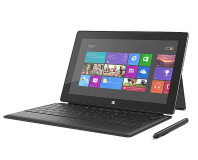
For others, Surface could be a hard sell. With Windows RT running on an ARM processor, the system isn't compatible with existing Windows applications and will have to work hard to build up the same kind of wide-ranging ecosystem of third-party developers as Android or iOS. Worse still, the Surface Pro tablets are due early next year and will bring a full-fat version of Windows 8 and backwards compatibility with existing x86 applications in a move which, depending on price, may kill off the ARM-based Surface models before they even have a chance to get started.
UK orders for the Surface with Windows RT are due to open on the 26th of October, alongside the launch of Windows 8.

59 Comments
Discuss in the forums ReplyThat's £899.99 for the full fat version but not sure it'll be the stand out leader.
I'll happily pick up a Surface RT to replace this iPad which should get to me on launch day.
The full fat version i would like to see do well to help reduce Apples lead on the sector, but im not sure if it will allow you to run standard windows programs off the net or will it force you to download programs through windows store and thus closing off the market.
On a different note, what x86 program's are people planning to running? Personally most things I can't get on rt wouldn't run on the hardware anyway.
They would, if you had a compiler for it. I use many of the programs listed on portableapps.com. Most of them are light enough, and if you had a windows compiler for ARM (or if you could have a MinGW for ARM), most programs could be ported, IMAO.
Everything about Microsoft Surface - Pre-order, price and design decision
Microsoft Surface thoughts?
Surface RT 32GB without cover - sold out today. You have to wait 3 weeks for delivery.
http://surface.microsoftstore.com/store/msstore/Content/pbpage.Surface?ESICaching=off&WT.mc_id=FY13WinHH
It's not overpriced. You have twice the RAM and storage capacity as the iPad, you have Office, you have XBox Music (free ad-supported streaming, or 10$ per month - unlimited download/streaming no ads), and if you add the Apple media card reader, Apples cover, and Apple keyboard to match the Surface RT 32GB features, you are spending way over about 140$ more than the RT, and you still don't have all the built-in apps, and a real full size USB port. Sure you don't have the screen resolution, but at 10inch the current resolution is sufficient, as it uses vector based graphic engine so everything is always smooth. You don't need higher/lower quality icon, and interface. Everything scales properly.
MS are at a major disadvantage being late to the party they're relying on there being enough people who haven't bought into Apple and willing to spend that kind of money or are willing to spend the same again to switch. Few of the Android tablets have managed to compete on spec and features with the iPad so it'll be interesting to see how MS do.
Also Apple may have just done a masterstroke and swept the rug out from under microsoft by announcing the iPad mini on the 23rd October. Microsoft were always going to struggle to force people away from iPads to their tablet so I think their main target would have been people who didnt like Android and didnt want to invest lots of money into an iPad, a cheap iPad mini gives them a very tempting alternative and so I think youll end up seeing the iPad mini selling like hotcakes and the surface only selling to people who must have microsoft outlook which I dont think will be a huge number of people.
Expect price drops quite soon after xmas
Not really. Because Microsoft has something that Android doesn't: the name "Windows". People associate "Windows", with ease of use, with "just like on my computer at home", with "plenty of programs", with "secure", I believe. Plus you mention that you have Office, and now people know "it has everything I need", and "I can do work on the go, like a laptop".
Apps will come and quickly. Why? Because all Modern UI apps works on BOTH Windows 8 and Windows RT, with no effort needed by the developer, due to the WinRT infrastructure set to them. So right now, you just widely expand the potential marketshare. Making a very tempting invitation, plus cheaper price than developing on iOS. Especially for developers as they get to use Visual Studio, the best development IDE there is, from what I am aware of.
So, I expect a lot of apps, and will quickly catch up to iPad. Plus consumers will love it more. Because your tablet apps, can be installed without additional fees on the desktop or their laptop.
So there are a lot of value for developers and consumers.
Obviously, I don't expect for Windows 8 to catch up the next year to Apple, that's impossible, but how many iOS apps are flash light, fart, some million's iteration of pong and other basic/classic games like that? A LOT of redundancy. Something that Microsoft has the edge of not having... at least not for now.
Apple is much bigger advantage, its synonymous with "just works" and fun, Windows on the other hand is synonymous with work and getting your son round to fix the computer. It might be getting better but a bad reputation like that takes a lot of work to repair.
The one advantage they might have is if Win8 gains some traction and people prefer to stick to one environment between their home computer and tablet. But since Intel are complaining that people are not buying as many computers as before it might be a while before the masses migrate to a modern Windows.
It will likely catch up but its not already there, Apple is. Unless you need or want a MS tablet why would you bother when the iPad already does what you probably need to do for the same price and Android is cheaper. Plus we've seen MS sink golden opportunities in the past.
Like I said it'll be interesting to see how they get on.
Sorry, I was unclear. I meant that most things I use that are currently x86 only would not run very well at all on tablet hardware. Games, handbrake, etc.
I see your point, but in my view, I don't see people seeing Android as you are seeing, including myself.
I don't have a cellphone, or a smart phone. I know shocking!
However I have been having peeks here and there and this is what I got from Android.
When people talk about Android to others or me, I hear a lot of jargon is passed, and mainly the word "rooting". To me at least, I see the Android platform, as a toy, basically a device for people that like their hands dirty. Always tweak this, tweak that, OC the phone, replace the OS, community Android this and that, that one is better for this and that, and that one is better for this and that. When it occurs, I just simply go in my head: "ENNNNNOOUUUGGTHH!!!! Already!". I love building and repairing computers, but when I am on the go, I don't have time for this ****. I just want to enjoy my device, the same why I enjoy my MP3 player. I don't care about any of this. I don't have the patience for this.
To be honest I have my eyes on the Windows Phone 8 right now. I don't plan to buy it though. I want to finish my study first, get a job, THEN at which point I'll actually make a decision.
I agree the surface isn't overpriced but don't agree you get twice the storage capacity. The three options are the same and they're banking on most people picking it up with a keyboard cover.
So in price iPad 3 = Surface + Cover. I think this was very wise of MS even if you're only getting a screen of comparable quality to an iPad 2.
Where do I start?
Office is great and might make a difference... certainly with the marketing. Xbox music sounds a bit like Spotify doesn't it, and maybe this time MS is going to do something in the music space and not abandon it two years later. Trouble is enterprise is going to (at first) want x86 compatibility or an extensive app market. RT has a very very long way to go before it will have the app support than an iPad can provide. And I'm talking pro apps here not just casual stuff like fruit ninja and bad piggies.
Most people don't buy smart covers, apple keyboards and card readers. So the value of having them 'included' looks good on paper but doesn't mean the same to all people.
As to screen resolution... oh my. Saying the elements of screen are vector based is completely irrelevant when comparing PPI levels. I thought the world now had a common understanding that unless you have particularly bad eyesight or a tolerance for extreme aliasing screens with high PPI ratings are significantly preferable to those with lower PPI.
It doesn't matter if the actual content of the pixels was generated from a raster bitmap or from a vector representation if the size of the pixels means small on screen elements can't be displayed in sufficient detail. Vector rendered images have some benefits (and some disadvantages) over raster stored images but negating the downsides to a screen with low PPI isn't one of them. iOS also renders some elements using vectors by the way but most standard onscreen assets other than text is pulled from pre-rendered raster images as it's faster and more forgiving on battery consumption. As an iOS developer I have to use rendered assets in a few compulsory places (EG the App icon) but for everything else I'm free to use vector images, and I do. But I don't use vectors for everything as that would be an insane waste of both my time and more importantly CPU / GPU cycles.
I would challenge anyone who tends to notice the difference between 'good' and 'bad' screens to spend time with a retina device compared to an equivalent non retina and not say they prefer the retina. I'd also do this test with the a new high PPI kindle over the older generations.
If everything else is equal, smaller pixels make for better images. End of.
The caveat of course is that if you really can't see or care for the difference between a ?x768 screen and ?x1536 screen (or equivalent) then you'll be fine with an RT table or an older generation iPad.
So in price iPad 3 = Surface + Cover. I think this was very wise of MS even if you're only getting a screen of comparable quality to an iPad 2.
[quote]
Actually the Surface RT without the cover is sold out already. Now you can only pre-order, for next batch, of the pre-order for this option.
Also, I see significantly more people with iPads covers, at least where I live, then third party. And again, you can buy it without the cover, and use a third party solution for the Surface, witch for sure will come.
You can't compare to the iPad 2 resolution is less than the Surface RT.
Spotify has a limited 14 million songs (based on their about page), while XBox Music has 30 million songs. Also, assuming you have a subscription on both, you can't download unlimited songs in Spotify for offline play. You can only make playlists and download those, which is getting complicated for nothing. Also, Spotify is only available in a few select country. Canada is not even in there. XBox Music is or will be available in 22 regions around the world.
If you want raster bitmap in action, simply boost the DPI in Windows, and see more than half of your program not scale properly. High-resolution icons needs to be done. For games it will be the same thing, you need to make higher (or lower, depending on where you initially start) textures, else it looks blocky and ugly.
Microsoft reply on screen resolution:
Call it crap statement, it does make sense. I saw the iPad retina display, and all I saw was this over-saturated IPS panel, and broken pixelated apps, and for teh rest that appeared correctly, I saw no difference. 0, none, nada, even when my eyes are close to the screen. This reminds me of OEMs that pack low end GPU's with 2, 3, 4, or even 5GB of RAM, to push sales, in trying to convince consumers that more memory is better, even if you had a 6 display setup to enjoy 5GB of of memory, the game will go at what? 1 fps. YAY! Another example, MegaPixel in camera. "Ohhhh but it has 500 MP", Ok so... does it take nice pictures? No! Because there is no image stabilization, or a crappy one, the lens is a joke, and the sensor is tiny.
If Apple spend money in an anti-glare glass surface for the iPad instead on a over the top resolution that provide no purposes, and break compatibility with most apps due to miss engineering of the OS, by not thinking of long term, then it would have been far better choice, and THEN it would have been, at least in my book, something important thing to consider
Classic! You can't compare two eco systems because one has thousands of different accessories and the other doesn't even have an eco system yet?
No need to shout sweetie.
I do know a little bit about developing for raster and vector based systems but I'm not about to compare CVs, and if you believe that it's less work to create a vector image that will scale nicely to any resolution compared to a raster image then you're right... but also wrong. It's not as simple as saying Vector > Bitmap. They're different and each has their advantages.
First up. If working with bitmaps you can generate those from vector sources. If working with vectors you can't easily create them from bitmaps.
Complicated images such as full colour icons with gradients etc will (on most systems) display with less CPU/GPU overhead if they are pulled from a bitmap rather than rendered on the fly. Alpha transparency can be a killer on some platforms.
If you want to adjust your image so that it looks optimal (and not just smaller / larger) on different PPI settings then you sometimes need to adjust the content of the image. For example an icon for a page of text may have 5 lines of text at 350ppi but only 3 lines at 72ppi. Easy with vector, a bit more complicated with vector.
LOL. Windows is crap at scaling assets as it wasn't designed to do this and the assets are low res to start with. OSX has it's HiDPI mode which when handled correctly by developers (Still unfortunately early days) works perfectly. Yes Apple and devs have to create multiple versions of files and OSX will pick the best one but the result is perfect and has a performance hit no matter how many assets onscreen, how complex or at what size.
You can get perfect results using vectors or bitmaps. Vectors are easier for some things, bitmaps are easier for others. Both will look identical if they are displaying the same pixels.
Shoddy assets look shoddy no matter what. Poor scaling choices are poor no matter what.
This is the same process everyone is already using on their premium devices that have been released since the manufacturing technique was perfected. Apple has it on the iPhone 5 & rMBP etc. I can confirm the rMBP does indeed have less reflections than older screens. It's great MS are using the latest tech, and I'm sure everyone will be doing this on their premium screens within the next 6/9 months.
So you couldn't see any difference between an iPad 2 screen and an iPad 3 screen and yet you could see when icons were horribly pixilated on an iPad 3? That doesn't make any sense at all! Either you can see a difference or you can't! You can't on one hand say the retina screens are identical to the lower res screens and simultaneously say than non-retina apps look awful on a retina screen.
It would be like saying you can see zero / nada difference between 1080p and 480p and then stating that 480p content doesn't look as good as 1080p.
I'm confused... and if it was someone else saying this I'd think they were trolling.
As to apps...
I haven't seen any "broken" apps on a retina iPad. 100% of standard assets are retina aware and I don't know of any app that hasn't been updated since the iPad 3 came out and hasn't been updated to retina. I bet there's some apps out there that haven't been touched in years though, so I'll concede a point.
Again I stand by my challenge. Anyone who can tell the difference between quality of screens will very quickly come to see a retina screen as 'normal' and a non retina as 'pixilated' when used for text based reading or work.
I think most people here on BT could tell the difference between a high PPI and a low PPI screen in the same way they'll be able to judge low FPS, poor antialisasing and screen tearing.
If you can't see a difference, or don't care about the difference, or are just on a big ol' anti Apple tirade then fine.
I think I'll stop now.
What they say about the screen:
As mentioned, I am comparing official accessories with official accessories.
As for "when handled correctly by developers ", that applies to Windows too. As most developers don't have high resolution monitor, or more like, as 99%, if not, 100% of their market share don't even touch the DPI settings in Windows, developers don't bother.
iPad 2:
http://www.helpweaver.com/ff_32.png
iPad 3:
http://www.helpweaver.com/ff_16.png
Couldn't that just be turned around on you as a "big ol' anti Microsoft tirade?
Apple on the other hand is basically everywhere you go, it's called building hype its what apple is good at.
Once the product is release, they'll get a letter form EU, and update the website.
I highly doubt they'll fight it.
German page has this :
This does not surprise me at all:
I think this is correct. And this doesn't surprise me. I mean:
-> Storage space mentioned is not what you get in real life, (like all SSD/HDD's that you buy)
-> You have Windows RT
-> Printer drivers, controller/joystick drivers (like the XBox controller) and any other drivers Microsoft wanted to provide via its USB port
-> You have Office which is big by itself
-> You have hibernation file (fast boot), and page file (so that you are not limited by RAM)
-> You have ALL the Windows 8 tools built-in Windows RT (Notepad, Firewall, Calculator, Disk Management, Paint, Resource monitor, task manager, event viewer, etc.)
-> All provided Metro apps.
-> Recovery for re-install without the need of any disk or other system.
So I don't see why anyone would be shocked.
Microsoft has now removed the FAQ entry. Too much info.
Personally I see the low res screen as the bigger issue.
You either have reduce performance, reduce battery life and a hot tablet (see iPad 3), or have what Microsoft picked, a reduced resolution. The Tegra 3 chip is a bit old in today's technology, so its not very powerful. Even the iPad 3 GPU is still not much, hence the hotness and reduce battery life.
We are close to exactly what we have on the desktop GPU. if you want a 2560x1440 monitor back in the GeForce 400 series days, you are looking at getting SLI setup, if you wanted a smooth gaming experience at max settings. But now you are balancing battery life and heat.
$899 for the Pro version, that doesn't sound bad at all.
I was expecting 1200$ product.
It beats most ultrabooks offering in build quality, display, and features. The only downside is the 1 USB 3.0, but a compromise that needed to be done for it's tablet form factor.
With it's mini-displayPort and built-in Bluetooth.. this system can easily be a desktop system, laptop, and tablet all in one.
So 4-5h, but at least the power adapter is small.
The Surface RT has 8h with wireless ON, browsing the web and playing music, at 50% volume, 200 nit brightness, based on TomHardware review.
http://www.tomshardware.com/reviews/surface-windows-rt-battery-life,3346.html
So half everything.
The second generation Surfacw Pro using Haswell might give us 8 hours. Then we have an all-round winner.
Exactly. Already it has a bigger/battery battery, so its not like Microsoft didn't try with the Surface Pro to alleviate the impact.
I don't think Haswell will boost that much battery life, maybe we will have a solid 7h.
MacBook Air - 64GB cost 999$
Surface Pro - 64GB cost 899$ + Type Cover (we will go fancy now) 120$ = 1019$.
Ok so let's have a deeper look:
-> MacBook Air needs Windows 8 for the same experience, so that's 140$. Now the MacBook Air is at: 1139$. So 120$ more.
-> No touch screen
-> Not a tablet
-> No digitize pen support, or any pen support for that mater.
Ok, the Surface Pro doesn't a backlit keyboard, but it has 2 web cams
The battery life is better?! Questionable. Windows 7 and much worse for Windows 8, Apple drive for BootCamp is complete utter crap. Specifically designed to break Windows experience to show how MacOS is better. If MacOS is so much better, Apple should not be doing these kind of tricks, as they should not be afraid of anything, and be proud of their product.
But lets assume longer battery life, the Surface Pro takes less time to recharge (assuming its close to the same as the Surface RT), and the power adapter is smaller, and it's bigger.
Could be, as it is CPU intensive task. I recall the reviewers were not specific at the time.
_____________
As for the Digitimes article: ah, more rumours. :)
If the Surface RT succeeds it will be almost despite the marketing department. Microsoft should be laying off some people there.
Same thing for WP8 devices, late for Christmas and expensive, only 8X available.
Microsoft still has a lot to learn from Apple in marketing and selling hardware.
Sadly for Microsoft, it won't work. If you don't do a dent in OEM sales, they won't care.
Not seen a signle WP8/8 RT device in the flesh or for sale where I am... which is a shame as I was considering a WP8 phone...