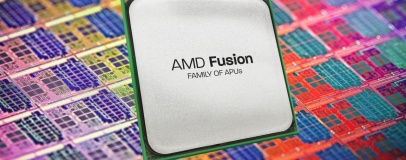
AMD's Z-60 'Hondo' APU, a revision of last year's Z-01 chip, could struggle to compete with Intel's Clover Trail family.
AMD has announced a processor product which continues its low- to mid-range assault against Intel, but this time bringing Cambridge-based chip giant ARM into the firing line as well: the Z-60 Accelerated Processing Unit (APU.)
A tweaked version of last year's Z-01 design, the Z-60 'Hondo' APU is aimed firmly at Windows 8 tablet makers looking for an alternative to Intel's Atom chips. A dual-core part produced on a 40nm process, the Z-60 is a disappointingly last-generation design: as with the Z-01, the Z-60 uses Bobcat-architecture cores running at just 1GHz along with 1MB of shared L2 cache.
The graphics side of things is handled by a Radeon HD 6250-equivalent integrated graphics processor, featuring 80 stream processors and running at a battery-saving 275MHz. Although it features support for DirectX 11, AMD isn't saying much about the chip's overall performance beyond a promise of Full HD video playback support and the ability to run Call of Duty-style games without trouble.
Where the design differs from the Z-01 of last year, aside from a slight reduction in graphics clockspeed, is in its thermal design profile (TDP): where the Z-01 had a 5.9W TDP, the Z-60 drops the power draw to just 4.5W - and with OEMs having universally chosen to ignore the Z-01, AMD is clearly hoping that a lowered TDP will be the key to making an impact in the tablet market.
Breaking things down still further, AMD claims that in S3 standby - from which the system can recover in seconds through the company's Start Now technology, providing instant-on capabilities with very low standby power requirements - a Z-60-based tablet should draw around 0.08W from the battery. Booted up but sat at idle, the tablet would require 2.88W of which around 0.75W is consumed by the APU. During web browsing, that rises to 3.89W of which 1.12W is the APU, while during HD video playback the system will need 4.79W of which 1.57W is the APU. Interestingly, but perhaps not surprisingly, AMD failed to give figures for power draw during gaming.
That translates into roughly six hours of continuous video playback from a 30Wh battery - something easily bested by Intel's Clover Trail Atom platform, which manages a claimed 10 hours from a similarly capacious power source. Although AMD's Z-60 is likely to offer increased 3D performance over Intel's Atom chips, manufacturers are unlikely to adopt the Z-60 if it comes at the expense of battery life - especially given the presence of Ultrabook-targeted Core i3 and i5 parts from Intel which could be easily massaged into a tablet if battery life isn't a concern.
Perhaps the most telling feature of AMD's Hondo launch, however, was in its list of hardware partners signed up to use the part - which is to say, none. Although the company claims to be working with a number of OEMs and ODMs on Z-60 based tablets, due for release towards the end of the year, it has yet to name names.

10 Comments
Discuss in the forums ReplyIt basically sounds like somewhat better graphics than Clover trail (DX11 support among other things), but at the expense of probably slower compute (Bobcat cores are clock for clock only a little faster than atom right now, but Clover trail can run its two cores at something like 1.5Ghz compared to 1Ghz, which should be more than enough to stay ahead of the Z-60). Also a lot higher power draw. That 4.5w TDP doesn't take in to account the extra .2-.5w of the FCH, which Clovertrail doesn't have to deal with as it is a true SoC, which Hondo isn't.
So yeah, it sounds like in typical use you'll probably see roughly 30-50% less battery life. Not so good. Also having to pay for a two chip solution means it probably isn't going to be much cheaper than a Clovertrail solution, especially since Intel sounds like they are going pretty cut price on it to get tablet market share from ARM. I can't imagine too many manufacturers are going to be itching to save $5 or MAYBE $10 off the BOM of their laptop...and have to suffer significantly less battery life, more heat AND more space (again, 2 chip solution).
If you want to recoup the battery life, it requires a fairly substantially larger battery, which makes a bigger heavier laptop and probably increases the BOM at least a much as just having gone with a Clovertrail solution to begin with.
I don't like Clovertrail, but the Z-60 just doesn't sound like it has anything particularly interesting to bring to the table other than maybe the lowest of the lowest end Windows 8 x86 tablets.
Sorry if that was an little rant just the 10 bobcat type. normal laptops all of them are unfit for use (an second hand pc that's 5-7 years old is faster ok power saving is not there thought)
I've got a fiver that says you've never even SEEN a system running a Bobcat-based CPU, let alone used one.
I've got tablet running on an AMD Z-01 (using that to write this), I can assure you I never have such problems, the cpu is actually very good (for a tablet).
The girlfriend has a E-450 in a laptop.
I own an E-350 based mATX board which I use for media and music.
I've just ordered a C-60 based itx board for the same purpose.
For the applications I use them for they cannot be faulted.
They better start making some decent high-end chips again if they want the AMD name to mean something.
All over the internet I see tech press lamenting the AMD chips and saying Intel is better.
I'm also in the midst of building a car PC on a second E350, since it's proved itself capable of handling the typical sorts of things you'd want a car PC to handle.
AMD just seems a little behind the curve, though - E350 was perfect for the netbook market that was already half-dead by the time the platform was released. Hondo is coming out at the right time...but is behind the tech curve, not being a true SOC....feels bad, man. I just want AMD competitive again :(
now that will make an excellent tablet/laptop hybrid!
On the laptops mostly E type (some C as well) I have used, I have been fixing pcs for 15 years and I have never come across an cpu that is this bad (ok VIA), single core atom was not grate but they was still usable, duel core atom was fine
If your doing any thing gpu side or on the cpu side that's not .net type of load they are fine but the mouse pausing due to the cpu getting stuck on an thread is bad (duel core as well), unless they have fixed the issue on the Z type cpus I expect it to be worse then the E C cpus as the Z is slower (I edit once I have compared them again)