AMD's latest Trinity APUs span the range from low-end entry-level parts to powerful quad-core chips, and could give Intel cause to worry.
AMD has formally unveiled its next-generation Accelerated Processing Units (APUs), the Piledriver-based Trinity series, releasing full specifications for two top-end A10 and two mid-range A8 parts, along with a chip each for its A6 and A4 entry-level families.
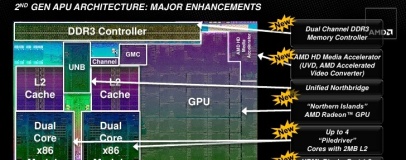
Starting at the top, the A10-5800K is an unlocked 3.8GHz quad-core part with Turbo Core capabilities that dynamically boost the clock speed to 4.2GHz when only one or two cores are under load. The graphics portion of the chip is handled by a Radeon HD 7660D core, running at 800MHz and boasting 384 stream processors. Despite its 7000-series name, however, the Radeon HD 7660D shares its architecture with the 6000-series with a few tweaks including improved dynamic boost support and compatibility with Eyefinity multi-monitor setups.
The A10-5800K is joined by a slightly cheaper A10-5700, which drops the clock speed to 3.4GHz stock and 4GHz under Turbo Boost conditions. The same Radeon HD 7660D graphics hardware is included on-chip and the full count of 384 stream processors makes it through intact.
In the mid-range, the A8-5600K is an unlocked quad-core 3.6GHz part with Turbo Core boosting the clock speed up to 3.9GHz. As well as a slight clock-speed hit, the graphics hardware gets a more severe cut-down to the Radeon HD 7650D with 256 stream processors running at 760MHz. The A8-5600 completes the mid-range Trinity line-up, featuring the same graphics hardware at the same speed but dropping CPU performance to 3.2GHz and 3.7GHz under Turbo Core.
Finally, the entry-level A6-5400K is a dual-core part running at 3.6GHz core and 3.8GHz under Turbo Core conditions. As befits an entry-level part, the graphics portion of the processor has been severely hobbled: officially rated as a Radeon HD 7540D, the GPU has 192 stream processors running at 760MHz. The A4-5300, meanwhile, drops the CPU performance to 3.4GHz and 3.6GHz under Turbo Core, while offering low-end Radeon HD 7480D graphics with 128 stream processors running at 723MHz.
With the new line-up, AMD spans a range of thermal design profiles (TDP) from 65W for its entry-level parts up to 100W for the range-topping A10-5800K. With initial indications showing that AMD's latest creations may outperform similarly-priced Intel chips, the underdog may finally have what it needs to bring the fight to its long-time rival in the lucrative mid-range market.

51 Comments
Discuss in the forums ReplyNone of which show the CPU's weakness....slow (relative to Intel) x86 performance.
Anyway, I'm sure if you want a cheap HTPC or 2nd PC for the kids, it'll be just the job, for everyone else...move along, nothing of interest here.
I doubt it! 100W TDP on the top end part, whereas an IvyBridge i5 peaks out at 77W - so AMD have created a hot monster of a chip that relies on brute force (ie: high clock frequencies) to get on par with Intel. Yes, the graphics core will be better, but in the enthusiast market every man and his dog has a discrete GPU in their gaming desktop.
A10-5800K, 100W, 3.8Ghz
i5 3570K, 77W, 3.4Ghz
I know which I would buy if they had exactly the same compute performance...
Yeah, the cheaper one?
The IGP is also by far better than anything Intel put inside IB. 100W TDP is not chockingly high.
and for a small HTPC with a pico psu it is perfect. You have a more than capable CPU with a decent GPU, maybe not suited for high gaming, but enough for casual gaming or some GUI acceleration (XBMC, etc).
100W is still less than i3 + low end discrete GPU.
In a gaming PC you can assume the presence of a discrete GPU, and any onboard graphics as being irrelevant. Therefore:
AMD 100W + GPU
Intel 77W + GPU
The Intel is lower. Lower TDP also means less heat being dumped in to the cooling system.
AMD can't survive as a going concern if all they sell is HTPC processors. They need to compete in the desktop space as well, which means they need to overhaul their architecture (again) and not try building off the failure that was Bulldozer.
Secondly : You took A particular use case to say that this chip is hot + hungry + worse than Intel ones
Thirdly : Not every one here are gamers, not every one on hearth are gamers. If AMD cannot compete with Intel on "gamer" CPU, then they can compete on good casual CPU. For a home / familly / univ purpose, those CPU are nice.
PS : And for A gaming rig I'd like CPU with no IGP (like the Intel core "P" series), mobo with no onboard sound and no display conenctor (saving space on the io shield for, lets say, more USB).
PS² : Sorry if I seam irritated or aggressive, but I feel like eveyone are taking there personnal use as the general case.
PS3 (no sony shares) : Gaming rig does not mean playing @ 250fps with 15000 x 1200 pixels. Alien swam, burn zombie burn, etc are games and many people are more than happy with that kind of games. It doesn't require much processing power, but requires a little more than even an HD4000. With an ITX mobo and HD4000 you have no other choice than having a discrete GPU (more heat, more watt) and no other possible card. With those trinity, you can still play casual 3D games and pluging something else (better sound card, satelite / cable card, etc). Do not forget Steam Big Picture, HTPC are not only about watching movies ...), and games are not limited to the ones that require 3 way sli to run @60 fps on 1080 res
http://media.bestofmicro.com/5/N/343643/original/wow%201920.png
http://images.anandtech.com/graphs/graph6332/50162.png
http://www.legitreviews.com/images/reviews/2043/system-power.jpg
Those are enough figures to prove it is a viable solution for do it all + casual gaming.
Yes wed all put money on the AMD chip being less efficient, but how much will that 22w matter when we see the benchmarks?
Does the AMD offering give you vastly more graphical grunt in its 100W package than the more efficient 77W i5?
After all, it is a jack of all trades approach, and it does fill a gap in the market, question is can it tease casual gamers away from dedicated GPU's?
Where is Trinity (or Llano) marketed as a desktop "gaming" or even enthusiast cpu?
http://images.anandtech.com/reviews/cpu/amd/trinity/review/trinity.jpg
http://www.cpubenchmark.net/cpu.php?cpu=AMD+A10-5700+APU
It's FM2 socket.
I will wait for the full review. I might pick one up for a cost effective rig...
http://www.teamhardwarevzla.com/wp-content/uploads/2012/06/a85ia-e53.jpg
At least in the past, AMD chips have drawn very, very close to their rated TDP. So odds are good, their 100w chip is going to draw just about 100w with CPU and GPU loaded. So it is likely closer to double the power draw of a 3570k fully loaded.
Fully loaded CPU performance without the GPU loaded is probably going to be even more in Intel's favor for power draw.
Also it is rather specious to say that "oh if you aren't a gamer, than CPU performance doesn't matter as much". Okay, how about those who rely on it, for things like video/image editing? Okay, lets take those people out to. Now lets look at the casual user. Ivy Bridge graphics are likely going to be more than sufficient (especially in a desktop, crap the HD4000 graphics in my i5-3517u are just fine and am a gamer. I'd like it faster, but they are sufficient).
However, unless Trinity really is a massive boost in performance in the desktop over bulldozer, at least if you bothered to try two systems back to back, even the casual user is going to not overall increased system responsiveness and things getting done faster/smoother with the higher end Intel system compared to the higher end AMD system.
CPU performance, especially single threaded, can make a big difference that even a casual user can notice.
Oh, sure the systems ARE just fine for the casual user, but even if they are cheaper, that doesn't necessarily mean even a number of casual users would jump on them.
For HTPC use they are great. Outside of that, at best it is a question of budget and how strict it is for a lot of people.
I know me, personally, the cost differential of $50 (if even that much) is going to make very little difference in an overall system price of $700-1,000 when the CPU performance is kroggingly better (my 3570, not k, just 3570, was on sale from Newegg a couple of months ago for $199...and I am going to go out on a limb and say it is massively lower powered and massively faster in CPU performance than the top of the line trinity APU).
To be honest, who really uses an i7 or even an i5 to its limits ? 1% of the computer users, probably less. Most "gamers" could still game on an i3 without any issue.
Like many people I have a job and a family, not much time to spend with gaming nor place to fit a tower. I'm not willing to spend thousands to play 1h a week. With this you can build a decent pc, smaller than a shoe box with a sub 100W comsumption (the 100W TDP is obviously given with the OC headroom in mind, just look at the locked 5700 with 65W TDP).
There are far more important things than TDP when choosing a new platform... For most people the sheer x86-performance shouldn't really be the main thing, either. In most uses and for most users the differences just aren't going to make any difference. CPU-performance graphs make people obsessed with long bars and 10% performance improvements, but in real life those just don't show nearly as radically - if at all.
TL;DR? Why are you reading forums if you didn't read that one? Stop comparing apples to oranges, noobs.
@Jipa: I posted a overall system comsumption compatison a few posts above ^^
Love that, such a wonderful way with words the Finns!
Yes I suppose not, essentially I want my HTPC system to be efficient, quiet and tidy, less components help me achieve this, the lower TDP (RIP baby panda) is a part of this but I should have stated my main goal more clearly!
And why are they pushing clock speeds again, thought we had finished the ghz race.
If all you care for is games you can build a gaming rig that will play all modern games for less than £500 as long as your willing to buy second hand. 580 is avaiable for about £130 on eBay / this forum the amd black x4 CPUs are not expensive some cheap mobo and you in business.
If you actually need pure performance, intel is likely still dominating.
What are you smoking and can I have some?
kthxbye
Edit: To be honest that goes for a couple of others here today. If you're looking at this chip as anything other than an APU then you've got it all very, very wrong. It's not a gaming CPU, it's not a productivity CPU and it's not a dedicated GPU. It's one chip to perform all tasks 'adequately' that costs relatively very little. If you can't fathom that concept then you can have a little pat on the head, have "run along now you little scamp" said to you and go off and play in your sandpit.
an i7 with hd4000 can't even play minecraft @1080 with decent fps
edit : with other word, try to fit an intel rig that can do home and devel purpose, while being able to play wow @ 1080 with good setting into a streacom f1c ..... good luck
Am i the only person who thinks its pretty dam good that you can get playable frame rates @ 1920×1080 with an all in one solution that draws 65watts?
I'm just thinking of the brand new Dell Core i3's based systems at work that Ive had to fit dedicated GPU's' to as they have failed to perform in Photoshop and Video editing tasks.
Sure your not going to compete with an i5 for specific tasks but then again it is very situational.
Looking forward to some more benchmarks and pricing to come out.
I'll copy/paste the conclusion I posted.
"AMD can't survive as a going concern if all they sell is HTPC processors. They need to compete in the desktop space as well, which means they need to overhaul their architecture (again) and not try building off the failure that was Bulldozer."
So, AMD aren't selling a gaming CPU, or a productivity CPU, or a dedicated GPU. What exactly are they selling, apart from a HTPC APU? Okay, so maybe we agree this is basically a HTPC APU, but then that means AMD have precisely nothing to offer anybody who wants a CPU for any other higher performance task.
Can AMD really survive with such a narrow set of target customers? Compare Intel and AMD's finances and you might see the beginning of the answer.
I want to see thorough reviews of this, but in my opinion, AMD need to take the fight to Intel on actual CPU terms, not just relying on a superior in-built GPU to compensate for what is effectively a poor architecture that needs to be clocked to 4Ghz+ to compete with Intel's offerings down at 3-3.4Ghz. A lot depends on exactly which i5 CPU AMD are pitching themselves against as well.
And again, regarding to the benches I saw about the A10 ... it's a more than capable chip for development (including OGL). I'd like to have something like that when I what a student in 3D development.
No. I find it quite astounding what this chip can do in gaming.
They're selling a laptop chip as a desktop chip. The clue is in it being on sale for months already. In laptops.
No
It's an all-in-one solution in it's 2nd incarnation.
The growth in the market is for things at Trinity's price point and below. Then you are into the realm of Bobcat. Both Llano and Bobcat have sold tens of millions
With Trinity and Bobcat they targeted almost everyone.
In a sense there's alot of truth in that, in another sense that's a total straw man attack. The poor dirty man has no talents, the well dressed rich man has lots and lots?
Maybe not.
The proof in this pudding is that Intel is moving away from 'good enough' graphics too. Integrated GPUs from BOTH companies are on a steep upwards curve. The iGPUs in both Haswell and Kaverei look set to make the current generation look silly. Both companies are integrating the CPU, GPU and connecting logic blocks into an ever more coherent whole.
In effect BOTH Intel and AMD offer APUs of all shapes and sizes. What you as the consumer have is a straightforward 50/50 choice. Do you want a 'media' laptop? A gaming HTPC? or do you want a 'productivity' laptop? a non-gaming HTPC?
When you blur the lines and start talking about adding discreet GPUs then you really are not in the market for an APU.
Yes and yes.
Also Intel should offer HD4000 graphics on more than just a handful of pricey models. There's a good reason Trinity is tested against 3770Ks, because so few other Ivy Bridge models (If any??) have the top-end iGPUs in them.
Also Intel should put more than bare minimum effort into it's driver software. A few profiles for a few big-name titles of the day, everything else crashes, glitches or runs awfully.
Why should it anyway ? It's priced to compete with Intel i3 chips. It sacrifices some single-threaded performance for better GPU (which also works as OpenCL accelerator). Those who don't need GPU performance can go the Intel route, others can go with AMD.
Yep, I'm not arguing that. I'm just spelling it out to the 'My i5 wipes the floor with that' crowd that it's not trying to compete.
It's marketed entirely different and I think it's going to fill the gap in the market nicely.
Just to derail the thread a little, I see Shogun runs like arse on AMD cards, you must have played with the settings a bit, are there some graphics options that really kill the framerate or is it just generally very tough?? Thx
JcA9W1xb0Cs
Well the AMD would probably be cheaper, in which case I go for that one.
100tdp isnt hard to dissipate.
No, not every man and his dog have a discrete GPU. I picked up an APU toshiba laptop for my girlfriend. She mostly plays a lot of indie titles so she didn't need a powerful gpu, but at least a usable one. It's be great so far and it's impressive to watch Bad Company 2 run on integrated graphics.
They're using higher clocks to mitigate their lower IPC - Piledriver is a bit better than Bulldozer, but that only puts them roughly on par with the Stars cores of Phenom (remember that Llano used Stars cores, while Trinity is using Piledriver cores.) That's a bit of speculation on my part until the rest of AMD's NDA is lifted.
Keep in mind that a lot of us are going to be seeing this from a skewed perspective - this here is a crowd that in a lot of cases, will drop several thousand dollars building machines with top-end everything - highest-end i7 proc (or even the workstation-aimed Xeon), highest discrete GPU (sometimes more than one), SSDs in RAID-0 arrays, etc. AMD has already said they're not aiming at that market anymore.
Maybe that's smart, though - are you going to make more money selling one system to one neckbeard that wants ZOMG fast gfx, or half a dozen systems to your mom, your uncle, etc, for $300 per?
So here there's only arguments over if this will make a decent HTPC. 99% of the rest of the world couldn't tell you what an HTPC even is. But they did just pick up a shiny Dell all-in-one that's got something decent under the hood that wasn't heinously expensive.
For me, I'm taking a long, hard look at these to replace my wife's Athlon 64 X2 - the lower-end quad-core would be about right. But I really, really want to make it ITX, and last I looked, FM1 ITX boards were nearly non-existent. I hope FM2 is different.
adding some AMD flavouring into the charts posted previously , your looking at comparable performance ON CHIP to a stand alone `low midrange` card from 18 months ago
(And yes, I'm aware of the weaker CPU performance relative to Intel's current architecture - but I've got a Core 2 Duo E8400 at the moment, so it's likely to be an improvement there, too.)
1866 MHz is a must have. Can't wait for the next gen APU, based of Graphic Core Next architecture and with CPU / GPU shared memory space ==> higher bandwidth between CPU and GPU. The next gen is aiming @ 512 stream processor (= to HD7750).
For the power users intel is far and away the choice to pick ( anyone using a discrete graphics card)
For people who buy dell I don't they even read what's in the box before they hit buy as long as its cheap.
Then you have businesses and this is where AMD might gain some points as power usage is critical in this area. If they can get a CPU Gpu combo that uses very little power they will go for it.
They can't survive just selling htpc chips no douts there. There days of competing at the top are over they said so themselves they are now the budget mid range company. Lets hope it's an improvement for both intel and AMD sakes.
Agreed i can see them doing well in this sector, I just ordered some low profile graphics cards for work because we got some DVI monitors and the old machines only support VGA. Pretty sure they would jump at this for their average office (non-dev) machines
Now how many will notice a minor difference in performance not many. How many will notice a big difference in performance? Tons.
I have 3 kids under 5. I probably spend about 3-4hrs gaming per week at most once the kids are to bed. However, I do a resonable amount of photography, a little video editing and/or transcoding and I can tell you, I don't have the budget for a $3,000 system, but I did manage to scrape up a $600 budget this time around (I can generally manage that about every 2-3 years). The performance difference going for a higher end CPU most deffinitely saves me time in my life so I can focus on things like being a father, chores around the house, etc. The extra maybe $70 I spent probably saves me on average 20-30 minutes a week when you account for time savings in things like image editing.
I can deffinitely tell you my time is worth a lot more than $70. Especially when you go out to 20-30 minutes x 52 weeks a year. An extra maybe 25 hours a year of my life where I am not sitting waiting for an image to finish processing, an application to load, something to export, etc. That is a mere $2 per hour. Well worth the investment.
Just my 2 cents though. It might not have been worth it if I had been spending a couple of thousand dollars for the extra performance, but 2 tanks of gas worth of expense for all of that time back in my life? Worth it.
However and in general, the "top of the line" chip in the TDP class CAN and WILL hit those TDP numbers in the worst case scenario and under typical 100% loading of CPU/GPU (if an APU, or just CPU if not) the chip as a whole is likely to consume roughly 90-95% of the rated TDP.
The TDP numbers account for zero overclocking head room (and most modern chips with turbo boost can and sometimes will briefly exceed TDP turbo boosting their CPU and/or GPU for a period of time until the CPU/heatsink thermal capacity is reached and then it'll clock down slightly. Intels stuff at least will, especially in ULV parts).
Overclock your chip without overvolting and likely you'll see a modest increase in power consumption. Without overvolting you'll likely see a roughly linear increase in power consumption. So a 10% overclock will likely see roughly a 10% increase in power consumption. Overvolt however and you'll see roughly a linear increase in power consumption with the overclock and a 2nd power increase in power consumption with the increased voltage. So a 20% overclock and a 10% overvoltage would see about a 20% power increase due to raised clock rates and an additional roughly 21% increase in power consumption due to increase voltage. Raise voltage 20% and it'll be increase by roughly 44% for power consumption. So that 20% overclock and a 20% overvoltage to achieve it in the end would lead to a roughly 72% overall increase in power consumption.
Yeah, that is a hell of a lot of extra power. That is why overclocking tends to decrease performance per watt, especially when you need to overvolt the chip to achieve higher clock rates.
The locked 5700 with 65w TDP also clocks in at 400mhz slower than the unlocked part and 200mhz less under turbo (and under turbo it might well be exceeding TDP until it runs out of thermal head room). Going with linear scaling it means that it should use roughly 11% power at regular clocks and about 5% less under turbo. The top of the line part probably won't actually hit 100w exactly, but the part below it probably just barely eeks in at 65w or less and is likely a lot more agressive at clocking down from its max turbo speed, especially if the GPU is active as well, to stay within it TDP limit.
I'm asked twice a month to build a sub 400€ computer for family or relative's family. Tasks is alway : Internet, Word, Souvenir photgraphy storage / viewing, Movie / series. Maybe it's hard to believe, but that's what 90% of computer users will ever do with their computer.
Our vision is biased on this forum because we play, do 3D modeling / rendering, photography, etc and a little more CPU / GPU power saves us lots of time. But we are a negligible part among all the computer users.
that is an older AMD F1 VS i5k 2500 tested with some friends absolutely no difference in FPS or performance.
the only game so far that has a difference was Sup COm 2 with shadows on and 1000 units on 8 player superlarge maps.