The prototype storage medium, created by Kiyotaka Miura, exceeds the data density of a CD in a format designed to last over a million years.
Hitachi's storage arm has developed a novel technique for recording data directly onto glass, in a move that could dramatically increase storage capacities while producing write-once, read-many (WORM) media significantly more robust than today's recordable CDs, DVDs and Blu-rays.
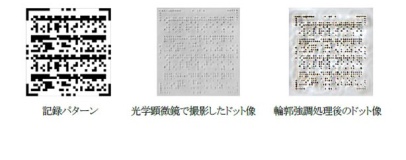
Existing in prototype form, the storage system uses dots captured in layers of quartz glass to store data. These binary dots are read back using an optical microscope in a procedure not a million miles away from how optical discs are read today.
Where the technology differs is in its longevity: as it doesn't rely on any dyes, the data should survive almost indefinitely. Designed as a semi-permanent storage medium, the technology uses the inherent strength of quartz glass and its resistance to heat, magnetism and water to produce something that should last forever - so long as nobody breaks the glass.
The medium itself consists of four layers of quartz glass, which is irradiated by a pulsed femotosecond laser to form areas with different refractive indices. These areas form the dots, and their different reaction to light when read gives the system the ability to store 0s and 1s for binary data. So far, so very-fragile-optical-disc. Recording a hundred dots at a time, through a modulator capable of adjusting the amplitude and phase of the laser light, the system promises improved recording speeds - but it's the capacity that is most impressive.
Despite being a very early prototype, based on work done by Hitachi in 2009 on laser tomography storage, the prototype created by Professor Kiyotaka Miura of the Kyoto University is impressively capacious: measuring just 2cm on a side and a mere 2mm thick, the square of glass holds data at a recording density of 40MB/inch² - an increase over a CD-R's density of 35MB/inch², with significantly improved archival capabilities.
Just how robust is the prototype? According to Miura, impressively so: during testing, the prototype was heated for two hours at 1000℃ - a handy way of quickly figuring out what a few years of more normal temperatures might do - with no loss of data. '
This corresponds to a retention period of more than a few hundred million years,' Miura claims.
While Miura states that Hitach will be developing the technology for exploitation, no date has yet been given for the release of a commercial implementation. Meanwhile, Miura is due to present his findings at the International Symposium on Optical Memory later this month.

17 Comments
Discuss in the forums ReplyThere's plenty of old data stored on various formats out there...but the hardware needed to read them, dies long before the data does.
Precisely. Hieroglyphs stored on stone tablets are still with us 3,000 after they were written - the problem is reading the language, not identifying the shapes.
The data on the disc is not in some "magical format" it's binary data.
Binary.
It's either 1 or 0, the same as sectors on a HDD platter, the pits on a CD/DVD or the flip flops in a static RAM chip. Imagine writing your name in the sand, then writing your name on a piece of paper. The process is the same and the storage method is the same, only the medium differs.
You can see the shapes on a stone hieroglyph just fine but you have no idea what they say.
Data on old formats is the opposite problem.
That's CD-ROM, not DVD-ROM or BD-ROM.
They're talking about 40MB per square inch!
It's a long way from electronic quantum holography that has been demonstrated to store at a rate that's equal to 3 Exabytes per square inch (That's three million terabytes to you and I)
We don't need archival mechanisms that will store data for millions of years. We need massively high capacity storage solutions that are robust and cheap enough to use and replace later on with the next big thing.
If they can get the storage density up to usable levels and it's cheap to write and read (Ha! I found the flaw. It's cost) this could be a winner.
I have one with 'Jay' laser etched inside (family has some bizarre ritual of buying ker-ings and **** with my name in/on).
Im guessing this is the same principle, just with some kind of practical application...rather than tatty gift shop w**k :)
Also, I never figured your username was your actual name. Jay pride! (pun intened :D)
Or say we discovered a distant civilisation - a probe enclosing a message from us would take (at least) thousands of years to travel to another star, and it would be relatively trivial for any sufficiently technologically advanced civilisation to decode a series of optical binary digits in a rock - and bear in mind that they'd need to be at - at least - 19th century human level for us to pick them up in the first place from radio transmissions at the time their signals were sent - add on signal transit time, probe construction time and the time it would take the probe to reach them and they would likely either have reached a technological level far in advance of our state of the art, or have wiped themselves out. They could safely and non-destructively examine the object, would quickly realise it contained ordered binary data, and reconstruct the bitstream. Assume it was primarily ASCII or Base64 encoded text - they'd work out very quickly that it was an 8 or 6 bit (respectively) encoding scheme, especially if we started with some sort of header to guide them to that conclusion. Conveying text information would be difficult with no common language, but numerical information could be exchanged. You could also convey bitmap images (either as binary data strings or by physically engraving the image in the rock using the same laser technology), in which you'd show schematics for more complex data formats. Think of the resources humanity would throw at decoding a message from an alien civilisation. One can imagine that they would do the same, and they'd very quickly get to the point where they could access any data format we had sent, including video and audio, star charts, maps of Earth, etc. There would be debates for years about what to include, because we wouldn't necessarily want to give away too much information to an unknown alien race, but we could send whatever we liked, assuming data density did go up a fair amount from 40 MB/in2...
Anyway, there's my flight of fancy for this morning :-)
How does one type a nerdly snort? :P
That is the ultimate in tackiness!
And yep, they think its such an unusual name (not really) so come any kind of gifting period, i get **** with my name on it. : P
Let's rejoice.