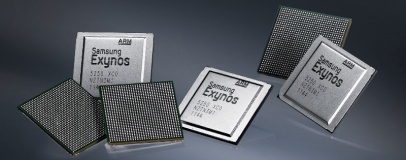
Samsung's semiconductor arm has revealed the first details regarding its upcoming Exynos 5 system-on-chip design, destined for future tablets and smartphones.
Replacing the ARM Cortex-A9 core design used in previous-generation Exynos processors - as found in the Samsung Galaxy S II and S III smartphones - with ARM's Cortex-A15 'Eagle' IP, the Exynos 5 promises to be one of the fastest ARM-based processors to be found in a consumer device. Improvements made by ARM's army of designers mean that the Cortex-A15's performance is significantly improved: official figures put the chip's integer performance at around 1.5 times that of the Cortex-A9, while floating-point performance is doubled.
Samsung's implementation in the Exynos 5 packs two 1.7GHz Cortex-A15 cores on a system-on-chip design with a two-port 800MHz LPDDR3 memory controller with 12.8GB/s bandwidth, a quad-core Mali-T604 graphics processor with support for OpenGL ES and OpenCL Full Profile, and a display subsystem suitable for WQXGA 2,560×1,600 displays.
That latter, it should be pointed out, points to Samsung's plans for a tablet designed to compete head-to-head with Apple's new iPad and its 2,048×1,536 'retina' display.
In addition to support for high-resolution display types, the Exynos 5 promises 1080p video playback at 60 frames per second with full support for wireless displays and 3D stereoscopic videos. If that wasn't enough, the image processor portion can capture pictures and video from an eight megapixel sensor at 30 frames per second and features hardware post-processing units including 3D noise reduction, image stabilisation and optical distortion compensation, along with a claimed zero shutter lag.
Finally, physical layer transcievers are included in the design for USB 3.0 - in both host and device mode - SATA 3 and inter-integrated circuit (I2C) communication across eight channels for talking to any sensors manufacturers may want to add to the device. Power saving functionality is also a major feature, with Panel Self Refresh (PRS) technology promising to boost battery life by reducing the power draw of the connected display.
In short: despite its dual-core nature at a time when other manufacturers are opting for quad-core - or, in Nvidia's case, sort-of-five-core - the Exynos 5 sounds like an exciting piece of hardware, and promises a new raft of ultra-powerful tablets in the not-too-distant future.
Pricing, sadly, was not on Samsung's agenda for the announcement.









Want to comment? Please log in.