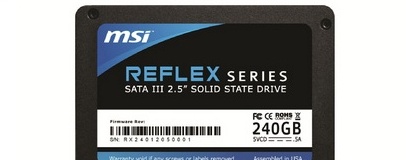
MSI's plans to enter the solid state storage market have been tipped ahead of schedule, with details - but, sadly, not prices - of its upcoming Reflex SSDs leaking ahead of an official announcement from the company.
According to pre-release details obtained from an anonymous '
inside connection' by
Inside Industry News - and, it goes without saying, thoroughly unconfirmed by MSI itself - the company is to shortly announce the Reflex family of SATA III 2.5-inch solid-state drives, its first in the market.
Based, so the leak claims, on LSI's SandForce SF-2281 controller, the MSI Reflex drives will launch in 60GB, 120GB and 240GB capacities, each in a 2.5-inch form factor with bundled 3.5-inch mounting bracket. Speeds differ according to side: the RX-60 boasts 525MB/s read and 495MB/s write with 85,000 input/output operations per second (IOPS); the RX-120 ups the performance to 550MB/s read and 515MB/s write with 90,000 IOPS; the RX-240 tops the range at 560MB/s read, 525MB/s write and again 90,000 IOPS.
Should those performance figures prove accurate, MSI could have a serious competitor on its hands - and for a first attempt at breaking into a market it has little experience in, it's undoubtedly impressive. Before we can applaud MSI, however, there's one piece of information which the purported leaker failed to include in his report: the price. Should MSI price its Reflex family aggressively, it could be at the forefront of a serious shake-up in the SSD market.
MSI has not yet responded to a request for comment on the leak.
UPDATE:
MSI has confirmed that the Reflex SSD family is real, and that all the leaked details are accurate - but with the proviso that it will
not be getting a retail release in the European Union. Although 'selected markets' will receive boxed Reflex SSDs with the aforementioned 2.5in-to-3.5in brackets, MSI has told [eurl=http://www.techpowerup.com/169412/Updated-MSI-s-Client-SSD-Lineup-Piloted-by-Reflex-Series-Pictured.html]TechPowerUp[/url] that EU nations won't be among them. It seems likely, however, that MSI will 'dogfood' the drives and start to use the Reflex family in its own laptops across all markets.









Want to comment? Please log in.