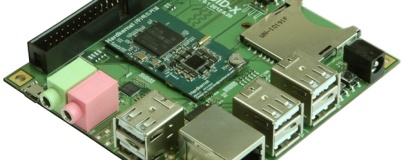
Korea-based Android specialist Hardkernel has announced a new entry in its ODROID family of products which should get those still waiting for their Raspberry Pi boards sitting up in interest: a low-cost quad-core ARM-based development board.
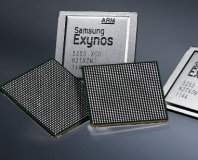
Built around the Samsung Exynos 4412 quad-core Cortex-A9 (ARMv7) implementation running at 1.4GHz and boasting a high-performance Mali-400 MPCore graphics processor, the ODROID-X certainly has the edge over the Pi's 700MHz ARMv6 chip. Memory, too, enjoys a significant boost with 1GB of LP-DDR2 to the Pi's 256MB. A micro-HDMI connector joins a specialised LCD interface port for 1080p video output, while a 10/100MB Ethernet jack provides connectivity to the outside world.
As with the Pi, the ODROID-X includes a MIPI CSI camera connector, an SDHC card slot, and a general-purpose input-output (GPIO) port which carries the LCD signal, I2C, UART, SPI, ADC and GPIO capabilities. Six USB 2.0 ports are included to the Pi's two, while the device cal also operate as a mass-storage device through an included micro-USB connection. Finally, the board includes both input and output analogue audio jacks.
All those extra features do mean an increase in size and power draw, however: unlike the credit-card size Pi, the ODROID-X is a chunky 90mm x 94mm and demands a dedicated 5V 2A power supply. For those with projects where the Pi's relative lack of power means it's a no-go, however, those could be prices worth paying. That goes double for anyone who is looking to run Android or Ubuntu Linux, both of which demand an ARMv7 instruction set - present in the ODROID-X and missing from the current-generation Pi.
The boards are
available to order now, priced at $129 (around £84) - a significant premium over the $35 Raspberry Pi. Buyers do, however, get Android 'Ice Cream Sandwich' 4.0.4 thrown in for good measure, with source code to be made available for download shortly.
If you're not quite convinced that the ODROID-X is worth the premium, perhaps a video of the device running a four-player knock-off of Mario Kart 64 at full speed via an emulator will help seal the deal:










Want to comment? Please log in.