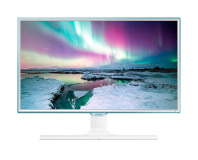
Samsung's new Series 9 family starts with a Quad HD 27in beast featuring a new Plane Line Switching (PLS) LED-backlit panel.
Samsung has officially launched its Series 9 monitors, with the first model in the family offering an impressive 2,560x1,440 resolution in a 27in diagonal.
Based on an In-Plane Switching (IPS) panel using new Plane Line Switching (PLS) technology with LED backlighting, Samsung claims the high-resolution display can hit a 1,000:1 static contrast ratio which can be further boosted using the company's Mega ∞ Dynamic Contrast Ratio (DCR) technology. Overall display brightness is given at 285cd/m², a response time of 5ms is promised, while the IPS panel means viewing angles of 178 degrees both vertically and horizontally.
The Series 9 LED S27B970D, to give the product its full title, comes in a high-gloss black and metal-silver casing with tilt and 100mm height-adjustable stand, and features dual-link DVI and HDMI inputs along with an integral dual-port USB 2.0 hub. Rated power consumption is given by Samsung as 63W maximum, with standby power rated at 0.5W maximum.
Given Samsung's targeting of the well-heeled prosumer market, it should come as no surprise that the box includes a power cable, DVI cable, Display Port adapter cable, and a USB 2.0 cable - although, for some reason, Samsung has opted not to include an HDMI cable with the display.
As well as acting as a standard USB 2.0 hub, the monitor's USB circuitry hides another feature: Mobile High-Definition Link (MHL) support. Connected to an MHL-compatible smartphone, the monitor can charge the device while simultaneously transferring high-definition video and stereo audio for playback through the monitor's integral stereo speakers.
The display's biggest selling point, however, comes from a claimed hour-long adjustment process carried out at the factory during which Samsung engineers calibrate the monitor for maximum image quality. An in-built calibration engine allows for additional fine-tuning on-site, although the colourimeter sensor required is an additional-cost add-on.
According to Samsung, the new PLS panel means improved colour reproduction across the entire sRGB spectrum with no degradation even when viewed at the extreme ends of the display's 178-degree viewing angle. The company is even going so far as to claim the panel offers the most accurate colour reproduction of any LCD on the market - although this claim has yet to be independently validated.
Currently the display is only available in the US through a timed-exclusive deal with retailer NewEgg, where it is priced at an eyebrow-raising $1,199 (around £767 excluding taxes.) Details of a UK release have yet to be confirmed.

33 Comments
Discuss in the forums ReplyCame in here expecting a 4k display... I am dissapoint.
I know you're technically correct, but it just helps un-muddy the water.
I thought HDMI only supported 1920x1080 anyway.
Must admit, when I saw Quad HD I was expecting more than 1440p....
Not sure why anyone would choose this over something like the U2711?
Kimbie
I was thinking of getting a 2nd U2410, put if PLS is better than IPS, I'll have to look at that route (*le wait for goodbytes to write a lengthy response explaining EVERYTHING)
Just going off what I remember, it is extremely similar to IPS displays. However, in the displays which currently use PLS, they have better AG coating than found in typical IPS ones, such as the Dell Ultrasharps, as it is not as grainy or sparkly. This may be why they appear to have better contrast and black depth too.
I know Linus believes the PLS monitor he tried had the best viewing angles he'd ever seen.
Allready available and cheaper using the same panel.
I suppose no one other than Samsung know what the image quality is like yet.
Hah! That's what you get when you spell out Light-Emitting Diode (LED,) then think "nah, everyone knows what LED stands for."
Why? Matte screens are brighter, but their usability is terrible. Any amount of sunlight ruins it. This might be why I stand by using eizo and NEC monitors almost exclusively.
You mean glossy. The reason is because it definitely does reduce the contrast and vibrancy of the display, once a matte coating is applied.
I have seen a glossy Apple Cinema and it does have amazing blacks and contrast which comparable IPS matte displays can't get near, and if I could be bothered to manage the light better I probably would prefer glossy over matte because of this reason.
However, I think a semi-glossy or very light matte coating is an excellent compromise.
Yes I meant glossy. By the way, most screens actually require a certain contrast setting to get the full gamut out. That said, the reason I can't stand glossy is the need to turn them up extremely bright to wash out the excess light. For me, I can't use extremely bright screens because of the eye strain. Hence my need to stick with matte monitors.
However, if it was possible to handle the light better, I would consider getting one. I was extremely impressed with the quality of the Apple I saw, and in a pitch black room it was gorgeous to look at.
It's obviously a personal choice then. I just felt that the glossy pro display was far more vibrant and the matte was grainy and dull (but still a good display). Just prefer glossy. I do hate seeing my reflection in my iPad though.
Interesting (whoever said "close your curtains") I find my matte Dell U27W11 to be far too bright on most settings besides 0. Sites like Facebook and Google Reader just wreck my retina.
I agree with you though. I also hate the dullness that thick matte coatings create, like the ones found on the Ultrasharps and many IPS displays. If people could see what they looked like without the coating, like you can for this U2711 that's had it's AG removed, or this U2312HM which has also had it removed, I think people would realise how much the coatings dull the overall vibrancy of the image.
I don't believe there's ever a need for that much coating (and thus that much nerfing of the display's contrast and vibrancy), which is why I prefer semi-glossy, but if I had to take a choice between the two I would still have to pick matte because reflections can destroy everything.
This is all the AG coating is:
kgKr4ofzWpY
The best monitor: matte IPS(or similar)
I missed the 'or similar' part (ninja edit? lol), but anyway some people do prefer glossy regardless of display type. I think some people on here would would choose PVA over IPS, name beginning with P :) (and I agree with him).
I know, what I meant was it's ironic that my matte requires the curtains to be open to tone down the brightness of the screen whereas a glossy you have to close it. Odd that we can't have the best of both worlds (maybe your links above are the best of both worlds, I'm assuming they're people who've removed the matte on the U2711, not looked yet...not sure i want to in case i end up doing it! )
In fact the U2711 and Apple Cinema use the same LG panel, so without its AG layer it is essentially an Apple Cinema.
The only way to get the best of both worlds is this: to get glossy but manage the light to get very minimal reflections, but also no contrast nerf. Or buy semi glossy for no reflections and only slight contrast nerf.
The problem with full mate, or heavy as it's sometimes called, is that it doesn't block anymore reflections than semi, but nerfs the vibrancy and contrast even more.
In reality though there are very few displays which offer semi gloss. Samsung's PLS one does though.
Sent from my HTC One S using Tapatalk 2
Quick someone call wikipedia and tell him he got such a key detail wrong! How dare he charge us for the information and then get his acronyms wrong!
I'm well fed up with wikipedia, I very much doubt I'll renew my subscription this year!
It's about time the whole site was replaced with some sort of crowd sourced alternative approach. That way when such mistakes are spotted they could be discussed and corrected by anyone. Of course you'd have to lock it down 'a bit' to prevent abuse of key pages, but imagine the possibilities that would exist in an online encyclopaedia the likes of you or I could contribute to!
What's wrong with 3 extra inches?