AMD's cashback programme runs until the 31st of August and offers up to £20 back on selected four-, six- and eight-core processors.
AMD has announced a cashback incentive for buyers of its multi-core products, with UK and European customers increasingly rewarded for adding more cores to their systems.
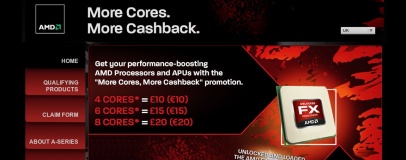
The sales incentive sees users given a partial refund on their purchase of qualifying products according to the number of cores: those buying a quad-core chip will given £10, those buying a six-core chip £15, and those splashing out on an eight-core chip £20. For Euro markets, the cashback amounts are €10, €15, and €20 - slightly less than the UK equivalent.
Not all chips qualify for the cashback programme, however. From the company's FX line, the FX-8120 and FX-8150 qualify for the maximum £20 cashback, the FX-6100 and FX-6200 for the £15 cashback, and the FX-4100 and FX-4170 for the bottom-end £10 cashback. Two APUs also qualify for the £10 offer: the A8-3870K and A8-3670K.
The promotion is open until the 31st of August, and comes with a
lengthy list of terms and conditions including a limit of two rebates per person, the requirement that the purchase come from an '
authorised eTailer' and a deadline for final claim submissions of the 18th of September 2012. The good news is that purchases dating back to the 11th of June qualify for the cashback offer.
The offer is valid in the UK and in Austria, Finland, France, Germany, Greece, Italy, the Netherlands, Norway, Portugal and Sweden. AMD has yet to confirm plans to offer a similar sales incentive elsewhere.
Full details, and a link to the claim form, are available on the
official website.

24 Comments
Discuss in the forums ReplyLooses I added a care. Nice idea though. Got to make it worth it somehow. Soz to bulldozer owners.
Just wow...
It's a promotion, Similar to HP's cashback offer on their Microserver.
Sam
looks like AMD are getting ready for a new launch - trinty and piledriver are due soon...
Neato :D
Bit of a sweeping statement there. Have you read every post I've ever made? Wasn't long ago I was using amd. And until January had never personally owned an Intel product that wasn't a network card.
Fact is, it's a nice idea, but the cost of them doesn't add up in the first place. It's not all doom and gloom but there is no apparent need to upgrade from a phenom 2 and unlike most New releases, there are more compelling reasons to stay with phenom 2.
2,3 & 4 cores with hardware assisted Hyper Threading is the more accurate reality.
True... When BD came out, everyone I know that likes AMD bought Phenom 2's or kept theirs... I just think that even with this incentive, these cpu's are too expensive for what they offer. They should have lower prices.
That's not really right is it. What if AMD (or any company) came up with a radically different processor design that didn't use cores (as we understand them) at all? Would you say it had zero cores vs Intel's 4, or 6?
Better still...why don't AMD just say "three-core-with-hardware-assisted-hyperthreading" instead of "6-core" on their packaging and marketing materials? Very catchy, and I'm sure Joe Public will know what that means straight away....or...perhaps they'll do what most people do...look for the bigger number and buy that one.
You can hardly blame AMDs marketing department for calling a processor "6 core" when it's in direct competition with Intel's 6-core offerings and is, for their architecture, the closet equivalent expression.
Some things like the Steam Suvey don't even use the term core. Take a peek at the hardware section and you'll see that 45.15% of PCs supposedly have "4 CPUs". I can only imagine how many people have looked at things like that and gone around talking about their quad-CPU system.
and need to sort out there bobcat cpus with oem laptop makers using them in full size laptops (15"+) as they are worse then an atom cpu under most cpu loads,
find it hard to recommend an amd laptop as most of them in the UK are the crap bobcat ones they mite have an one or two a8/a6 on show but the discounted i3/5 laptops are cheaper normaly even the dual core celeraon is just an i3 with bits chopped off (lower cache, no HT ) overall does not affect performance much
as to who when some one comes to me asking for good laptop just get laptop with power cable in the side (less likely to be broken off) i3 or i5 as long as its below £400 (sure Intel is doing something with oem to be constantly offering £100-200 off laptops prices )
i can't recommend an amd laptop as i have to explain to much tech jargon to avoid buying an laptop that is 10x slower then there last laptop they had before , bit-tech wish you would pass this onto amd
sorry if it seems an rant but amd need to sort out there oem laptop makers and stop them from using netbook cpu in an big laptop (its what Intel does, they do not allow atom in an laptop bigger then 11-12"i think)
also, amd's processors are physically the same amount of cores they claim they are. their 8 core cpu does actually have 8 cores, but each pair is tied together.
The AMD deal is the same: buy a qualifying CPU, send the receipt and claim form to AMD, receive a cheque (actually, a BACS payment) for up to £20.
Why not just reduce the prices by £20? There are a couple of reasons. The first - and least important - reason is that a blanket drop in RRP requires the cooperation of all your retail partners, some of whom may not be making £20 profit on the chip in the first place. That leaves you - and 'you' here means 'AMD' - with a bunch of ticked-off retail partners who need mollifying, and who may decide to make their next AMD order smaller just in case you pull the same trick again: nobody wants to buy 100,000 units based on an RRP of £100 if you're going to knock it down to £80 a couple of weeks later.
The second - and most important - reason for running a cashback scheme rather than just dropping the price: it's cheaper. You knock £20 off the RRP, and assuming all your retail partners obey, every single chip you sell nets you £20 less. Use a voucher-based cashback scheme, and suddenly your profits increase. Why? Because X% of buyers don't know about the scheme; another X% bought a chip thinking it was included in the offer but it wasn't; another X% lose their receipt before claiming; another X% forget to send in the claim form before the deadline; another X% didn't buy their chip from a 'qualifying eTailer.' The result: a substantial percentage of sales which occur at full retail price, while the company still benefits from increased volumes as a result of the offer.
Yes, it's sneaky.
Yep - that's pretty much it. There's also a third and fourth reason for running a cashback scheme (though your second point is still by far the most important)..
3) People like offers. Setting a new lower RRP doesn't scream "this is a special offer" to those who aren't in the know. They'll just see the price for what it is. People like to feel like they're "winning" somehow when they make a transaction. Buying something at the RRP doesn't feel like winning even if the price is cheap to start with.
4) Reducing RRPs in the long term leads to devaluation of the brand. Remember Cyrix CPUs? Yes, they were a load of rubbish, but they were £20. For those who were budget conscious that's a great deal - but it also meant that Cyrix were seen as the "cheaper option" which, like many brands-you've-never-really-heard of get tagged with the "it's cheap so it must be crap" label (and many of them are, of course). Thus, it's better for AMD to be seen to be giving money away (which sounds great) rather than to concede "we're the cheap option, you won't pay much, but don't expect too much either.
Indeed!