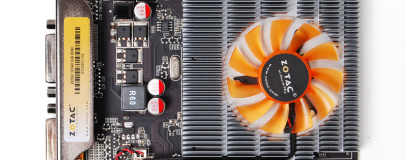
Nvidia's hardware partners have announced retail GeForce GT 640 2GB boards, while the graphics giant itself offers an OEM version.
Nvidia and its multitudinous hardware partners have announced the first mainstream-oriented Kepler graphics family, the GeForce GT 640 2GB.
A cut-down member of the GeForce 600 series, the first GeForce GT 640 card out of the gate - a fairly stock model from Zotac - boasts a Kepler GPU with 384 CUDA cores running at 900MHz, 2GB of DDR3 memory running at 1,782MHz effective on a 128-bit bus, and includes all the functionality you would expect from a 600-series card.
Most of the boards announced include a pair of dual-link DVI-D ports and a single HDMI output, with some adding in VGA either through a dedicated port or a DVI-to-VGA adapter bundled in the box. Fans of DisplayPort, sadly, will have to look elsewhere.
Thanks to its trimmed down GPU and cheaper DDR3 memory, Nvidia is positioning the GeForce GT 640 2GB as being for mainstream consumers who do a bit of gaming and are looking for an affordable upgrade away from integrated graphics systems. Accordingly, the company has focused heavily on the board's multimedia functionality including its hardware-accelerated Full HD video playback, Blu-ray 3D support and lossless audio bitstream capabilities.
That's not to say that Nvidia isn't hoping gamers will be interested in the board: like its bigger brothers, the GeForce GT 640 2GB includes support for multi-monitor gaming through Nvidia Surround and the company's Adaptive Vertical Sync technology, along with the same streaming multiprocessor (SMX) technology as other Kepler boards. Nvidia 3D Vision is also supported, when paired with a certified monitor and a pair of active shutter glasses.
As well as retail boards from its hardware partners, Nvidia has confirmed that it is producing an own-brand board of its own for original equipment manufacturer (OEM) customers. This more than anything indicates Nvidia's desire to convince system builders that an affordable discrete graphics board is a sensible investment, instead of relying on the on-board capabilities of Intel and AMD processors.
The boards have yet to show up in the UK retail channel in significant quantities, but a pre-order page from
KSN offers a clue as to pricing at £87.29 including VAT.

19 Comments
Discuss in the forums Replyhttp://www.tomshardware.com/reviews/geforce-gt-640-review,3214-5.html
http://www.overclockers.co.uk/showproduct.php?prodid=GX-294-SP&groupid=701&catid=56&subcat=1699
Only good thing about it is single slot HSF and no PCIe power connector required, but the HD7750 has both, is the same price (or cheaper!) and smacks it stupid.
(I do think the connector is slightly nicer than HDMI, but I've never been able to see the point in it otherwise)
HDMI attracts a licensing fee on all devices that uses it. DP does not, and is free.
HDMI includes device restrictions *cough*you're a pirate*cough* that can make it a pain. DP does not.
It is arguable which is better, but my opinion is that HDMI is better for Home Theatre applications (for obvious reasons) and DP is much better for PC purposes.
Is it a Dell Ultrabook you were referring to? I ask because the specifications implemented by Intel on Ultrabooks leave very little room for ports. Many Ultrabooks only have one or two USB ports for example, and so display port options are also going to be limited. If Dell chooses HDMI over DP on an Ultrabook it wouldn't surprise me.
Now NVIDIA really needs to bring out a 660 at a competitive price.
edit:
i asked a coworker to buy this for me (i gave him the cash while we were checking out, as newegg doesn't take money orders anymore).
http://www.newegg.com/Product/Product.aspx?Item=N82E16814125433
wanted to get the fat evga one (gigabyte is so unreliable), but this had an extra vga output. will update after testing...
Get a 7750. That should do okay as an upgrade. This probably will equal a 9800GTX. Which coincidentally is still a decent card.
You mean that the HD7750 (that doesn't have a power connector and only consumes 20w more than the GT640) isn't faster in a benchmark? Which non-CUDA benchmark is this? The HD7750 is faster in any benchmark you care to provide (in many cases almost TWICE as fast) and is the same price (or sometimes less).
Buying a slower card, for same money because you are enamoured with a particular graphics maker in one game - side-splittingly funny. And without seeing a benchmark for that game - laughing even harder.
BTW the HD7750 runs GTA4 @ 1280x720 at a similar framerate as a GTX550Ti, and the GT640 doesn't beat a GTX550Ti.
The massive flop of the GT640 can be seen at the complete lack of reviews at launch (Tom's is the only one I can find). Far, far too quiet. When was the last time that Nvidia didn't ramp up the media-engine for a product launch? Only when they didn't want anyone to take too much notice.
And anyway, I've never actually heard of anyone having real problems with HDCP, except when it was first introduced and not all hardware supported it. Anything you buy nowadays will work fine, and from my experience it is utterly seamless.
DisplayPort is the only connector that can power 2560x1440/1600 monitors with audio, unless you want to use dual-link DVI (not every monitor comes with and only 1 port per graphics card). HDMI cannot - it's limited to 1920x1200 (unless the 1.4b spec allows it? but most 2560 monitors don't have it)
Well it does, but it needs both a 1.4a output and input. In other words, at this moment in time. No not really.