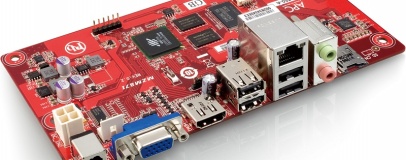
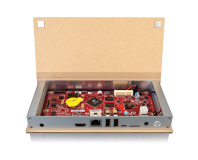
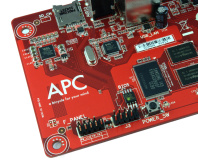
VIA's APC 8750 ARM-powered Raspberry Pi competitor boasts a clever neo-ATX form factor, which makes it mountable in mini-ITX or micro-ATX cases.
Low-power computing specialist VIA has announced its answer to the Raspberry Pi: an ARM-based neo-ITX system running Google's Android operating system.
Based around a WonderMedia ARM11 processor running at 800MHz - 100MHz faster than the stock Raspberry Pi BCM2835 chip - and with 512MB of DDR3 RAM - twice that of the Raspberry Pi, and faster to boot - the APC 8750 is certainly impressive at first glimpse. Additional features above and beyond that of its credit-card sized competitor include 2GB of on-board NAND flash storage, four USB 2.0 ports, microphone input as well as analogue audio output and an analogue VGA connection in addition to HDMI.
Not everything about the APC 8750 will impress Pi fans, however: for no readily apparent reason, the device is limited to 720p output (1280x720) through its HDMI port, while the Pi manages 1080p (1920x1080) or higher. The system also requires an external power supply, adding to its already sizable dimensions. Finally, the device is also more expensive, costing $49 to the Pi's $35.
VIA is targeting a subtly different market with the APC 8750, however: its clever neo-ITX form factor, measuring just 17cm by 8.5cm, allows the device to be housed in any standard mini-ITX or micro-ATX chassis. The Pi, by contrast, is significantly smaller but requires custom cases to be constructed.
Where the Pi is targeted at education and curious hackers, the APC 8750 has its eyes firmly on the developing world.
'
APC brings the familiarity and convenience of Android to the PC at a $49 price point that will open up exciting new markets and applications,' claimed VIA's Richard Brown at the device's unveiling. '
Like a bicycle for your mind, APC will enable more people than ever before to explore the vast online universe.'
The APC 8750 comes pre-loaded with Android 'Gingerbread' 2.3, a somewhat outdated version of Google's smartphone- and tablet-oriented operating system. While that means it's ready to go as soon as it's unpacked, there's no news yet as to whether VIA will be opening up the bootloader to allow other operating systems to run on the device - another tick in the Pi's favour.
The company has indicated that the APC 8750 is to be but the first low-cost low-power device in a new APC family. Details of future devices, however, are not yet available - but it's easy to imagine a more powerful, dual- or quad-core version with integrated Wi-Fi and Bluetooth launching in the near future should the initial device prove a success.

31 Comments
Discuss in the forums ReplyRaspberry Pi is still almost impossible to get, so this might make a dent in the market.
Lets just hope the community can get behind it and offer some good homebrew goodness over and above the android it allready has.
From what I have gathered, the RPi just uses a miniUSB port for its power.
This uses 12V.
So, you might be able to plug it into your case with an extra 12V header.
I think I just found the board for the LCD in the side of my case.
The Pi will run on any 5V power supply capable of feeding it 500mA on the unlikely-to-ever-be-released Model A or 700mA on the Model B. That's more than a PC's USB port can offer, even after negotiation - which the Pi doesn't do.
You could probably build a Molex-to-microUSB adapter and power it straight off the PC's PSU, though.
Not sure why, really, as your interpretation makes a lot more sense!
Seroiously, though, this might make for a decent Linux box for an HTPC.
Windows RT won't work - it's only for OEM use with a small number of partner companies' SoCs, and this ain't one of 'em. As for the others, they'll only work if VIA opens the bootloader - otherwise you're stuck with whatever version of Android they choose to give you (2.3 currently, with no mention of any planned upgrades.)
I'm waiting to hear back about the bootloader.
That's certainly one of the more interesting concoctions of marketing tripe that I've heard... can you imagine exploring the universe on a bike? It would take a long time... :D
So being slightly less negative, looks an interesting bit of kit but it's a shame if it's android exclusive and only capable of 720p -- I suppose if it's popular enough *nix hackers will break it so it can run custom distros.
Thats the term i was thinking of my minds gone to mush today with logistics planning. I have both on SD cards waiting to try on the Pi rather than emulate them.
Also not sure if im loosing the plot but im sure i saw something about windows 8 possibly having Arm support on the mobile version though spec wise im not sure if its going to be compatible.
http://gareth.halfacree.co.uk/pubimages/wm8710-blkgram.jpg
Note that the processor itself supports 1080p, but VIA has for no readily apparent reason decided to restrict it to 720p in the APC. Also, check out the stuff VIA is leaving unused: infra-red support, MPEG-TS decoding for DVB reception, camera input, TV/LCD/LVDS outputs, gigabit Ethernet (if you spend the cash adding in the required PHY), JTAG port, six UARTs, two I2Cs, two SPIs...
The other final bit of interest from the block diagram: the WonderMedia 87x0 family has an on-board real-time clock, which the BCM2835 on the Raspberry Pi lacks. That may or may not be important, depending on what you're planning on doing with 'em. (If you've got GPS, mind you, an onboard clock is fairly redundant.)
Cheers.
Thanks for the clarification.
...
Still....
*You could also use a keyboard with a built-in USB hub.
This'd be almost PERFECT for my Dell GX150 case I have!
Much of the work that needs to be done with the Rasbperry Pi will also need to be done with this: drivers. Part of the problem with the Pi at the moment is that very little can tap into the GPU powerhouse because there is a distinct lack of accelerated drivers. The foundation have already stated that it is unlikely that either they or Broadcom will be releasing accelerated X drivers, kernel modules, etc. There's a lot of work ongoing to try and offload graphics processing onto the GPU, but one of the biggest issues is that the GPU supports OpenGL ES rather than standard OpenGL.
If the APC is to succeed with another operating system it's going to need drivers. Especially if people hope to utilise all those funky widgets in the block diagram. If VIA isn't going to release drivers - or will only release/support Android drivers - then it'll need a big O/S community behind it, and I doubt they'll match the level of interest that the Pi has.
It's certainly a promising and capable device, but I've kinda planted my flag in the Raspberry Pi camp already :)