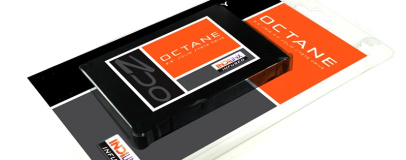
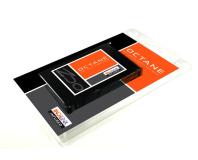
OCZ's new Octane 1TB is the first 2.5in solid-state drive to offer such an impressive capacity, but it doesn't come cheap.
OCZ has announced plans to launch a 1TB 2.5in solid-state drive (SSD) based on the Indilinx Everest controller, as part of its Octane family of drives.
The impressively capacious Octane 1TB uses a SATA-6Gb/s interface, but its performance rating isn't the greatest: despite a high-speed interface to the motherboard, the drive manages a somewhat lacklustre 460MB/s read and 330MB/s write. Throughput in input/output operations per second (IOPS) is given as 24,000 IOPS for 4K random reads and 32,000 IOPS for 4K random writes.
The performance from the multi-level cell (MLC) flash may not be much to write home about, but the capacity is nothing short of astounding: holding 1TB of data, the Octane 1TB is designed as an alternative to OCZ's 3.5in Colossus LT 1TB for uses where a physically smaller drive is required.
It's also the first 1TB 2.5in SSD on the market, and as a result will likely find favour with blade server users who need speedier storage than mechanical drives can offer without sacrificing capacity.
Sadly, those are about the only users likely to be able to afford the device: official pricing has yet to be announced, but Scan has confirmed that it's taking pre-orders on the drive at £1,963.02 - making it supremely unlikely that anyone will be using it as an upgrade to their laptop's existing storage device any time soon.
For the cash, buyers do get Indilinx's proprietary page-mapping algorithms, claimed to boost performance in real-world mixed-workload environments, along with NDurance technology for improved NAND flash lifespan. The drive also includes automated AES encryption, for those of a security-oriented mindset. A three-year warranty is included as standard.
Where one manufacturer has gone, others will follow. We're expecting to see a flood of 1TB 2.5in SSDs in the near future, with pricing - hopefully - dropping steadily to something the average home user can finally consider as a premium-grade purchase.

23 Comments
Discuss in the forums Reply£1900?
No, sir, no.
People ask why I don't use SSD's - This is why.
I do not fancy a.. £27500 bill for making everything, for all intents and purposes "A bit" faster.
SSDs are massively quicker...
But if he's talking about 14TB worth of 'average BT user data' storage it's unlikely moving from mechanical drives to SSDs will make accessing said data anything more than 'A bit' faster. But of course it all depends on the gear and what use.
If he's streaming 1080p videos then he'll be fine with mechanicals as it's the network that's the issue.
If he's hosting a 5TB SQL Server database on local storage then those SSDs will suit the job nicely.
Horses for courses.
Edit: I currently have a 120GB SSD and a 1TB spinner in my MBP, I'd love to rip them both out and install a couple of these. But not at that cost...
How have you got 2 Drives in your MBP?
replaced the optical drive with one?
http://www.mcetech.com/optibay/ ← probably
my mate bought one of these and i remember the price being pretty ridiculous. seems even third party mac stuff gets a premium shoved on it
Costs more to put vastly more data into the same space. The fact it exists alone means that they should eventually become affordable, give it 2-5 years and providing there isn't a better alternative beating out SSD's these will become commonplace in these sizes :)
Likely because it wasn't trivial to shove that much capacity into a 2.5" drive. Yes, there have been other 1TB SSDs, as the article itself points out, but this is the first 2.5". You want bleeding edge, you'll always pay a premium.
Personally, I'd appreciate a move to PCIe SSDs for consumer-level hardware. PCIe 3.0 supports a data rate of 15.8 GB/s on a x16 link. Make it bootable, TRIM support behind the hardware RAID on the card - hell yes. Granted, currently they don't typically use a full x16; x4 is more common, iirc. I'd give up 16 lanes for that, not that I'll be able to afford it until it comes down to $100 :p
Remove the optical drive.
Unlikely*.
Despite how high it is the GTX690's price can be argued as "reasonable" as it is basically 2 x GTX680 for roughly the price of 2x680GTX (if we look at in stock average prices rather than out of stock anomalies).
This 1TB drive on the other hand offers only double the capacity of a 512GB Crucial M4 but costs nearly 4 times as much.
I could understand it costing around £1,000 to £1,250 but £1,900+ is just taking the mick.