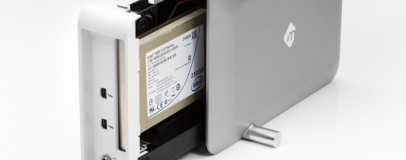
The mLink Chassis turns half-length PCI Express cards into external Thunderbolt-connected devices, but it comes at a serious price.
mLogic has announced that it is to begin shipping its mLink PCIe to Thunderbolt Expansion Chassis in June, providing a means for laptop and small form factor users to access hardware previously restricted to desktop systems.
As the name suggests, the mLink Chassis is an external casing which provides a PCI Express slot and a pair of Thunderbolt ports to turn any PCI Express card into an external device. The chassis support a single card apiece, but the paired ports mean they can be daisy-chained for up to six cards into a single system.
There are, unfortunately, restrictions: while mLogic claims that graphics cards are supported, the chassis only has room for half-length cards. As a result, the most powerful hardware - and, by extension, the hardware laptop users are most likely to want to add in to their systems - simply won't fit into the device.
Despite that, mLogic is keen to point out the potential of its creation: PCI Express-based HD video capture cards, RAID controllers, solid-state drives, 10GbE network and fibre-channel host bus adapters are all available in half-length formats, opening up an impressive world of peripheral joy for previously bereft laptop users.
Sadly, such functionality comes at a not-inconsiderable price. While mLogic has yet to confirm UK availability and pricing, the company has given a US recommended retail price of a whopping $399.99 (around £253 excluding taxes.)
That eye-raising price tag is perhaps unsurprising when you learn of mLogic's target market: video editing professionals with high-end MacBook Pro laptops who need high-speed access to storage, networking or video capture devices. For the rest of the world, however, mLogic's creation is likely to remain out of reach for quite some time.

14 Comments
Discuss in the forums ReplyIt's a pro-device aimed at pro users with specific needs. It's got very little (Nothing?) to do with your normal subject matter. So while I herald the aim to break into new areas I question the logic in jumping in with such an isolated and negatively pitched article.
Are Intel holding it back for the inevitable Ivy-Bridge-E motherboard refresh or have Apple tied their hands for a few years of exclusivity?
Wouldn't there be massive OS X driver issues with this? If Thunderbolt is an interface port, surely you still need drivers for the actual device that you want to use? (Much like USB) My own experience of Hackintoshes and using PC hardware with OS X leads me to believe that there will be few official drivers available - if any - meaning that this would enjoy very little support outside of a few niche areas.
Apparently there's a new revision of Thunderbolt due any day now, which is open access to anybody (and the controllers are cheaper as well). I'd hope it'll be on PCs within 6 months to a year.
PC laptops have full size PCIe slots to fit in a desktop GPU? Wasn't aware of that...
Drives could well be an issue. Some GPUs are supported by OS X with a driver update (namely NVIDIA cards), whilst others would need new ones to be written (namely AMD cards). Any other kind of device would also need drivers of some flavour (but then people who make RAID cards etc have been doing this for years).
When I first read the article, I assumed it took Mini PCI-E cards and/or ExpressCards. It wasn't until I found a larger version of the photo, showing that what I assumed to be an ExpressCard is actually an SSD, that I realised otherwise. I wasn't aware that you can get storage devices with a PCI-E interface; I had assumed that SATA (or real high-end stuff like SCSI, fibre-channel, etc) was standard...
The more I think about it, the more I keep coming back to this post:
This is a *really* niche product... You can indeed use most Nvidia GPUs natively on OS X, but if you're talking about AN Other PC PCI-E card, then it's going to need custom drivers. Chances are that most manufacturers aren't going to provide that for such a limited use case.
Bear in mind we've also covered such gems as Intel's Internet of Things Joint Lab, Snapdragon-based laptops, Microsoft's Project HomeOS, the Tricorder Project, and an ATmega that can run Linux - every single one of which I would argue is more 'niche' than a PCIe-to-Thunderbolt bridge.
I may, however, be biased: I have a PCMCIA-to-PCI bridge in the back of my PC as I type...
PCIe SSDs are usually seen in the enterprise world. Way better performance than the ones we use, and higher capacities...and cost!
As previously stated, manufacturers have been making OS X drivers for PCIe cards of various kinds for years now (Mac Pros have got them), don't see why they would stop. The product in this case isn't going to need drivers, as it will be invisible to the computer, so it's just driving the end device in the PCIe slot.
I do agree it is a bit niche though, not exactly much demand...
I wasn't trying to criticise the inclusion as a news story, just that it took me a while to get my head around what it actually does and what goes in it... Besides, some of the other stories you mentioned are pretty cool so it doesn't matter that they're niche! :D
Don't doubt that many PCI-E (I keep trying to type PCE damnit) cards exist for Mac, with full software support. But the market for Mac Pro's is still relatively limited, never mind PCI-E expansion cards supplied with OS X drivers or native OS X support. Please don't misinterpret this as a Mac vs PC thing though; I got over that p***ing contest years ago and I'm not trying to slight either platform. My point is more that many manufacturers don't even release Linux drivers and, outside of hardware that's already designed with OS X in mind, it wouldn't be any better for generic hardware under OS X. That doesn't make it a bad product, it just limits its utility.
I am curious regarding what you mention regarding not needing drivers, though... Do you mean that the mLink chassis itself does not require drivers (which is what I would assume) or that the PCI-E card in the chassis would not need drivers?
Only the same issue as running any PCI-E device in a Mac Pro. Those mfrs aiming at pro mac users will already have drivers sorted out for a Mac Pro.
This is exactly what Sony did with their Z series laptops not long ago - the laptop only had integrated graphics, but the Thunderbolt connected unit held a BD burner and a discrete 6 series Radeon, with appropriate outputs. It's what Thunderbolt was designed for, but is just taking forever to get anywhere!
What I would hope for this though is to make it much more generic - not just a specific box sold for use with a specific series of laptop, but just "it's a box, put whatever graphics card you like in it, use whatever Thunderbolt laptop you like".
But... As you say this box won't do full size GPUs (it's not designed for that). The full size Thunderbolt PCI-E enclosures are more expensive... and announced a long time ago... and don't have the power requirements for a high end GPU... and the thunderbolt ports won't let you drive a GPU at full speed anyway. It's all currently tech for professional mac users.
This is tech designed and marketing for a specific niche in the industry. Yes one day it might allow you to hang a huge PCI-E of your Ultrabook / Macbook Air but not yet and not really even being talked about on product roadmaps.
This wasn't an article talking about the future possibilities of external devices replacing internal (We all do that to some extent with external drives these days). No it was a mini-moan about high priced the product was.
Thunderbolt is a tech that's growing all the time, but it's being adopted in a different sector. Take the new Blackmagic Cinema Camera, the first camera to come equipped with a thunderbolt port. 2.5k 12bit Raw video for $3000. Yes it'll really work well ATM with a Mac but do you think the pros care about that? They want it to work that way.