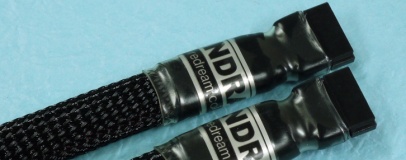
WireDream's £190 WD-SATA-INDRA cables can boost audio quality appreciably, the company claims.
Audiophiles have long claimed that expensive cables constructed from oxygen-free copper, gold or even more esoteric materials can have a serious impact on sound quality - but now a Korean company is making the same claims for SATA data cables.
Korean company WireDream has announced the release of its WD-SATA-INDRA cables, now available for sale in Japan via local company Zionote. The key feature of the WireDream cables is its use of wires made from 97 per cent sterling silver and 3 per cent pure gold.
WireDream goes beyond mere materials, however: the cables are constructed using a high-temperature treatment for several hours followed by low-temperature processing for a hundred hours, before being 'aged' so the cables are 'broken in' by the time they are shipped. The result: 100 per cent ability to make some truly questionable claims.
The SATA cables are designed, as all SATA cables are, to sit between a storage device and the motherboard of a PC in order to transfer a digital signal. This signal, containing the zeros and ones which make up the stored data, either gets to its destination intact or it doesn't. WireDream claims, however, that use of its SATA cables results in a detectable improvement to audio quality.
We'll repeat that again: switching SATA cables to WireDream's silver-and-gold model is claimed to boost audio quality. According to importer
Zionote: '
While every effort has been made with various field tests, we decided to sell [the cables] because the effect of improving the sound quality was observed. Sound quality will become like smooth analogue sound, while a sense of stage depth is widened. The sound of vocals and stringed instruments in particular should be easy to understand.'
Neither WireDream nor Zionote are willing to provide an indication of
how the cable affects the quality of digital audio files transferred between the storage device and the host PC. The companies are also silent on whether the cable works for other file types: are images given a deeper colour gamut, games more weapons or databases more detail?
Zionote has confirmed it will be selling the cables for ¥24,800 (around £190 excluding taxes) in 40cm length, with 50cm and 60cm versions made to order. If you're interested,
OlioSpec has the cables available for mail order - and we have a bridge in Brooklyn in which you may be interested...

74 Comments
Discuss in the forums Replyshouldn't these guys be prosecuted for scamming? :o
*Cough* Bolloks
Ive just invented some *insert name of most valuable metallic mineral known to man* necklace that improves the efficiency of the human ear when worn around the neck.
Such advantages include:
1. Increased Bass response.
2. You can actually feel the instrument you currently here in your hand, as if you where playing it yourself.
3. Changes your physical appearance to a likeness of the artist singing/playing.
But yeah, the claims here are utter balls.
I read a bit on some high-end hi-fi site, and gave up due to snake oil poisoning.
dunx
However, about that bridge...
Why so sarcastic :D. Oh wait, i know why... Because the product itself deserves it :D. I wonder how long will it take for Monster Cable to sue them for selling overpriced cables (i guess they have a patent for that) :D.
That said, I'm highly sceptical about these sorts of products.
Sure, we can talk about that when we will talk about 15 meter HDMI cables, long USB ethernet cables.
But this is a SATA cable connecting the hard drive to the motherboard. It has ZERO impact on audio quality.
Actually, error correction is where the claims for higher quality cabling affecting digital come from.
Error correction can cause noise (from the chips making the calculations) and jitter (from delays caused by the calculations, or a request to re-send).
Better digital cables where the transmission is one-way will generally improve things to a point (eg SPDIF or try getting a decent freeview signal 30 miles from the transmitter using chewed up cables).
But, i'll be taking these claims with a pinch of the white stuff ... the SATA connections are likely far enough removed down the chain not to have an affect.
However, if the manufacturers will send me 15 of them, i'll happiliy replace all the sata cables in my file server and conduct some double blind testing.... before sending them off to we buy any gold (dot com)
I wonder how products like this even get to market -- are there people that actually believe these claims?
http://www.monstercable.com/digital_life/categories/usb.asp
Description of one of their USB cables :
No comment.
I note you've said "subculture", but I just wanted to point out that some audiophile gear can be empirically proven to provide better quality sound (Whether it can actually be perceived or is at all worthwhile is another matter)
Monster cables and similar offspring obviously do not -- binary is binary.
Hey, I can hear that difference as well - or rather I can't, because there is no whine and access noise when a new track is loaded from an SSD.
For a computer dedicated to audio playback an SSD is a sensible investment. (And usually rather cheap compared to some of the other components of your hifi setup.)
As I understand it, none of that matters - not flaming though, just so you know ^^
The timing of the signal is irrelevant because everything is buffered. Devices that can't use large buffers (such as sound cards for recording music where round-trip latency has to be low for monitoring purposes) have their own internal clock gen anyway.
The squareness is irrelevant because all that is required for perfect playback is for each 1 or 0 to make it across the cable intact. There needs to be some heavy corruption of the signal for this not to happen and it will be obviously broken if it does (see UK digital TV for an example).
The reason people keep buying into all this nonsense is that if you WANT music to sound better it DOES sound better, because your brain has the power to alter the way you experience the world around you - the same way food tastes better if you're sat outside in the sunshine :D
Still, companies like this are good for a laugh.
Cables for digital sound do not - it's digital signal, it just has to arrived.
I understand spending a lot of Hi-Fi and speaker cables.
I do not understand spending a lot on AV and computer cables.
pfft that's nothing.
http://i.imgur.com/k7n9Q.png
The only difference is, because some people have spent ball-crushingly large amounts on cables that they try and justify it with crappy attempts at pseudo-technical explanations, willingly helped on by the companies that make them. This applies to both digital and analogue cables as well, they're just as bad. Given that monitoring equipment far more sensitive that the human ear cannot tell the difference, there's really nothing to it. Arrange a blind ABX test and it becomes very clear that there's nothing in it.
:( Some people will believe anything as long as you pretty up the description in pseudo-science speak.
In this case (fancy SATA cables), I agree completely. I was just pointing out the fallacy of the "digital is digital" argument presented by MiNiMaL_FuSS and others. With current technology, digital is actually analogue and at the moment it enters a typical DAC circuit, the quality of the "digital" input affects the quality of the analogue output.
This kind of comment is what often lends credibility to the claims people make about their magic pixie dust audio cables. Fancy magic pixie dust cables are all a terrible lie. The sound quality of an audio system can't improved with "high quality" cables so these cables don't change the sound or make a difference.
The confusion often comes from people using cables are are completely inadequate that are degrading the sound quality, which, if replaced with a set of cables of a sufficient gauge will sound fine. Beyond the sufficient gauge the sound quality isn't "improved" upon at all because it's simply not possible. It's not a case of the difference being questionable, the difference is simply not there in the real world, whether some chump who's just spent thousands on them hears a difference though is another matter, but that's their issue. But because of this, I don't count cables that are below spec, because they shouldn't be used at all and therefore shouldn't be referenced against for "sound quality".
Or in other words cables that aren't fit for purpose will degrade sound quality, but it's not the same as high quality cables increasing sound quality, because it simply doesn't work like that. £5 per metre is still way too much and completely unnecessary. You could wire your hi-fi up with coat hangers and the sound quality would be as it should be.
The above also applies to digital cables too, a poor cable (poor means below spec) will degrade audio and image quality to a point where it's clear there's something wrong. We all know the "it's digital, it's either on or off" is used a lot, and it's not true but generally speaking it may as well be true. With digital, the image is either fine, problem free, or it's clearly degraded in some way. Be that artefacts, corruption or any other visual disturbance that indicates there's a problem.
Eurogamer did a test with some HMDI cables which involved hash checks of images going in and out of HDMI cables and guess what? They were the same through cheapo but in spec cables, and expensive magic pixie dust cables too.
Meh, lamp cord for $1/ft or less. Once it's thick enough to carry an adequate signal (and unless you're pushing several hundred watts, it's likely already fine), it matters not at all.
Gotta admire the balls here, though. I mean, well over $200 for a 40cm cable? I think they've stolen Monster's game right from under them!
Even if they made a difference (in signal transfer, if not in audio), would the oxidization that will start nearly immediately make a difference down the road? Silver isn't magic like alu, where the oxidization protects the metal from further oxidization, so won't these break down, given how reactive silver is to oxygen?
I do think hi-fi sites / magazines have a lot to answer for, extolling the virtues of overpriced magic cables. This goes for analogue cables to an extent, but especially for digital. Like the other commentators, I use the most basic acceptable quality digital interconnects I can (so not the dodgy 99p eBay HDMI cables, but the £3-10 (depending on length) ones). I do think proper speaker cable makes a difference as it is a powered analogue signal, but I'm talking about switching bell wire for basic oxygen free copper speaker cable at £5 a metre, not crazy money silver cable at hundreds of pounds a metre.
Note I'm not saying expensive Blu-Ray decks aren't worthwhile - they certainly tend to offer considerably better build quality and may offer better features. The remote is likely to be a lot nicer. The interface is likely to be nicer. They may last longer and look better in your equipment rack. But on pure sound and image quality I am unconvinced.
Thoughts?
There probably are differences, if the player does some postprocessing ("image enhancement"). Otherwise no.
given the same CD two players may output different signals due to:
-poorly balanced disk, causing the laser to miss it's target
-poor optics causing incorrect readings of the laser's reflection from within the disk
-poor hardware/firmware causing errors when interpreting output from the optics
But I'm no expert, this is just a guess.
I suppose you could just read the same disk with two drives and compare the output bit-by-bit and find out for sure whether there is a difference or not.
Also the quality of a cable doesn't affect an analog signal (as some have said here). Shielding might though, if the cable is exposed to appropriate EMI.
Oh yes, fair point. But I'd argue that your Blu-Ray player shouldn't be doing ANY processing at all - it should deliver the uncompressed signal to the monitor in the pure form it was intended to have. Any digital processing required (and for a well mastered Blu-Ray processing should be minimal if any) should happen in the monitor, which is already tasked with colour calibration etc. To process the image in multiple places risks a form of generation loss.
" I think we should take it as a given that (unless a disc is so defective that one of our test Blu-Ray players can't cope with it at all), the bitstream read from the disc is identical irrespective of the player used"
Well my point was that if the player is of poor quality you might expect more errors due to poor balance, poor optics, or whatever. But your right as long as the errors are correctable the output will be the same.
I guess the question is whether or not small (as in single-bit or close to it) errors cause playback to fail completely or just alter it (causing "poor quality"). I don't pretend do know.
@mclean007 again
"I assume you mean it doesn't affect a DIGITAL signal, right? All conductors have resistance, capacitance and inductance, all of which can affect an analogue wave form."
I mean analog audio. When it comes to normal speaker cables there's no audible difference between a coat hanger and $2000000-magic-cables. If your using conductors that have no business being used for speakers then sure, you'll have a problem, else, not.
Well of course you think it was a worthy investment, you spent £90 a metre on magic pixie dust. The cables you bought, in the real world, don't do what you think they do over a standard properly specced cable. The cable merely needs to be of a sufficient gauge and that's it.
Generally with expensive Blu-Ray players you'll be paying extra for all the extra features they offer. I'm fair sure some come with DLNA capabilities for example, better OSDs, build quality, warranty, better build materials so it'll end up lasting longer, and all those kind of things.
If I were looking for a new Blu-Ray player as soon as you go over £100 I'd just pick up a PS3 because of all the benefits that come with it. I personally can't see me liking a stand alone Blu-Ray player more than my PS3, not because it's a games console because it's very rarely used for that, but for a media player. 95% of its use is either Blu-Ray movies or streaming Blu-Ray/DVD rips and TV shows over my network to my TV.
I agree
I would guess that actual AV-quality-per-$ differences between various players are not worth worrying about. If a player works at all chances are you wont be able to tell it's output apart from another working player's output.
If a player is corrupt enough to degrade AV to a noticeable amount chances are it's output wont be able to be used at all.
Overall quality or features should be the deciding factor.
I would assume that AV quality claims for blue-ray players are mostly bullshit.
"That's a matter for debate..."
Thicker wire might result in a louder signal if your dealing with a few hundred watts or more, which might in turn let you turn the volume down on your amp. If your amp was over-worked before then using a thicker wire may indeed result in better sound (as your amp is working better at a lower volume).
But in terms of audio quality (not volume) as a result of just the cable (not the amp or speaker which may do better with various levels of cable resistance) I doubt there is any difference.
I'm not saying that using an ethernet cable for a 1kW amp is a great idea - you do need to use the right cable for the job, I'm just saying that cable material (or build quality ) isn't going to affect relative voltage at the other end (which what this comes down to).
That's exactly how it is. It's very much like the HDMI cable reviews where you'll find a lot of the same phrases. They purposely focus on things that can be deemed subjective . Generally there's no reason to buy an expensive Blu-Ray player, it's just a way for some companies to make more money from gullible people with bulging wallets. Well I say gullible, but it could also include people who are very well off and are happy to spend a huge amount to get one that they like the look of. However, as I said before anything over £100 and just get a PS3, they're the best blu-ray players to get in my opinion with the added benefit of being able to play games on them if you wanted to.
I am very interested in Hi-Fi and AV stuff, but I tend to avoid websites and magazines related to it (other than AV forums) because it's full of rubbish about how quality doesn't stop going up as long as you keep dropping loads of money on the latest audiophile fad. Cable elevators says it all as far as I'm concerned, that in this kind of industry they're not completely and utterly blasted in to oblivion upon the mere mention of them. Magic pixie dust cables are bad enough, gold plated toslink are even worse but cable rises? They hurt my brain.
This is where the problem lies. Too many people exclaiming "this magic pixie dust cable makes loads of difference". People will hear *a* difference in the sound and attribute it to it being an increase in sound quality without actually understanding what they're hearing.
It reminds me of that monster test that had two speakers next to each other, one with "MONSTER" cable, and one with woefully inadequate bellwire. Naturally, the one wired up with bell wire's volume was pretty low, whereas the "MONSTER" cable was of a sufficient gauge, so it was louder. Obviously they're being very ambiguous by saying "Hear the MONSTER difference" because there was a difference, you could easily tell that but they were falsely misrepresenting the inadequate cable by inferring that it was a standard cable.
This is how they effectively conned people with their "tests", a lot of people fell for it and they made a lot of money from people who had no idea, and weirdly they still do. Some people just don't want to listen to the suggestions that their magic cables aren't actually magic and it's just a con that they spent £90 a metre on them.
Any changes in sound are related to sound degradation, or the lack of it when you use an adequate cable, not an increase in sound quality.
"You're oversimplifying this"
I don't think I am.
As far as normal home audio goes (anything from a few to a few thousand watts per channel) capacitance and inductance of the loudspeaker will affect sound FAR more than wire will. Resistance of the wire is the only thing that has any real possibility of degrading your signal (audibly).
"You can definitely measure a difference between identical electrical signals transmitted over different wires. The only matter for debate is whether it can be heard."
Sure, I agree with that. I'm just saying that the difference cannot be heard.
And if your happy with your purchase then more power to you, but I think a lot of these products are unfair to most consumers who don't know they are wasting their money. It's kinda like people selling fuel-saving additives (that don't work), it's a total scam (even if the consumer is happy with their purchase).
Also OFC, oxygen free copper, used presumably to keep copper-oxide out of cables, is a gimmick. You can make a cable entirely (or partially, it doesn't matter) out of copper-oxide and you'll detect no signal distortion.
So yeah I disagree with you, but I don't have enough wire coat hangers to connect my speakers D:
dunx
Huh? In a digital signal, the information being sent is completely removed from the condition and timing of the analogue carrier wave. If it gets there intact, it's perfect information.
Nor I.
It's a bit like saying using a better quality PSU in your gaming PC makes the voice acting in Oblivion more convincing.
Well if you use a REALLY crappy PSU there won't BE any voice acting in Oblivion.. ;)
You're missing the point (and couldn't be more wrong if you tried). The point is that your typical DAC circuit is not "perfect"; its output is affected by the quality of the input (even if all the bits are intact). Do some reading.
I think you're missing the point:
Data stored on disks is stored in binary. if read correctly there is no "quality of input". You might as well be talking about the "quality of input" of your hard drive.
Analog is not the same at all.
Because you are using wrong arguments unfortunately. If all bits are intact, then the quality of the input is perfect.
Pretty much the only place where you can have digital errors is when you stream without error recovery (your typical huge error blocks in DVB signal), the cable is too long (above maximum length allowed by specification) or the cable is damaged (not up to specification for the specific cable type).
The digital part either works or not. If not, you get damaged data, which is either corrected (CRC data integrity checks, for example in case of SATA or ethernet cables) or not - ignored and processed as is (streaming, DVB).
The other side of the DAC, the analog part can produce better or worse sound - but that is irrelevant to this discussion.
Ya can't learn without being wrong, no need to regret :P
To save me some time, why don't you tell me specifically in what way the quality of a digital input affects the analogue output of a DAC? You can't just tell us we're all wrong without actually providing any facts to support your position.
As I understand it, the DAC produces output voltages that correspond to the original signal, with some interpolation. The fact that the output from the DAC doesn't quite match the original analogue signal is due to a) the sampling frequency/compression of your music and b) the limitations of the DAC. Both are entirely unrelated to the quality of the input signal.
;)
If you had 3k worth of HiFi you wouln't cut corners on speaker cable. It makes a huge difference to the sound quality......you woulnt pair a GTX 680 with a cheap low res LCD using VGA would you?
not to be a douche but actually that isn't unrealistic. first of all, low res is relative. people on these forums think 1680x1050 is small, when its really just average. on a resolution like that, VGA works fine as long as you don't care about the auto-tuning. but even technicalities aside, 2 GPUs like that could be used for GPGPU purposes instead of gaming.
i do see your point though and i agree with it (with the exception of the setup i described).