The silk of the golden orbweaver spider has proven a more efficient conductor of heat than copper, promising a new breed of heatsink.
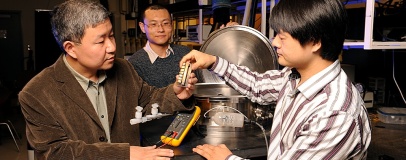
An engineer at Iowa State University has made a discovery that could lead to improved flexible electronic components: that spider silk conducts heat as effectively as metal.
Revealed in the journal
Advanced Materials, associate professor of mechanical engineering Xinwei Wang's discovery came as he looked for organic materials as effective at the transfer of heat as copper, aluminium and diamonds. While some had speculated on the potential of spider silk in such an application, it had never been experimentally tested.
Along with researchers Xiaopeng Huang and Guoqing Liu, plus funding from the Army Research Office and the National Science Foundation, Wang was able to test the web of golden silk orbweaver spiders (
Nephila clavipes) for thermal conductivity. The results were surprising: the draglines used to anchor the spider webs in place conduct heat better than most other materials, including aluminium, silicon and pure iron.
According to Wang's experiments, the spider silk tested at a heat conductivity rate of 416W per metre Kelvin. In contrast, copper - a common material for heatsinks - measured at 401W per metre Kelvin. Traditional silks, such as that of the common silkworm, conduct at a mere 0.4W per metre Kelvin, while human skin manages 0.6W per metre Kelvin.
'
This is very surprising because spider silk is organic material,' Wang explains of his discovery. '
For organic material, this is the highest ever. There are only a few materials higher - silver and diamond. I think we tried the right material.'
The spider silk has another interesting property: its thermal conductivity increases when stretched. According to Wang's testing, stretching the spider silk to its 20 per cent limit increased thermal conductivity by the same value, contrasted with typical materials which become less efficient conductors as they stretch.
It's this property which could lead to spider silk becoming a key component of flexible electronics, as used in wearable computing devices and prototype folding displays.
Wang's research could also, theoretically, lead to a modified form of spider silk being used as a thermal transfer material in computers. Instead of the typical copper or aluminium base on a heatsink, a sheet of stretched spider silk would provide increased thermal transfer and better overall cooling performance.
Wang is being careful not to suggest that his research is ready for commercialisation, but claims that the preliminary results are promising. '
I've been doing thermal transport for many years, he explains. '
This is the most exciting thing, what I'm doing right now.'

29 Comments
Discuss in the forums Reply? Breed ? :P
I'm under NDA hehehehe!
"anchor the spider webs in pace" Pace should probably be place.
Cool article and I agree is there anything spiders can't do?
Once they've worked that out, unfortunately I imagine the resulting product probably has a million and one more pressing uses than as a heatsink.
(I had to try pretty hard not to say "tweaked" or "modified")
This is very interesting. Perhaps if they were able to determine more details on how the molecular structure of the silk enabled such good heat conductance they would be able to make more refined synthetic materials so we can have non-metal heat-sinks? Or maybe water cooling tubing made out of the stuff?
See:
It'll be massive goat herds.
your coat sir
There is a farm in the US that's worked it out, they have spliced the silk making DNA/Genes whatever ! from (I think) an Orb Weaver Spider with goats to create spider goats ! (True) (they just look like normal goats :( )
When the spider goats are milked, the milk gets refined and they get spools of spider silk straight out of the refined liquid !
http://www.youtube.com/watch?v=VkNEIXlt8rg Hour long documentary about it.
I wonder if they'll make the fencing out of the spider-goat silk.... would be ironic if the only thing strong enough to resist goat-munching would be....goat milk
It makes me wonder if there's a way to synthetically mass produce this material.
No offense to any Texans here (I know of at least one on the site) but **** I hate Texas.
If you'll allow me a sentimental moment, I would say this: it's not so much that I am a lover of life, or religious, or I have kids, or whatever other reason people like to keep on living. Not like that for me. It's things like this and carbon nanotubes that make me want to live a long life to see what happens. If I got hit by a bus next week and had the chance to think of what I didn't like about being dead, it would that I didn't ever get to see any of the really cool stuff that is allegedly right on the horizon (where's my nanotube space elevator already?)
That's a brilliant documentary btw although it only has a short bit about the goats.
I read about that too. The problem though is that the web substance in itself (as produced by the goats) is useless. It's the way it's spun into silk through the spider's spinnerets that gives it its unique properties, and it's that aspect that we're currently unable to reproduce.
It's a very funky development (if a little odd), but only half the story unfortunately.
Hey thanks! :(
Ah yeah I forgot about that, it get's covered in the first 15-20 minutes if I remember correctly !
But it'd be great for catching any bugs in your system.
Also, if anyone needs orb weaver silk, I'm in Brisbane, and we have whole constellations of them everywhere...
None here either, this state is too big to to take offense over every little thing.
Spider silk radiators? I would wonder how hard it would be to clean them.