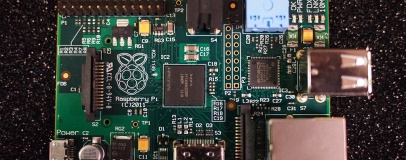
The Raspberry Pi is in great demand, with both RS and Farnell's website struggling to keep up with the traffic.
The Raspberry Pi single-board computer officially went on sale this morning, only to sell out within an hour due to unprecedented demand.
The ARM-based microcomputer, the size of a credit card and costing just $35 in its most powerful 'Model B' incarnation, is now being produced under licence by Premier Farnell and RS Components rather than purely by the Raspberry Pi charity itself.
'
The involvement of RS Components and Premier Farnell means that we can build volume much, much faster than would have been possible on our own,' a spokesperson for the project explains. '
We are no longer limited to batches of only 10k Raspberry Pis; the Raspberry Pi will now be built to match demand.
'
Both Premier Farnell and RS Components have worldwide distribution networks, so wherever you are in the world, you will be able to buy from a local distributor. This will saves you money on shipping; it’s a much better way for you to buy than getting them all shipped from the Foundation in the UK.'
Raspberry Pi announced the opening of orders for both RS and Farnell on its website at 0600 this morning; at 0602, both third-party websites had been driven offline by traffic as gadget-hungry fans tried to place their orders.
An hour later, Farnell confirmed that despite its website being offline for the majority of users it had managed to sell out of its initial production run of Raspberry Pi boards. RS, meanwhile, is delaying opening orders at all until later this week in a last-minute decision that will hopefully give the company time to bolster its servers in anticipation of the traffic hit.
The - brief - opening of orders also brought a welcome surprise: the cheaper 'Model A' unit, costing just $25, is to receive a memory upgrade from 128MB to 256MB at no extra cost when it enters production later this year. As a result it will match the specifications of the more expensive 'Model B,' missing only the additional USB port and Ethernet connectivity.
If you're anxious to get your hands on a Pi, RS is
asking for email addresses ahead of the orders opening later in the week. Farnell, meanwhile, is allowing customers to pre-order the device now with a new batch to be built within 16 days - but at the time of writing, its website is still suffering under the strain.

76 Comments
Discuss in the forums ReplyThat said, I'm not quite as desperate to get one; now that they're no longer limited to production runs of 10,000 units at a time, it should be far easier to meet demand. For what it's worth, the foundation were reporting that Farnell had sold out by 0627 - only 27 minutes after launch...
I've been up since 0540 this morning to follow this launch and I feel knackered; I have no idea what the Raspberry Pi team must be going through, but I think it's safe to say that they've all earned a pint (or twelve) when they finally finish for the day!
There are over 100,000 people on the mailing list, so there were major problems getting the emails out; you aren't alone in not receiving the email. But the email didn't say anything more than the announcement on the website anyway.
The reason for the antisocial hour is presumably so that everyone interested has a good chance of getting one no matter what time zone they're in. If it launched at 1000GMT, that'd be between 0300 and 0500 for the US.
What the hell are you actually supposed to do with a Raspberry Pi, anyway? I've yet to see that there's actually any software for it.
F*&#$ing linux-powered, penguin-poking, Farnell-offlining piece of (#$!...
Mutter, grumble.
Power cable, ethernet cable and HDMi cable
Then you install RaspBMC and watch movies on your 1080p capable mini computer.
The Debian root filesystem has already been uploaded - last week - and a Fedora distro is expected imminently. Both distros already have a large library of ARM software available - particularly Debian.
What are you supposed to do with it? Well, what are you supposed to do with any other computer?
Do you think if it was a US company, they would have shown similar consideration to potential purchasers outside their home market?
..somehow i doubt it.
Probably not, but this isn't a profit making company - it's a charitable foundation. Besides, even if no-one else in the world would have done this, that doesn't mean that they shouldn't hold themselves to higher standards.
Exactly, you're supposed to do whatever you want to do with the Pi.
The only difference between it and any other desktop is it's tiny and cheap, so it lends itself to tinkering, coding and modding.
A cheap AppleTV/Airplay receiver?
http://www.neowin.net/news/35-raspberry-pi-pc-hacked-to-stream-airplay-video
Luckily I have started looking at other products, so they might have missed a few customers already.
Badly organized, badly distributed
Wow! A killer application and no mistake! Where else can I get a computer that has, crikey, a filesystem? Sign me up!
You conveniently forgot to also quote the part of my post that mentions that there's already a large amount of ARM applications already available through Debian - which actually takes more effort than just clicking the "Quote" button and quoting the whole post.
If you're not interested then move right along - there's no need to be an ass about it.
Not that a filesystem is a trivial bit of software engineering, but it isn't an application. Nobody buys a PC so they can use its filesystem.
I ask again: what can this thing actually do?
http://www.google.co.uk/search?q=XBMC+on+raspbery+pi
http://www.google.co.uk/search?q=quake+3+on+raspberry+pi
The Quake example is sort of what I mean, though: it's another instance of Linux people getting very excited about doing something everyone else considered trivial ten years ago.
I think we're mixing up terminology. The Debian "root filesystem" I refer to is actually the Debian SD card image - that is, a complete distribution of Debian ready to be imaged to an SD card. A Fedora distribution is also on the way very soon.
It is a single-board computer based on a Broadcom ARM processor, with 256MB of RAM, 2x USB ports, composite video, HDMI and 3.5mm audio output. It is a computer. All one needs is an operating system on an SD card and it is identical to any other desktop running Linux.
The point is that this is not something trivial; this computer can handle the vast majority of desktop tasks that the vast majority of users need for $35. This first release may be targeted at "linux people", but it is not the end of the line for this product.
But can you do it on a system the size of a credit card that runs on a 5v power supply, which can also decode 1080p h.264 video at full resolution with no loss of frames?
That's why people are excited.
The agenda shines through; you know, you could have saved yourself an awful lot of time if you'd just said "LOL LINUX SUXXORZ!!ROFL!" right at the start.
Clearly you have utterly no interest in the Raspberry Pi and are now just trolling. I'm not going to waste any more time debating the matter with you.
http://xkcd.com/386/
You seem to be missing the point :p
I had no idea it was launching because I used the mailing list to save me having to check the website for updates ;)
It's $35 for flip's sake. What do you expect it to do? The fact it's $35 and can decode h.264 is a pretty good feat!
Pretty sure Farnell's price included shipping where the RS one did not.
Raspberry Pi Twitter
Also you can tell you are a generic troll just from your attitude of linux being completely incompatible with modern devices.
Because you're an infant. :P
Looks like this guy might have: http://www.ebay.co.uk/itm/Raspberry-Pi-Model-B-confirmed-shipping-date-/130656922987?pt=LH_DefaultDomain_3&hash=item1e6bc26d6b#ht_500wt_966
Quite a mark up at £50...
I'm actually quite surprised that it's the only one on ebay at the moment.
What I don't get is why are you complaining and whining about it NOT being something it clearly isn't? So you aren't interested and don't find it useful? Congratulations on your promotion to Phil Rhodes: Global Usefulness Expert On Everything.
The fact that in the time I took to read the article I had thought of three useful things that *I* could use a 700MHz ARM-based computer that draws 3.5W for, says that there is a market for them beyond Phil Rhodes: Global Usefulness Expert On Everything.
Also, there are people on the planet who don't need OS, drivers and software supplied to them in neat little .exe packages with friendly wizards, simple step-by-step instructions and a reassuring hand to hold on to.
(Sometimes, you just need to use Rhetorical Weapons of Mass Sarcasm in a post. Sorry about that. That was sarcasm too.)
Yes, but they're not really the sort of people at whom this seems to be aimed. I mean, it's supposed to be about teaching kids to code, right?
I can't describe how much this is exactly not the way to do that.
You're quite an ass, and if you'd had something like this as a kid such as the Amiga/BBC Micro you might actually be interested. As it turns out, you're probably either too young to remember those platforms, or too old to have been at school when they were actually used to teach kids programming; or unfortunate enough to go to a school where they didn't really have computers and IT, if taught, was done on a white/blackboard.
I, personally am looking forward to getting one of these. I plan on running, one or more websites off of one or more of these from home. But then I work for a web development house as a systems admin that covers Windows servers and PCs as well as Linux servers.
I tinker because that's what school got me to do when I was younger; it developed my inquisitive streak towards IT.
You don't think a hardware platform affordable enough for it to be "one per child" in the class room and achievable for most parents to pick up for their interested kids combined with a framework of software, documentation and training that is specifically aimed at teaching kids to code is the way to go?
There's been purely software based methods before, but this is more hands on. I say it's a pretty good idea worth pursuing and for the cost... bargain!
But why don't you enlighten us with the solution you've made available to the public? You do have a better option you've developed yourself right?
LISTEN TO PHIL!
I know Phil is a troll but maybe he is right. you know what exactly is this tiny piece of cheap hardware going to do? like most people on the planet will need something way more powerful than this, after all most people use really demanding programs like a web browser or word processor and stream movies over the internet. These people will be better off going to PC World and buying a proper computer because its not like everyone has an LCD with HDMI socket and even if they did why would they want something that could save them up front costs of buying a PC and constant saving on energy. Everyone has loads of money. Seriously people listen to Phil, if they even ever made these they would just end up on a shelf gathering dust. NO ONE would buy one.
http://www.ebay.co.uk/itm/Custom-case-Raspberry-Pi-Model-B-professional-Recycled-/290677470826?pt=UK_Computing_DesktopComponents_RL&hash=item43adba366a
It must be put in the March edition of "Project Log and Case Mod Index update"
Because the foundation and it's many supporters are working their backsides off to get the auctions pulled. No one can sell one on ebay, because no one actually has one in their hands yet.
Seriously?! 80 quid?! And last time I checked, a 2 year warranty shouldn't cost more than the hardware it covers! Still, at least the seller is generous enough to give free shipping, the profiteering goon.
I'll just leave this here:
BLC is right. By the end of this year there will be so much cool homegrown software for it, that 5-year olds can build code on it with virtual Lego blocks representing operands and variables. There will be a host of snap-on modules. It will be just like the Arduino, and then some.
Phil, son, I is disappoint. You are undoubtedly much more knowledgable on computer programming than I am, but your vision-fu is weak.
+1
I think OpenBSD will also run on this im sure it supports ARM. Cant wait to have a fiddle with one. And yes it is trivial in some ways, but i don't give a damn its what i like doing!
Get normal people talking about teaching kids to code? Maybe even get the product featured a few times on the front page of BBC News? Getting the word out that the UK used to be #1 when it came to "teaching kids to code" , and all it takes is a bit of forward thinking and balls to get people focussed.
You ever seen this happen with something like Scratch or Alice?
The only trouble with using Microsoft software is that it's quite expensive; although educational institutions get a big discount, it's still a big extra cost - plus there's the indirect cost of ensuring that your licenses are always up to date. Part of the point of using open source software is that the licensing is so much easier and in many cases there's no cost at all. I'm not rubbishing Visual Studio or SQL Server because it is very useful, espcially in the workplace - I write quite a bit of VB and now SQL at work, but wouldn't have any need for Python; I even use Visual Studio at home for my own use. But the aim I think is more fundamental than teaching someone a specific language.
Once you wrap your head round programming concepts - variables, functions, algorithms, abstraction, etc, etc - you can apply that knowledge to almost any language. That's where the foundation believes that the problem lies: fewer kids are introduced to even the very basic concepts of writing code. Many of the founding members are also professors/staff at Cambridge University, and they have seen students apply to Computer Science degrees that have never even seen any code before.
Before I get flamed to death, I'm not trying to start a "My programming language/operating system is better than yours" argument. Each language - as well as OS - has its advantages and disadvantages, and some are better suited to particular tasks than others are. I wouldn't run Linux if I want to play Skyrim, but I wouldn't run Windows on a lightweight machine; similarly I wouldn't write MI systems in work in prolog.
Yeah, a reflow oven, maybe!
I can't see where MS are changing schools to use VS Express when it's free to the rest of us. Actually as far as I can see with DreamSpark they can get VS Pro and a load of other stuff for free.
This may fail but the fact is a charitable organisation has made a step forward which other institutions can learn from. What we might see other subjects getting similar fantastically priced teaching tools thanks to the success of the Pi.
Anyone who is arrogant enough to believe it's a bad idea when it hasn't been tried since a true availability of cheap computing, I invite you to draw up curriculum that will teach kids useful skills whilst keeping them engaged.
HAHA, reflow oven! ISWYDT :)
On another note; You got one kosch?! Have you got it running yet? Any first impressions?
The rest of the open source community has failed more or less completely to create software that is usable by anyone other than nerds and techy types. I don't see why releasing a small cheap computer will create a situation where open source software is suddenly suitable for "mum, dad & schools".
Neither do I but what has this got to do with anything? the point of the devise was something where some kids will learn to do some low-level programming.
Oi Troll!
Open source is perfectly suitable for 'mum,dad & schools' as they only use web browsers and word processors and not much else. Oh and open source OS's have these too, they arent windows exclusives. You can't see the point of anything tho can you troll, but everyone buying these things seem to see something. for the amount of demand i'd say there are numerous possibilities to use these.
Right, now i'll look after your bridge because i know you get antsy about goats and you can go have a play with a recent linux distro, you know so you'll be a bit more educated rather than spouting out the same troll tripe.
But the machine you're going to need to run that will cost more than $35 (+shipping/VAT/tax) and even with a discount for educational institutions, I doubt the license cost per copy of Windows would be that low.
Like I said, I'm not trying to turn this into an OS/programming language war. What's important is getting kids/young people interested and being able to do it at a low cost.
Sure, kid.
Oh come on... it's not the "only" thing wrong with it1
Sure but there is plenty of PC hardware around in schools. This is not going to change that.
This is a new direction and it's a great direction too, but it does not mean that we should encorage learning at high level as well as low level.
+1
I've lost track of how many times posts/replies have made me laugh.
As for the actual subject of the article, I'm considering purchasing one whenever they get the supply issues straightened out. The potential uses of it for such a low price point are awesome. Low power consumption and size are also huge pluses in my opinion.
Not arguing on Phils side here, as I do see the point for the Pi, but shirley anyone who uses a pc purely for surfing the net, streaming video etc; isn't going to have the slightest interest in a barebones board like this.
Currently its a geek toy, which will lead to something more main stream, as per the foundations own statement.
I also preordered there on Saturday and the shipping date has just moved to May.
I have 2 young step brothers, one is aged 8 and he's really into science and technology, he's always building stuff with lego, mechanco and has his own tool kit for kids.
He's really good with general computer stuff, as he grows up and has access to a cheap powerful computer like that, he could creat things we can't even think off.
Thats the idea, a new generation making original ideas!
I know when website making was not something you could do easily, I was up all night playing with code and scripts, pretty sure they'll be tons of teens doing the same with these.
Has your March/April order just been pushed back to May? Read this!
We’ve had a lot of people mail us and tweet about this today. If you were expecting a March/April delivery and got an email from Element14/Premier Farnell this morning saying delivery had been pushed back, please don’t despair: it appears to be a mistake. We’ve contacted Farnell about it and they’ve come back to say they’ve added this to their Raspberry Pi FAQ:
Update on the pushed back orders:
Q: I got an email from Farnell element14 stating that my delivery date for the Raspberry Pi I ordered is now into May or June, is this correct?
A: Sorry! We updated the data in our system so that new customers placing their pre-order would be advised of the delivery date at the end of May or beginning of June. If you originally had an estimated delivery date in March or April, your delivery estimate is still as per the original communication.
http://www.raspberrypi.org/