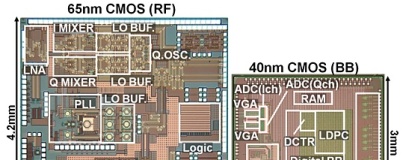
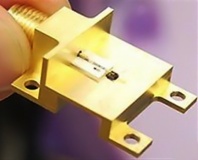
The chip, jointly developed by Tokyo Tech and Sony, boasts data transmission rates of up to 6.3Gb/s using 16QAM at 60GHz.
Sony has announced that it has developed in partnership with the Tokyo Institute of Technology a design for a low-power wideband wireless communications system capable of transferring data at a whopping 6.3Gb/s.
According to the company's presentation at the International Solid-State Circuits Conference in San Francisco this week, the design takes the form of a chip combining a baseband system with the required codec and a radiofrequency transceiver using four millimetre-wave channels.
Using Sony's low-density parity check (LDPC) error-correcting code, which the company claims is the most efficient in the world in terms of energy usage per bit, the combined design uses around 90mW when transmitting at 6.3Gb/s. It's this high efficiency, Sony claims, that makes the design uniquely suited for mobile gadgets that require high-speed short-range radio communications.
Based on the 60GHz spectrum band, the system won't be replacing Wi-Fi any time soon. It may, however, find a use in future Sony gadgets including laptops, tablets and smartphones as a handy way of shuffling large quantities of data around a home network to, for example, stream high-definition content to a compatible TV.
The impressive speeds achieved by the prototype are down to a team of researchers at Tokyo Tech led by Professor Akira Matsuzawa and Associate Professor Kenichi Okada. Designing the radiofrequency portion of the system the team were able to create a 60GHz direct-conversion transceiver capable of operating in 16 Quadrature Amplitude Modulation (16QAM) mode at every frequency defined in the 60GHz millimetre-wave communications standard. It's this amplitude modulation that allows the chip to squeeze so much data into such a small space, and combined with the low-power error correction developed by Sony makes the resultant chip a tempting proposition.
Thus far, Sony hasn't indicated when it plans to bring the technology to market. When it does, its first customers are likely to be military: a portion of the research and development was carried out as part of a project dubbed '
R&D for Expansion of Radio Wave Resources,' sponsored by the Japanese Ministry of Internal Affairs and Communications.

12 Comments
Discuss in the forums ReplyIf this is somehow safe to use, it sounds like a pretty good project.
if it means you can stream 4k HD and cook hot pockets it's win win. Vague possibility of mutating a super power makes it win win win
The current generation of routers are nowhere near causing cancer. If you think 60GHz is scary, how would you feel if I told you you were probably at this moment being irradiated by a source of 600THz radiation 100 times stronger than your router? This is the radiation we should be concerned by, and people are putting emitters everywhere... Sometimes, the pulsed 600THz radiation source cruelly attached to a certain device in my room is so powerful that I can't sleep. I was actually once burned quite badly by a broad-spectrum 400+THz radiation source, but nobody seems to care. It's not right that people campaign against wireless routers but don't recognise the menace that seems to be everywhere you look!
As for 60GHz is to die early so they are curing the worst world's problem = too many people on Earth!
Radiation is merely a word to describe electro magnetic waves (normally) and also small 'nuclear' particles such as Alpha particles. Lets be clear, the human race does not produce any magnetic or particle based radiation the universe has not produced. It staggers me that people try and latch on to the most un-scientific rubbish whilst stating that the cause of their ills are radio masts.
Seriously. I get a headache every now and again. But I work, and have a family, and try my best to everything society expects of me. I dont sit at home holding on to joss sticks, babbling about lay lines and the evil of mobile phones or any other tiny source of EM radiation.
If you bought some dodgy electrical device from a market that was made in China and got a shock or burnt from it, thats your look out. It is not science, the technology industry or societies responsibility, but your own.
http://www.zdnet.com/blog/storage/60ghz-wi-fi-coming-next-year/1240
http://www.fiercebroadbandwireless.com/story/wireless-gigabit-alliance-completes-specs-60-ghz-technology/2009-12-13
Shouldn't be long for it to become widespread I reckon.
This is probably what I was thinking of - yes, frequency by itself really means nothing, but generally speaking with electronics, the higher the frequency, the more power you need if you want a good range. So, at 60GHz, it is going to need a lot more power to send a signal the same distance as 2-5GHz routers. This wattage increase along with this frequency range just sounds dangerous to me.
There are only two ways radiation can directly harm living organisms. 1: Heating things up, and 2: Causing molecular damage. Only very high frequency (UV and X/gamma) radiation has enough energy to cause molecular damage or ionization, and this is the only kind of radiation that will cause cancer or radiation poisoning. The only way microwaves (much lower frequency, and generally much lower power too than visible light sources) can harm you is by heating stuff up. 2.4GHz (used in normal wi-fi and microwave ovens) is particularly effective, much more so than 60GHz, because it can excite water molecules. Mobile phones already operate at much higher power levels than wifi (generally 10-20 times more powerful) and don't do any harm.
People seem to get scared by 'radiation' because they can't see it, and because they're ignorant, but the only really harmful source of radiation most people are exposed to on a regular basis is that big-ass nuclear reactor in the sky... UV gives plenty of people cancer, and people pay to lie on a beach and get irradiated... Wi-fi has never harmed anybody and never will. If it wasn't for the problem of interference, they could make it much much more powerful, and it still wouldn't do any harm.
TL/DR: people are idiots.
As an aside, and for the sake of completeness: if you put your face front of a high-power microwave source, the heating effect will probably give you cataracts... don't do that.
If 90 milliwatts sounds like a dangerous amount of power to you, you probably should turn off that computer you are sat in front of... it's using around 450 watts, or 5000 times more power!!! This probably explains what happened to the rational thought part of your brain. Fried by the wattage I tell you. Luckily the world ends this year so you won't need to worry about getting 5000 times more death-rays from it for very long.