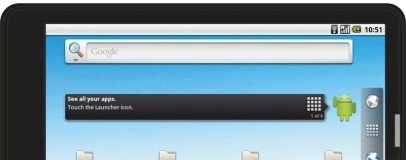
DataWind's Aakash tablet may now not be the Indian government's choice for its cut-price educational computing programme.
The dream of the $35 tablet looks to be disappearing in the harsh morning light, as the UK company chosen to develop the device by the Indian government is given the cold shoulder.
DataWind's Aakash tablet was an amazing achievement, there's no doubt about that. At a time when Nicholas Negroponte's One Laptop Per Child (OLPC) project was still chasing the $100 laptop, the Aakash was put together for a bill of materials totalling $50 (around £32.) With subsidies from the Indian government for which it was created, that meant students would have access to a touch-screen tablet for educational use for just $35 (around £22.)
Reports of troubles surrounding the project suggest that all is not well, however, with the government claiming DataWind's design is sub-par while DataWind accuses the government of changing the requirements half-way through the first phase of the project.
According to an unnamed source at the Indian government's Human Resource Development Ministry speaking to
MSN, the project will be pulled from DataWind and put out to tender. '
It's not automatic that because you have done phase one you will do phase two,' the official reportedly stated. '
The feeling is that sufficient interest has been generated to get better specifications at the same or a lower price.'
The government claims that specifications are at the heart of the problem. While it was aware that the Aakash was being built on a tight budget, the resultant device is far from what it was promised. An unresponsive resistive touch-screen coupled with a distinctly under-powered processor mean a poor user experience, even for a device retailing for less than the cost of the average university textbook in the UK.
DataWind denies these claims. According to chief executive Suneet Singh, the real problem comes from a last-minute decision to change the requirements from the device. As well as a budget-friendly bill of materials, DataWind was suddenly required to make the device conform to US IPX durability specifications.
With those specifications requiring that the tablet be able to withstand four inches an hour of sustained rainfall, it was never going to happen without some serious redesigning and a significant increase in cost.
Despite the setback, DataWind is forging ahead with its own version of the Aakash tablet. Due to launch later this month for 2,999Rs (around £39,) the commercial tablet includes an in-built GPRS modem to provide internet connectivity in areas where fixed-line networking is still extremely rare.

14 Comments
Discuss in the forums ReplyI'm surprised you can even get a touchscreen, let alone the hardware behind it, for that kind of cost.
The Hong-Kong-special I bought from eBay was £140 last year and it is one of the worst electronic devices I have ever used. So god only knows what that thing would be like!
If the iPad3 really does come with a retina-like screen and has at least the same PPI as the iPhone 4 then I'll have one.
Went to the apple store with the cash in my pocket for an iPad 2, but after seeing the crap PPI I just couldn't part with the money.
I think this is an incredible engineering feat as well as an incredible procurement task - like everyone has said, getting parts to do this for £30 odd is incredible!
I'm going to order one when I can and then see if i can fold on it :-)
It's not a $35 tablet, it's a tablet which is made of materials costing a total of $50, sold to students for $35 thanks to subsidies by the Indian government. As it the article clearly states, the commercial version of this tablet (the one any non-Indian students would be looking at) is set to cost 2,999Rs, about $61. No one here is going to be seeing a tablet hitting shelves for $35.
Secondly, this is an educational device for a developing country. Something like a £100 Blackberry Playbook (not to point fingers) is multiple times more expensive and likely to be unaffordable even with subsidies. These expensive devices are simply not an option for the targets of this tablet project. The "$35 tablet" isn't meant to be a competitor against devices costing many times more than it, it's meant to get technology into the hands of students who can't afford most electronics.
Terrible idea - e-readers and tablets are completely different things. Reading on any tablet is horrible.
You need an E-ink screen to read on, not a tablet screen, sadly there isn't anything capable of doing both at the moment. Even a kindle fire is awful for reading on!
For you, but I read a lot on LCD screens. Hey I'm doing it now. There's no doubt eInk screens are great and do genuinely offer a better experience if you have ambient light, but have you actually read a novel on an iPad?
I use my iPad for reading at night without having to resort to partner disturbing lights, I can't do that with a Kindle or a real book.
Now when they bring out a daylight readable self illuminating high PPI fast responsive battery efficient 24bit colour panel... then we'll be cooking on gas!
Maybe because they're out of production, and the $99 price tag (at a massive loss) was Leo's last FU before he got canned? Might be that, I'm not positive.
+1
Why is it people always feel the need to compare every single product under the sun to their own needs and have almost zero empathy and consideration for the needs of others. As you quite rightly state, this is to get technology into the hands of those people who have never had access to a computer, or a mobile phone, or the Internet.
I see adverts for sanitary towels and tampons....but I don't imagine how they'd feel on me and then write it up on a forum bitching that they aren't designed for my (male) anatomy :p