Canonical's vision of Ubuntu for Android is impressive, but it has yet to convince the OEMs and ODMs.
Canonical has announced that it will be showing off a version of its Ubuntu Linux distribution capable of turning an Android smartphone into a fully-fledged PC.
Dubbed Ubuntu for Android, and due for formal unveiling at the Mobile World Congress event in Barcelona early next month, the release allows Android handsets with two or more processing cores to run Ubuntu Linux with the same applications as a desktop PC.
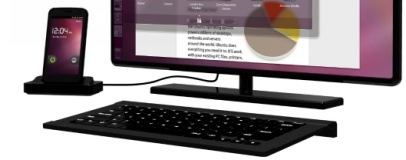
The system clearly owes a debt of gratitude to Motorola's Atrix: when in phone mode, the handset runs a vanilla Android experience. It's only when the device is connected to a docking station connected to a keyboard, mouse and monitor that Ubuntu Linux appears as if from nowhere.
The two operating systems run side-by-side, so there's no delay while the system switches from one to the other. Canonical has also confirmed that data is shared between the two platforms, meaning the full contacts database along with telephony and SMS/MMS messaging services are available in Ubuntu just as they would be in Android.
'
The desktop is the killer app for quad-core phones in 2012,' claimed Canonical's Mark Shuttleworth at the announcement. '
Ubuntu for Android transforms your high-end phone into your productive desktop, whenever you need it.'
Sadly, there are a few caveats. Unlike the standard Ubuntu Linux distribution, Ubuntu for Android won't be made available for use by hackers and modders. Instead, Canonical is looking to interest original equipment manufacturers (OEMs) and original design manufacturers (ODMs) in licensing the software for inclusion in their upcoming smartphone designs.
As a result, it's unlikely that the software will appear as an upgrade to existing handsets. Rather, companies may choose to implement Ubuntu for Android alongside future releases of Google's popular mobile platform in upcoming smartphones.
Thus far, Canonical hasn't suggested that it has reached an agreement with any OEMs or ODMs yet. As a result, the picture the company paints in its
promotional material of being able to ditch the laptop for a pocket-sized device that does everything you need isn't quite there yet.

26 Comments
Discuss in the forums ReplyAs a side note that as nothing to do with this news:
The funny thing is that ubuntu can run these days on a phone, but mac mountain crappy lion cannot run on dual cores. Just comes to show where apple lies their priorities.... certainly not their users.
Having your desktop in your pocket would be awesome, is this a demo or just a concept?
Cool
In all fairness, this can only run on quad-core phones.
Funky idea though. My phone is probably more powerful than my five year old work laptop, so I'd be more than happy to switch over. Would make hot-desking a lot more simple as well.
Obviously it's largely down to provided functionality but I'd have thought Android could be modified to provide this without running an additional operating system on already relatively meager hardware.
That said, it's still a pretty cool implementation.
I'd imagine it's because single or dual core phones aren't up to the task -- I'd guess they've hacked together a custom kernel using pretty odd core assignment voodoo.
i see you are one of the many people who stereotype linux as a CLI-based OS.
The news article above isn't 100% correct.
The official Ubuntu website says "In every dual-core phone, there’s a PC trying to get out."
http://www.ubuntu.com/devices/android
It also says "Dual-core 1GHz CPU" on the Features and specs page.
http://www.ubuntu.com/devices/android/features-and-specs
I read somewhere else this morning that it works on dual core phones and wanted to double check and came across those links. One would obviously think that a press release direct from the company would be correct. :)
I've used linux on and off for many years and don't see the point of working out of the cmd line on a phone.
if by "working out of the cmd line" you mean "operating a cmd line" you completely missed my point - i'm trying to say you DON'T need to use the command line and linux should not be stereotyped as requiring to do so. ubuntu is one of few distros that don't ever require you to open up a terminal. i happen to use distros like arch or debian, where a cli is necessary, but i personally like the cli and find it faster than a gui in many cases.
You do of course realise Andorid is Linux?
In basically the same way the window manager that chap is using in the video is just another application running on a Linux kernal, Andorid is just a layer on top of the kernel.
although your somewhat right in what your saying, for most people it will be confusing. Android isn't GNU/Linux (whole system is NOT linux) but is an OS that runs on Linux (a linux kernel). Ubuntu and Android run the same (linux) kernel and this is where the two systems communicate, But Android isnt Linux or GNU/Linux. Ubuntu IS Linux or GNU/Linux.
And although i just did a geekburst i'm a linux mint (distro based on ubuntu) user and have never used the cli/cmd since i had it. I have found linux mint to have been the easiest OS (including windows) i have used.
With regards to the kernel business, I thought Android was a fork of the linux kernel, and this version of ubuntu is the distro running on top of the Android Kernel instead of the main linux one?
Personally I use too many windows based programs to work with Linux, as nice a concept as this is
I have to say that I've never ever used a distro of Linux that I haven't had to use the terminal on. Why is using the terminal a problem? :S
First impressions are that this is useless but cool. I have a feeling that it would be more practical to have a dedicated smartphone and desktop, sharing files between them via a cloud service.
Also, where does this leave Ubuntu's slow march to being a touchscreen-friendly desktop? The Unity interface (with a few tweaks) would seem well-suited to a smartphone. Why run Android underneath?
Get an N900, install easy-debian and you've got debian support with an LXDE desktop. This sort of thing has existed for a while now. Also you get access to the thousands of applications in the debian arm package repository.