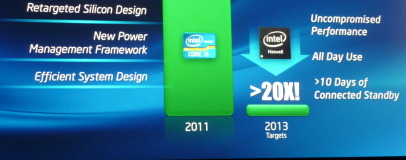
Haswell not only promises to be a power-efficnet CPU, but will have system-wide power savings too. And without compromising performance.
Intel CEO Paul Otellini revealed that ‘
We’ve already completed the design of Intel’s next generation microprocessor, Haswell,’ and made the claim that laptop charging will become a weekly or even fortnightly affair with Haswell technology.
‘
Haswell was designed to enable a 30 per cent reduction in connected standby power over the currently shipping notebooks using our second-generation Intel Core microprocessors [Sandy Bridge], said Otellini, ‘
But we can do more than that, we can do much better than that.’
The plan is that not only will the CPU consume much less power than current CPUs, but that the system around it will also be heavily optimised for extending battery life. ‘
We’re architecting a system-level power management framework that’s supported by efficient system design throughout the ecosystem that has the opportunity to reduce the platform power by a factor of more than 20 times over our current designs.
‘This means that we’ll be able to enable all-day usage and more than a ten-days, always-connected standby capability on a single charge.’
That should mean that in typical use – a bit of work and a bit of web-browsing, and sleeping the laptop in between use – will result in only having to hunt out the power brick every week or two. It’s brilliant to get a month of use from one Kindle charge, but imagine only have to charge an entire laptop only one a week.
Even more impressively, Otellini said that ‘
we’ll do and deliver all this without compromising any of the performance you’ve come to expect from today’s mainstream notebooks. The implications for the ultrabook are huge.’
A fast laptop with a week or two of battery life? What’s not to like. We expect the Haswell CPU design to arrive in 2013 and to feature heavily in super-thin ultrabooks (presuming Intel’s latest laptop craze lasts that long).
Can’t wait for Haswell, or are you sceptical that Intel can deliver on that promise? Let us know in
the forum.

25 Comments
Discuss in the forums ReplyBulldozer FTW.
Now to wait for acceptable colour e-ink to make its appearance.
Just tidying up the thread after Snips' antics - I deleted posts that referenced that silliness to avoid confusing new posters - this reason is stated if you view the thread in the forum. Either way, it's no reflection on your comment, which was perfectly valid.
Please don't follow Snips' lead by posting the same phrase in multiple threads though.
What's "connected Standby"? Connected to what?
The mains ;)
I don't believe this is for Intel to meddle with, this should be down to the laptop manufacture not the chip maker
Kimbie
Ok noted :)
This should be really interesting, I do find it hard to believe that a laptop can last for 10 days but then I would consider myself quite a heavy user.
A lot is left unsaid.
Ten days of all day use AND standby in between?
Just to emphasize: current netbooks give you ~6-8 hours of use (which could be considered all-day in a work environment) OR a week in standby (lowest energy saving mode).
Or this interpretation of the former:
Again, this is what a current netbook will do with three days between charges.
Hey Ipad-folks, how long does your battery last when using it for some light browsing about an hour a day?
what would be nice to see though is some inbuilt remote charging circuits and low cost remote charging pads, so that you can position the pads around the house in convienent places, attach it under a table top so that when you put the laptop on the table is will charge, have one on your bed side table, on a worktop in the kitchen etc
this added in with the jelly batteries http://www.bbc.co.uk/news/science-environment-14852073 could make interesting solutions
I am loving the sound of this!
TBH the headline for this news piece left me salivating - 10 days usage form a laptop between charges. Unfortunately it sounds like you will be able to get a "days worth" of charge from the laptop before it will nee recharging OR 10 days in standby (possibly including a couple bouts of checking email) OR roughly a weeks use if you only use it very periodically.
it means at zero standby and im guessing around 50% processor usage, it will last a day of charge, 100% usage, im guessing half that (maybe 6-12hrs between charging).
ten day standby, its what it implies im guessing , just to have some kind of idea compared to current laptops, most of the laptops at work that are left on stand by on a weekend (friday) are completely drained by monday. im betting intel's platform it not just about processors, but a whole bunch of technologies including the chipsets and whatnots.
im really not a negative and BS the company kind of guy but still I wan't to see a tech demo of this :) (if it holds Id really want to have one of those laptops for work)
* Assumes laptop is turned on, not in use, no USB peripherals plugged in, hard drive not being accessed, and LCD is off.