EK is a popular maker of water-cooling kit, selling its own blocks, pumps, reservoirs and radiators.
Water-cooling hardware manufacturer EK has halted production of all of its nickel-plated waterblocks, as certain coolants and additives have apparently been eating away at the nickel plating,
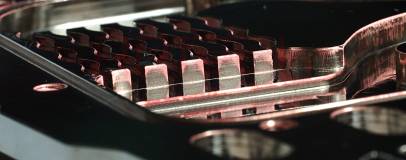
The plating has a lustrous shine and high corrosion-resistance, but owners of the blocks have reported evidence of corrosion, where the nickel layer has been stripped away, revealing the copper underneath.
EK has carried out its own independent tests, and claims that silver coils and copper sulphate additives are to blame, which are both used as anti-algae treatments.
However, a member of water-cooling forum
RRTech called rubidium has undertaken his own testing, and revealed what seems to point at sub-standard nickel plating, with plenty of copper visible through the plating on the site's test sample.
The latest
response from EK appeared on its site over the weekend, and reads as follows:
'As EK is looking for lasting solution for nickel plating issue (concerning corrosion because of silver coils and copper sulphate additive) we decided to halt sales of nickel plated products till solution is found and tested. Our resellers were advised to halt sales too.
We cannot put users into position, that we replace products and corrosion starts again on new product. Hopefully we will find an answer and tested solution in short while.
We will update you as soon as we have any news.
However, If customer insists on buying EK nickel block, we offer a customer full 24 month warranty on material, manufacturing and corrosion'
Do you own a nickel-plated waterblock? What coolant and additives do you use? Let us know in the
forums.

48 Comments
Discuss in the forums ReplyHarden the frack up EK...
This problem have nothing to do with the fluid used. It is solely based on sub-par nickel plating, and cutting corners in manufacturing as rickysio also stated.
They never tried to blame the coolant, they are saying that the additives or silver coils are causing THEIR nickel plating to corrode. They are not trying to blame another product otherwise they wouldn't have stopped production, and they wouldn't be trying to fix it. They are also offering a full warranty for the corrosion. I fail to see how they are fobbing this off on someone else.
http://farm4.static.flickr.com/3271/5800743334_6aee97c96c_o.jpg
"nickel is nickel" right?
Many times EK stated that their was NOTHING wrong with their nickel plating, and even in the "official" test they trew out, it was only mentioned that "the fluid is eating away the nickel"
Not once did EK suspect that their plating process was the issue, and kept trying to blame everything else.
It is the exactly same story as with their cracking and leaking reservoirs. Just more stuff is affected this time.
And about the production stop, they should have done that loooong time ago. It was only after sidewindercomputers stopped selling their blocks duo to the test made on rrtech that EK manned up.
Apologies, i wasn't aware the issue had been going on that long.
I lost an EK Supreme HF as well as the entire loop attached to it from flaking nickel pounded through the loop. The whole deal was a loss.
However, I still have a copper 470 block I have no intentions of replacing. Picked myself up a Kryos Pro on sale at Sidewinder to replace the EK. Mine was old enough it was not covered by the RMA.
imho
And that's a damn shame! I personally believe that they made huge mistakes trying to blame everything but their nickelplater...
no signs of corrosion but then, i dont use additives. just plain old distilled and a little mayhems dye.
What, if anything, are they putting between the nickel and the copper?
Rubidium is a great guy that really knows his stuff.
Deposition method needs looking at IMHO.
(2 x Nickel Plated 580 blocks)
If you bought a block in good faith as I did in April then you either risk your system by using it or write it off as a loss.
It's frustrating having to wait and see if testing proves a product defect which would at least allow you to RMA the item and hopefully receive a replacement you could have confidence in.
Else it's an expensive write off unless you fancy your chances with the rest of your costly water loop.
Until then you either buy another brand or wait for some concrete independent testing results and then hopefully the aforementioned product recall.
you could always get an inline water filter, they are cheap and I recommend having a few anyways to catch anything that could shed off into the coolant.
It's a good thing i wont be building the system for a while (have to scratch build the case first ;) so i can leave the bits in their boxes for a while and return them for replacements if they decide to recall.
If they don't i think i'll just spin the chamber, pull the trigger and hope my nickle doesn't flake off. =)
I would keep an eye on it, and if you notice any spots on the block where copper can be seen, shout out to EK and get an RMA. Sadle, they are handling this so bad that they only offer warenty until the 31´st beacuse "People should know by then" IIRC. Which, btw, is against a great deal of laws in a few country´s.
NO it would not. Acording to EK that is exactly what is "eating away our perfect nickel plating"...
Any block that is proper nickel plated will not be affected by a loop with destiled water + a kill coil. It have proven to be the best recepi for watercooling for a few years now, and unless you have an EK nickel block, it will still be.
The EK blocks will start to tear down no matter what fluid you use.
Remember, the issue only affects the nickel blocks :)
Even though there are ongoing rumors that EK is using cheap "non" 0.999 electrolyte copper. But tests are on the way to clarify that too.
No, this is not correct. Water, distilled or otherwise, is corrosive irrespective of the metals it is in contact with, be it nickel, copper, silver, zinc, or aluminium and the process is called OXIDATION. This process will happen no matter what you do unless you add a corrosion inhibitor. The combination of electrically connected metals in the presence of water will enhance its corrosive effect through a process called galvanic corrosion. Nickel is no exception. Unless you add a corrosion inhibitor and regularly flush your system and replace your coolant IT DOESN'T MATTER WHICH BRAND OF WATER BLOCK YOU USE OR HOW THICK THE PLATING IS, they will all eventually OXIDISE. Using brass radiators (which contain Zinc and Copper), Silver coils and Nickel plated blocks is mixing metals and a galvanic effect will occur the moment you put water on it unless all of your components are electrically isolated, which in a PC water cooling loop they are not. Distilled water plus a silver kill coil is NOT a PROVEN method for preventing corrosion. Silver ions suspended in water act as an effective BIOCIDE, nothing else. As I have stated in a post above, there is a lot of misinformation around about water cooling and to run any loop without a corrosion inhibitor is plainly stupid, ignorant of basic chemistry knowledge, as well as bad advice whether you have an EK block or not.
The 'issue' will affect ANY block because water is corrosive to all metals, copper, nickel, silver, aluminium or otherwise. The process is called OXIDATION, and the purity of the metal is insignificant. In any PC water cooling there is the presence of a number of different metals, zinc and copper from your radiator, copper (or nickel or both) from your blocks, and silver in the case of kill coils. Add to this all the other impurities that can accidentally enter your system as well as the pigments in dyes (some of which are derived from various metals that give the dye its distinctive colour: cobalt, aluminium, barium, to name a few) and you have a chemical soup ready for some galvanic action. Unless a corrosion inhibitor is used and you clean your loop and replace coolant regularly, your blocks will eventually rust, probably your radiator too, irrespective of the brand of waterblock you use. You wouldn't run your car's cooling system without a rust-inhibitor, would you? Nothing different about a PC water cooling loop and noithing unique about an EK water block.
Whatever those 'tests on the way' you refer to are, they are a waste of time as the answers to this alleged 'issue' have already been written in the science of elementary chemistry.
Luckily I had already decided to drain my system down this week in order to fit some new radiator fans. I'll definately give the blocks a good check over before I re-build it. I'm hoping that everything is ok, because I really like their blocks and they are always one of the first to get out blocks for non reference cards etc.
If I do have a problem, I'll just RMA them. As long as they sort the problem out, I'll be happy to carry on using them.
If it's basic Chemistry why do you fail so hard at it then ?
The metals you are naming and the oxidation process are not inter exchangeable according to the Chemistry mineral chart, which you should know because you refer to it.
Please look it up and come back with the correct chemistry chart and a good understanding of the oxidation process.
If galvanic corrosion was so common with nickel/brass/copper there'd be a lot of reports of blocks and rads being eaten away.
Many people run a corrosion inhibitor in their loop possibly without realising it as it's a additive in some fluids. The comments about always using a corrosion inhibitor seem to have only surfaced after the EK problem came to light and certainly wasn't the recommendation of watercoolers with many years experience (I don't count myself as one of those).
[Thinking any other manufacturer has no quality issues is just out of picture.]
After talking to some major resellers, left knowing their block were far best sold on market, meaning many, many people use their blocks, e.g. higher number of reported cases.
For further reference, it is not first time RRR jumped on manufacturers back and tried to free ride him to hell and back. They already cursed Swiftech, Koolance and others are just waiting in line. Also comments people post there are biased (you have to pass crap test to join their kindergarten), hate breeding, purposeless... Been there, never found one single useful advice, or any decent build log or solution to hardware problem from people referring them selves as experts. Connecting tubes together and running liquid over them does not count for expertise.
The problem I see is; RRT is leading anti campaign to protect their own business interest.
FYI, I used to run EK blocks with coolant before [NOT A SINGLE PROBLEMS FOR A YEAR], then tried something fresh and went for major public conviction with distilled. Now I run Koolance nickel plated blocks only with silver and PT Nuke copper based water additive and am already starting to find MICRO shiny flakes on edges of reservoir, just where water level varies a bit.
When I find some time in future I will disassemble block to see what is going on. This came to my attention after seeing corroded CPU 370 with silver koil and distilled only.
I'm certain there is another side of this story. And bad news do spread like fire and are contagious.
Post scriptum : AFAIK, Koolance and Swiftech recommend corrosion-inhibitors since middle ages, we just ignore it.
The trouble is, some biocides/additives use copper sulphate , which also has issues with EK's blocks apparently. Anti corrosion additives are the only way to be safe - they coat the blocks in a thin protective layer which does protect against corrosion. Only trouble is they also coat the inside of your tubing I find but you only need to worry if you have a nickel plated block from EK. No reports of any other manufacturers blocks having issues yet.
Changed you mind? http://forums.bit-tech.net/showpost.php?p=2631696&postcount=16
Read: ALL metals rust (oxidise), not just iron. The rate of oxidation will be different for each metal. A corrosion inhibitor is essential wherever you place a metal or multiple metal types in contact with water .
I mean if you only have copper and nickleplated copper in the loop it shouldnt really matter if the nickle corroded off to reveal the pure copper. Or is it the nickle that is corroded away that is the problem? not the state of the block afterwards?
You are confused. All metals will eventually oxidise, or, to be more precise, create an 'oxide' of themselves (corrosion) when in contact with OXYGEN ions, commonly found in WATER. (H2O). Nothing to do with the other metals. Fact of nature. Basic High School Chemistry. :)
Yes, actually, since then, I have. I changed my mind when I decided to stop following other people's advice about watercooling after building my first watercooled PC and listen to my own advice. I recommend: Distilled water, silver coil AND corrosion inhibitor of some sort.