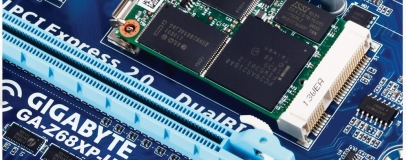
This tiny module holds 20GB of SLC NAND, making it perfect for an Intel Smart Response setup.
Gigabyte has just announced that it plans to launch a motherboard with an integrated SSD in early June, which will be available from
'selected online retailers' around the world.
The new board, dubbed the Gigabyte Z68XP-UD3-iSSD, uses Intel’s new Z68 chipset and will feature a tiny m-SATA SSD module that effectively functions as a small Intel Solid State Drive 311.
'
We are thrilled to deliver the world's first motherboard to come pre-bundled with an Intel SSD 311,' said Richard Chen, vice president of worldwide sales and marketing for Gigabyte. '
The Z68XP-UD3-iSSD is the easiest way for [Gigabyte customers] to instantly take advantage of the performance boost [of Intel Smart Response].'
We’ve tested Intel's
Smart Response technology and found that it successfully delivered SSD speeds for commonly used data.
The only concern was whether the technology was appropriate for a high-end motherboard, although Gigabyte's UD3 branding indicates that this board may be keenly priced. We've asked Gigabyte for pricing information, but haven't had a response yet.
With only one chipset, which is located in the typical Southbridge position, Gigabyte has placed the m-SATA connection in the historical location of the Northbridge. This is clever thinking, as the SSD is just a bunch of ICs on a PCB – you won't need to swap the SSD in and out, and it won’t clash with connectors or cards there either.
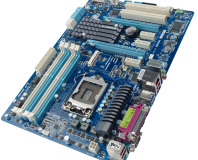
Elsewhere the board looks fairly typical. It uses Gigabyte’s blue and white colour scheme (the company's high-end boards are black these days), but still uses the chunky, curved heatsinks that look a bit like the power stations of Hoth.
Given the UD3 branding, we were surprised to see a chunky heatsink on the VRMs and the overwhelming number of features advertised on the box. With two 16x PCI-E slots, three 1x PCI-E slots and a pair of PCI slots – plus four SATA 6Gbps ports and at least a pair of USB 3 ports – it’s hard to see where Gigabyte has skimped. There’s even
Lucid Virtu support, if you fancy trying it.
Are you intrigued by the prospect of an integrated SSD on a motherboard – if not for Smart Response, then for ultra-compact builds – or are you more interested in buying a large, fast SSD for your data? Let us know in the
forums.

21 Comments
Discuss in the forums Replyhttp://www.traynier.com/software/steammover
http://download.intel.com/design/flash/nand/325502.pdf
SLC chips, speeds seem fast enough, its an elegant solution, I think I would be interested.
Or even better yet, picoITX-boards with an E-350 and mSATA-SSDs allowing for a nettop in a case with less then 1l
EDIT: Seems I'm allready being listened to in parts -> http://de.kontron.com/products/boards+and+mezzanines/embedded+sbc/pitx+25+sbc/kta55pitx.html :D
This is for use with Intel's Smart Response technology and software (link in article) that will create a hybrid array with the SSD and a hard drive. I am hoping the package deal will effectively be a discount, I think the boards will be available without the SSD too according to Gigabyte's site.
You would still have to bus data into and out of the RAM, surely the hard drive is still the limitting factor even with obscene amounts of RAM? Ideally you want all storage, volatile and non-volatile to be as fast as RAM, in practice you want the fastest non-volatile storage possible.
Reading the article again, it is interesting the idea of storing only frequently accessed user files on the SSD long term, so it's there even at boot up. The RAM idea I stated would rely on caching that data to allocated hard drive space on shut down/sleep and bringing it back booting up. I still think it would theoretically faster in operation, but would negatively affect boot times. I've been interested in RAM disks for a while, but I'd agree the mainstream user would be better suited for this solution, considering how cheap 20Gb of SSD is compared to 20Gb of memory.
Heres the english link:
http://uk.kontron.com/products/boards+and+mezzanines/embedded+sbc/pitx+25+sbc/kta55pitx.html
Now THIS is interesting, it would make a perfect XBMC front end if the integrated Fusion APU can decode 1080p content.
I like the idea, at least. In theory, it all sounds good. I just hate it that theory and reality are often horses of a different color.
Don't you mean a RAM-DISK?
like a BIGGER VERSION OF THIS:
http://www.systemsofhull.co.uk/gigabyte-ram-ramdisk-p-82.html?osCsid=58cacad2f3f58826d328db90ff65079c
I was thinking of getting a small SSD for my HTPC but my case only has a 2 HDD cage. I even jimmed a 3rd one above the CD drive, so no more space even for an SSD. Would be great to have one on the mATX board though!
Or is that only now become possible with Intel's Smart Response feature?