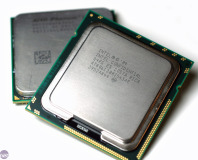
Intel has unveiled its new line of Xeon server and workstation processors, and the centrepiece is the company's first 10-core CPU.
Based on the 32-nm Westmere-EX architecture, the new CPUs offer suitably outlandish specifications. The top-end Xeon E7-8870 offers an amazing ten Hyper-Threaded cores running at 2.4GHz, with a huge 30MB of shared cache. The new chips are also able to address up to 2TB of system RAM; a 100 per cent increase over Intel's last generation of server chips.
However, with prices starting at $770 and rising to $4,616 for the E7-8870, you'll need to be a committed Folding@home team member or the owner of a major server farm in your basement in order to justify the purchase as a consumer.
Intel has also introduced the first server CPUs based on its Sandy Bridge architecture, entering the range as the E3 series. These are aimed at the lower-end server market, though, with Intel expecting the Sandy Bridge architecture to 'trickle up' the Xeon range in the future.
Are you excited about the prospect of CPUs with ten cores or more finding their way into consumer CPUs in the future, or are you still struggling to use four cores, let alone ten? Either way, let us know in the
forums.











Want to comment? Please log in.