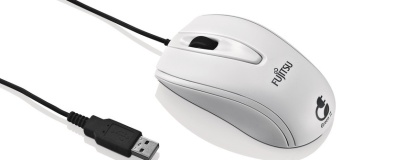
Fujtisu's M440 ECO Mouse promises to be 100 per cent recyclable, and features biodegradable casing.
Fujitsu has announced its latest attempt to jump on the eco-wagon: a biodegradable mouse, which it claims is 100 per cent recyclable.
The M440 ECO Mouse may not have a particularly exciting or original name, but its design is surprisingly clever. Rather than using the plastics that traditionally make up the shell of a mouse, Fujitsu has replaced the casing with a pair of environmentally-conscious alternatives: Arboform and Biograde.
As alternatives to plastic, the pair of materials are pretty neat. They're designed to be fully biodegradable, come from renewable sources and their manufacturing processes produce far less CO
2 than equivalent volumes of plastic.
This isn't the first time Fujitsu has taken this approach, either. Last year, the company created the KBPC PX ECO Keyboard, which replaced almost half of the overall plastic with renewable alternatives. The company claims that the move will equate to a saving of around 60,000kg of plastic each year.
The M440 isn't just about green credentials, however. Fujitsu has equipped the device with a 1,000dpi optical sensor and a scroll wheel, and while its feature-list might leave gamers cold, there's no denying that it meets all the requirements of a basic mouse.
Garry Sales, manager of the client products team at Fujitsu UK, claimed that '
by choosing this mouse, environmentally-conscious businesses can feel good that they are helping reduce CO2 emissions without sacrificing durability or comfort – and without having to pay any extra.'
The M440 Eco Mouse is due to hit the shops imminently, with a recommended retail price of £13.20.
Do you applaud Fujitsu's move towards renewable, biodegradable materials in place of plastic, or is the company just trying to jump onto the green bandwagon? Share your thoughts over in the
forums.

20 Comments
Discuss in the forums ReplyAll else aside, the other mice that visit the composter might get jealous... ;)
Recyclable, sure. Biodegradeable? Pics or it didn't happen tbh.
Does it degrade quickly after a certain point i.e. fine for 5 years then bam it's all 'earthy' and needs to be composted. Is it a slow process where it slowly falls apart giving you months of flaky use?
If you use the newish tesco bags you will be familiar with it also. If you wrap something in a tesco bag and put it away for storage, when you come back to it about a month later, the bag will be falling to bits.
It all depends how long you expect your mouse and keyboard to last. my MX518 has lasted for years, along with my G15 keyboard. It may be cheaper to make those biodegradable ones in a 1 on 1 comparison, but how many sets of those would I have to use for them to last as long as my logitech ones?
Your cat has the edible kind.
Depending on the properties it is probably either only biodegradable in water, or with UV. My wife's Yoga mat is that way, UV light will begin breaking it down. Safe to use outside a bit, but a few weeks of constant sun is going to make it start to fall apart. A lot of vegetable based platic alternatives will only begin biodegrading if exposed to water (such as in a landfill), and it isn't immediate.
I'll ask my cat to save you one!
10, 20, 50 100+ years?
We could do with more products making use of Arbofoam and Biograde, like keyboards and gamepads, consoles, headsets, cases and enclosures of all descriptions, printers and to other household things like cooking utensils, smoke alarms, tv's and so the list goes on.
Hopefully other manufacturers will take this example and follow suit.
http://www.wellpromo.com/upload/upimg77/Custom-Chocolate-Molded-Comput-109277.jpg
The next big thing... edible motherboards..
http://lh6.ggpht.com/_hVOW2U7K4-M/TO1vTOzUMXI/AAAAAAABYwA/sHLoC0PbF7w/r54y6e5rtgergerg.jpg
I would :D
+rep
@Ph4lanx: If you do a google search, you'll quickly find Arbofoam degrades into the same constituent parts as wood since Arbofoam is made of lignin (a waste product from paper manufacturing and an entirely natural component of wood). This probably tells me Arbofoam will last a pretty long time unless exposed to less-than-normal circumstances such as extreme humidity.
I couldn't find much on Biograde except that, unlike Arbofoam's lignin, Biograde is based on natural resins. In both cases, Biograde and Arbofoam are non-toxic, non-polluting, fully biodegradable, and yes.. if you leave parts made from Biograde or Arbofoam in the ground, it won't hurt nature at all.
Just make sure to recycle the inside bits! But that should be completely obvious... right?