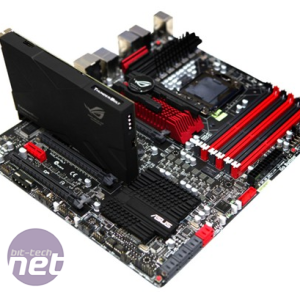
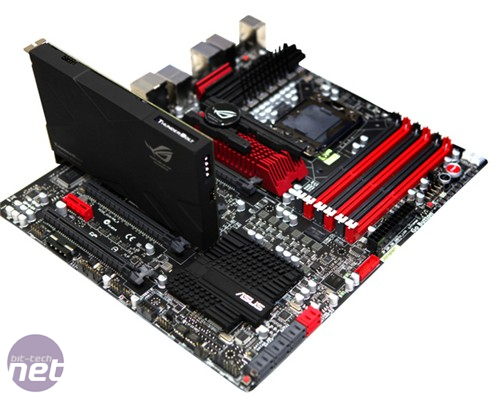
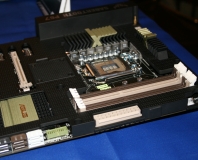
The board's new ROG Thunderbolt add-in card functions as both a sound card and a NIC
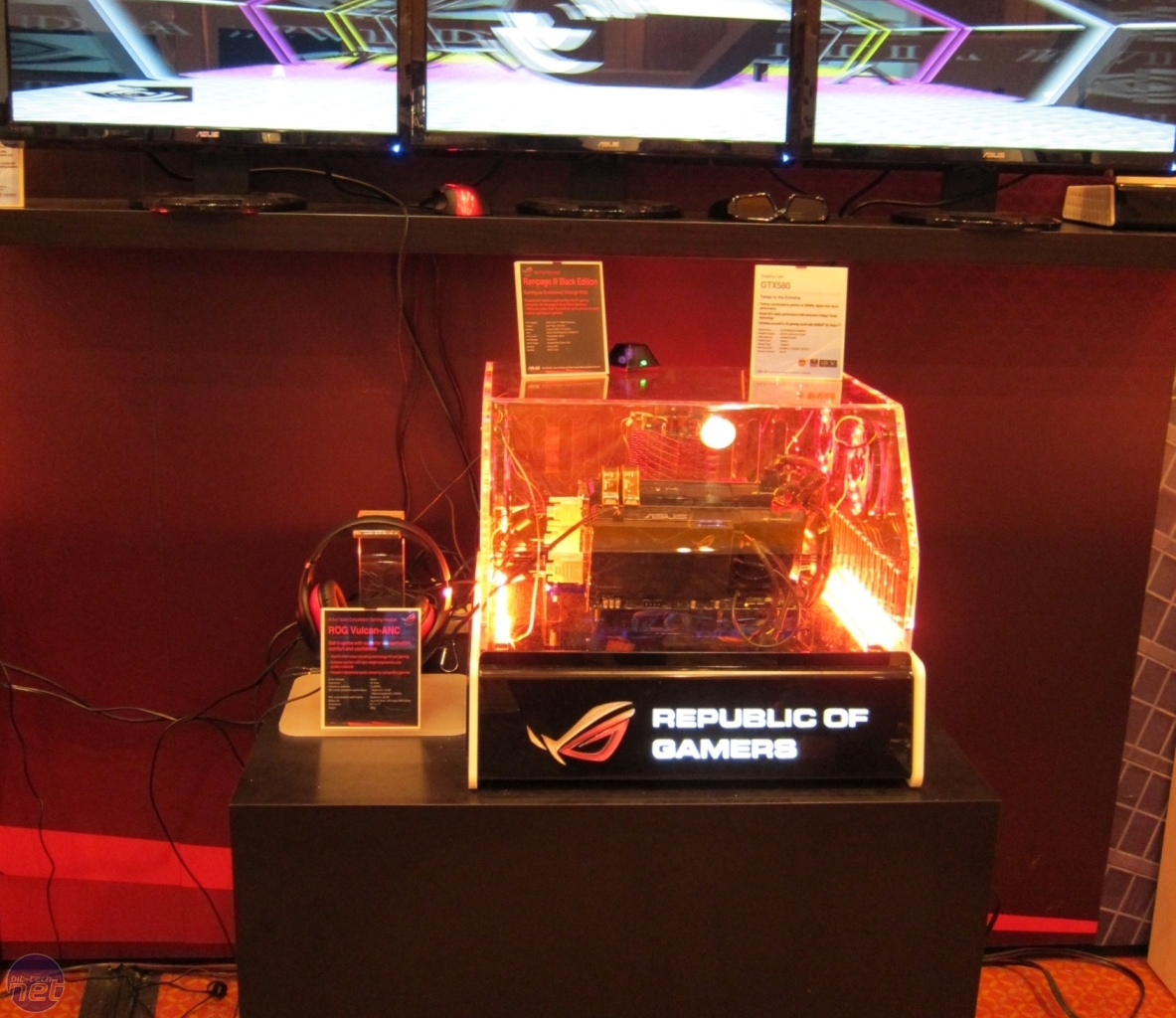
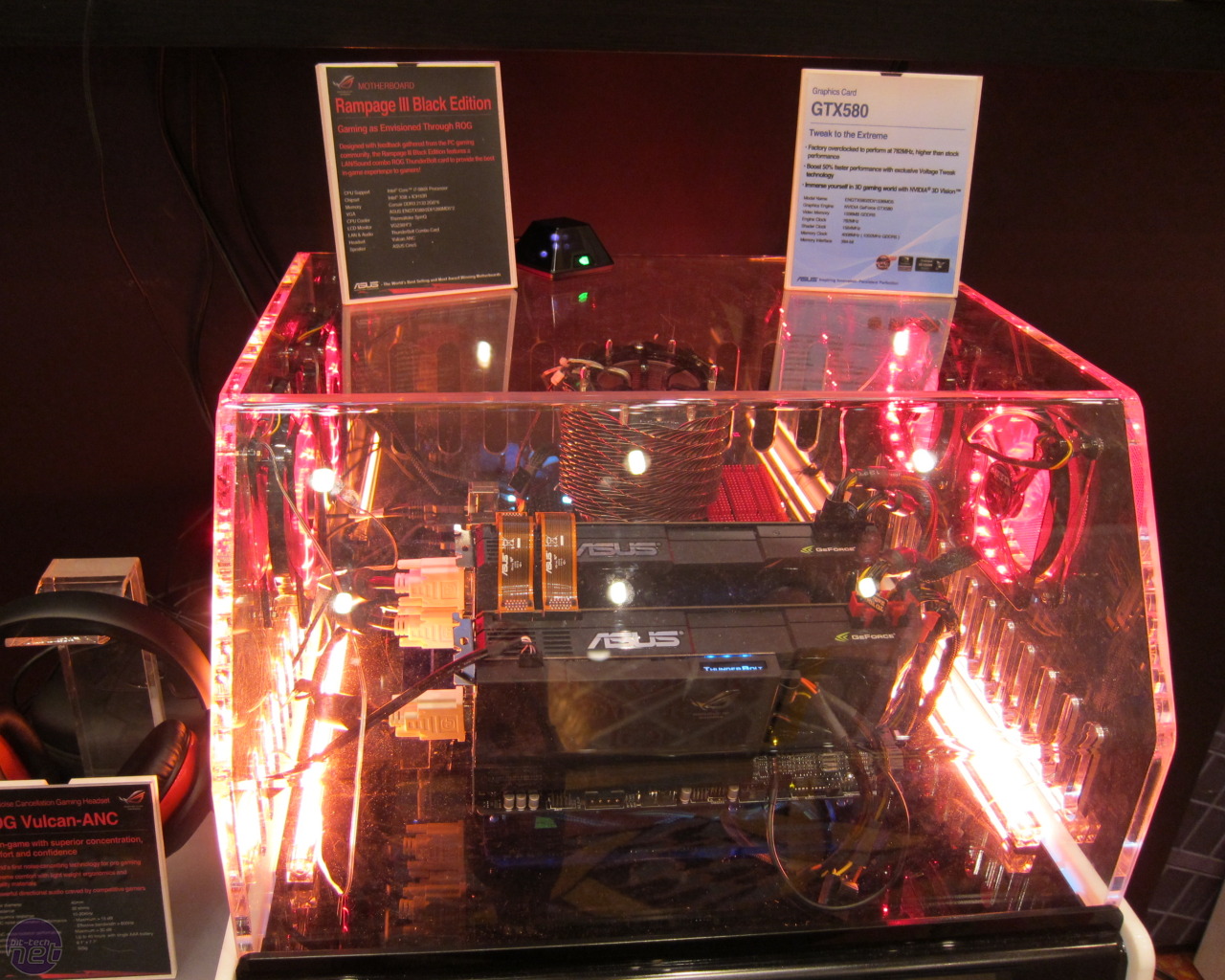
Asus has announced a revamped version of its ROG Rampage III Extreme board, dubbed the Rampage III Extreme Black Edition, which the company claims will feature ideas inspired by feedback from the gaming community.
The board has the same core specs as its
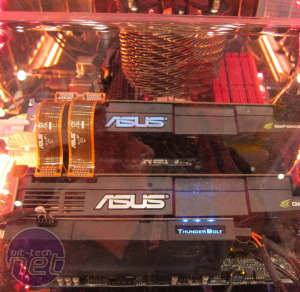
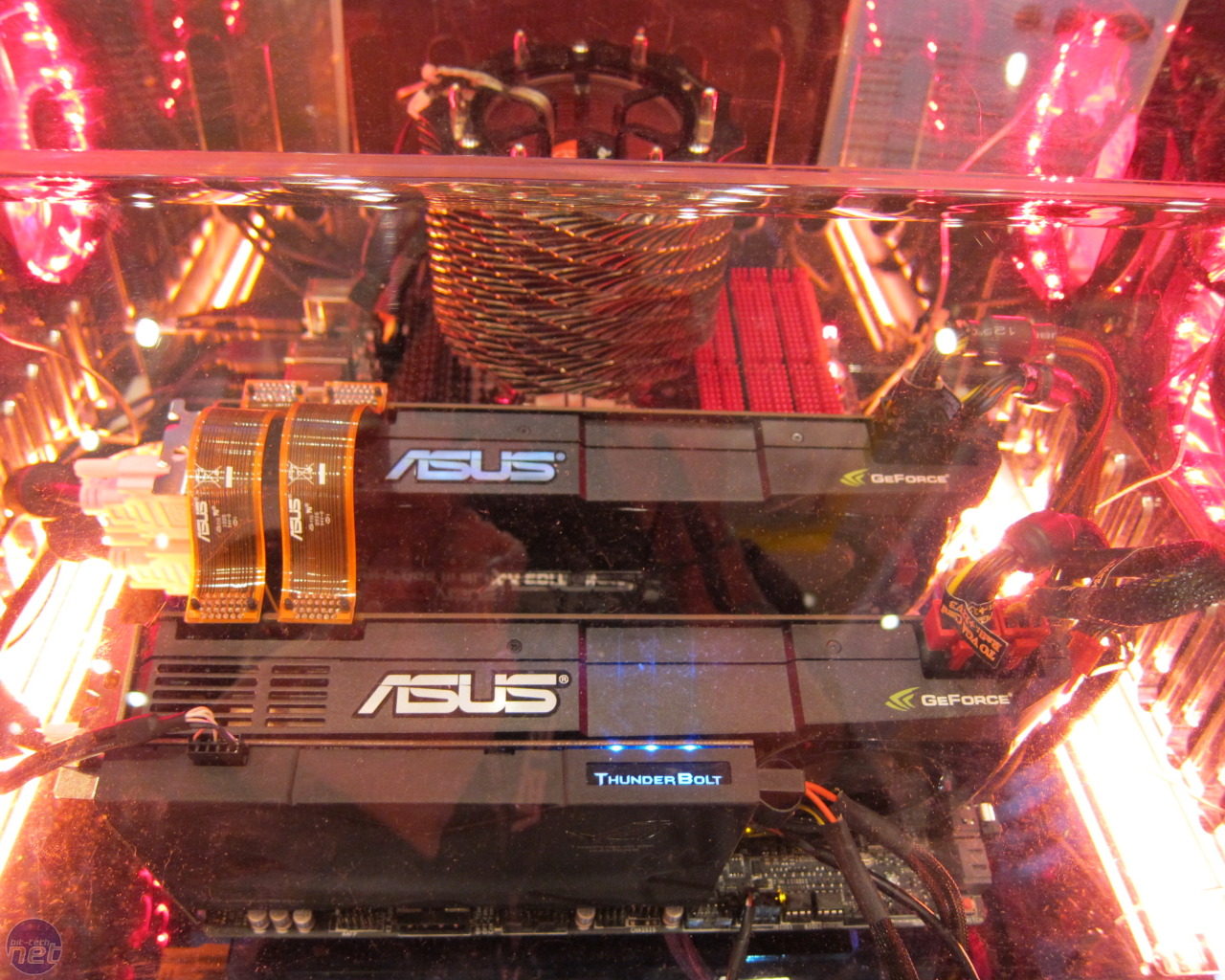
predecessor (X58 chipset, with support for 3-way SLI and 4-way Crossfire), but introduces a new ROG Thunderbolt expansion card. This new add-on, which can be seen in the pictures below, incorporates both a Xonar audio chip and a Bigfoot Networks LAN processor.
Asus claims that the audio provided by the Xonar portion of the card provides sound quality that's ‘four times better’ than that of a regular sound card. This is reportedly due in part to the dedicated headphone amplifier, which offers optimised impedance settings. The card also allows you to set up fine-tuned audio gaming profiles, which appear to adjust the audio output depending on the game you're playing.
Meanwhile, the networking portion of the card fulfils the same role as Bigfoot Networks'
Killer 2100 NIC card, purportedly optimising and prioritising gaming traffic more efficiently than the standard Windows network stack.
The design of the heatsinks that straddle the motherboard's chipset and VRMs have also been redesigned to, in Asus’ own words, ‘look more like a big ol’ gun.' Asus also stresses that there are more tweaks under the hood of the board, and has promised us more details about these in the near future.
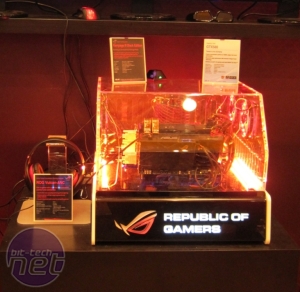
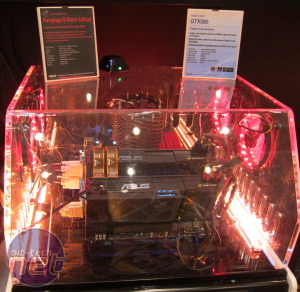
Click to enlarge
Click to enlarge
Are you in the market for a ridiculously over the top LGA1366 motherboard? Will you be able to afford one of these without remortgaging your house? Discuss it all in the
forums.

21 Comments
Discuss in the forums ReplyOr they could just do the smart thing and go for Sandybridge (now) or socket 2011 (by the end of the year).
As an aside, have we got a more interesting codename for 'socket 2011' yet? Nehalem sounded awesome, s2011 just sounds pathetic. Maybe they should've gone retro and called it the 1186?
This is correct.
Not very inventive eh
(i.e Thunderbolt slot, PCI-E 2.0 x16 slot 1, PCI-E 2.0 x16 slot 2, PCI-E 2.0 x16 slot 3, PCI-E 2.0 x16 slot 4)
This would mean that the daughtercard doesnt get in the way of all the x16 lanes rather than sticking it slap bang in the middle. Either that, or just embed the NPU and Xonar into the board itself >.>
Other than that, it's looks good :)
The daughter card, unless I'm mistaken, is just a standard PCIe x1 card, so can go anywhere you want it to be. Look at the thumbnail pic location and the trade-show photo and see how they're in different places?
Borrowing "Black" as an extreme title from Mercedes?
And it isn't all black, or even very much more black, there's still about the same amount of red on there as before...
Or am I just being insensitive?
2 - Yes, definitely I will love to also see Asus Thunderbolt (Xonar + Bigfoot) on sale... by itself... (without the mobo.... :) ). If thunderbolt needs a 4 pin power connector from the psu, please, include in the box a long sleeved black 4 pin extension cable.... hate to have to drive psu connectors in the middle of the motherboard... does not look so clean on many cases.
3 - Would love to see leds on the back of the motherboard... for some nice good looking illuminated view from an acrylic case... (yes, you can turn the leds off on bios, right? yes....)
3 - Dear Asus, please make a Rampage-I Deluxe (Mini ITX with P67) with Thunderbolt onboard (don't forget the WiFi and Bluetooth from P8H67-I Deluxe)....... this will KICK ASS for sure, chuck style (yes, it's going to be hard to do... but hey, you guys are Asus, right? It's going to be expensive... but hey, there are people that will buy it.... just DO IT.
:)
On that note I'm surprised Asus is even bothering with new 1366 boards. You'd have to be a complete sucker to buy this now. 1155 is kicking all kinds of ass unless you want benchmarking performance and 2011 isn't so far away that it won't factor into buying decisions.
Which is totally out of line with the current desire of small but punchy. With that said, where's the integrated wifi boards? There aren't too many ATX boards with integrated wifi, the last I recall being that P35 board Asus released.
Whatever happened to innovative and random desgins rather than giant **** measuring contests in the mobo sector?
http://www.scan.co.uk/products/asus-rampage-iii-gene-intel-x58-s1366-pci-e-20-%28x16%29-ddr3-2200%28oc%29-sata-6gb-s-sata-raid-matx
so if "the currect desire is small but punchy" then this board would have sold thousands and ASUS will keep updating them too.
I agree, however the number of people who seem to think they need a big 4x4 to ferry about London would suggest human nature is not that logical.
I am aware that they do have a few occasionally, but the general and majority of boards aren't mATX.
I guess my real pointwas the fact that after all this time, we don't have say, mainstream mATX boards that are like the P5K Deluxe of old, with many integrated abilities and capabilities of the larger boards but just smaller.
One board surely cannot comprise of the whole market, especially if it's X58.
Could be Socket R, I'm not sure. I know that LGA 775 was called "Socket T" in its early days (make a cue from AMD, who called 462 "Socket A"), and I believe that LGA 1156 is technically "Socket H" (so 1155 is "Socket H2"). Those names never really took off in popular use... I haven't heard anyone refer to an Intel socket by its letter in a long time. AMD, on the other hand, had "Socket A" used just as often by enthusiasts as "Socket 462", then dropped the lettering for 754 and 939, then came back with AM2, AM2+, AM3, AM3+, which no one ever refers to by their pin count (probably because they are all ~940 pins)
I'm not sure where "Black Edition" comes from. I know AMD uses it for unlocked, and XFX has been using it for some stuff, as has Western Digital. Maybe it's from Mercedes as you say. Could also be from scotch, although WD really messed it up if they did, as everyone knows that Johnnie Walker Blue Label is better than Johnnie Walker Black Label, with Johnnie Walker Green Label being a different technology (vatted malts) so really Western Digital's "Blue" drive should be the fast one, "Black" should be the cheap one, and Green should have the different technology (low power consumption)